

Key Takeaways
Option A
Professional Installation
The safer, warranty-backed path with predictable results.
Best for: Homeowners who want peace of mind, manufacturer warranties, and zero ladder time.
Option B
DIY Installation
The lower upfront cost option for capable, confident homeowners.
Best for: Handy homeowners comfortable on ladders who want to save on labor costs.
If you want guaranteed workmanship and minimal personal risk
Professional Installation
Licensed contractors carry liability insurance and typically offer labor warranties, protecting you if anything goes wrong after the job.
If you have a single-story home and are comfortable with basic tools
DIY Installation
Single-story installations on gentle roof slopes present manageable risk for capable homeowners, and kits are designed to clip on without specialized equipment.
If your home has a steep pitch or multi-story gutters
Professional Installation
Height and slope dramatically increase fall risk — professional crews have the training and safety equipment to handle complex rooflines safely.
If keeping upfront costs as low as possible is the priority
DIY Installation
Skipping labor fees can cut your total cost significantly, though factor in your own time and the potential cost of fixing mistakes.
If you want manufacturer warranties to remain valid
Professional Installation
Some gutter guard manufacturers require certified installation to honor product warranties — always check the terms before choosing DIY.
Breaking Down the Cost Gap
The price difference between professional and DIY gutter guard installation is real, but it isn't always as dramatic as homeowners expect — and the numbers alone don't tell the full story.
DIY gutter guard kits typically range from roughly $0.50 to $3.00 per linear foot in materials, depending on the type — foam inserts at the low end, micro-mesh at the higher end. For a 150-foot home, that puts materials somewhere between $75 and $450. Your only other costs are tools you may already own.
Professional installation adds labor on top of materials, which can bring the per-linear-foot total to $2 to $10 or more, depending on your region, roof complexity, and guard type. That same 150-foot home could cost $300 to $1,500 or beyond when professionally installed. For a more detailed breakdown of what drives those figures, see our plain-language cost breakdown.
| Criterion | Professional Installation | DIY Installation |
|---|---|---|
| Typical cost range (150 ft home) | $300 – $1,500+ | $75 – $450 (materials only) |
| Labor warranty | Usually included | None |
| Product warranty validity | Generally maintained | May be voided |
| Fall/injury risk | Managed by trained crew | Borne by homeowner |
| Time required from homeowner | Minimal | 4–8+ hours typical |
| Installation quality consistency | High (experienced crews) | Variable (skill-dependent) |
| Best suited for | Complex rooflines, multi-story | Single-story, simple layouts |
The gap is meaningful — but the factors that fill that gap are what this comparison is really about.
What You're Actually Paying For (or Giving Up)
When you hire a professional, a portion of that cost funds things you may not immediately see: liability insurance, proper equipment, warranty-backed labor, and knowledge of local gutter configurations. If a guard is fitted incorrectly and water backs up behind your fascia board, a licensed contractor's insurance typically covers the repair. With DIY, that cost falls to you.
Many homeowners also underestimate how much product warranty terms matter. Some micro-mesh and reverse-curve guard manufacturers require installation by an approved contractor for the product warranty to apply. Installing the product yourself — even perfectly — can void coverage. Always read the warranty language before purchasing. For a broader look at factors that shape final costs, explore what affects your final bill.
DIY saves on labor, but it costs time. A typical 150-foot installation can take a novice four to eight hours across one or two days, not counting time spent researching, purchasing materials, and making return trips for forgotten supplies.
The Safety Factor You Can't Ignore
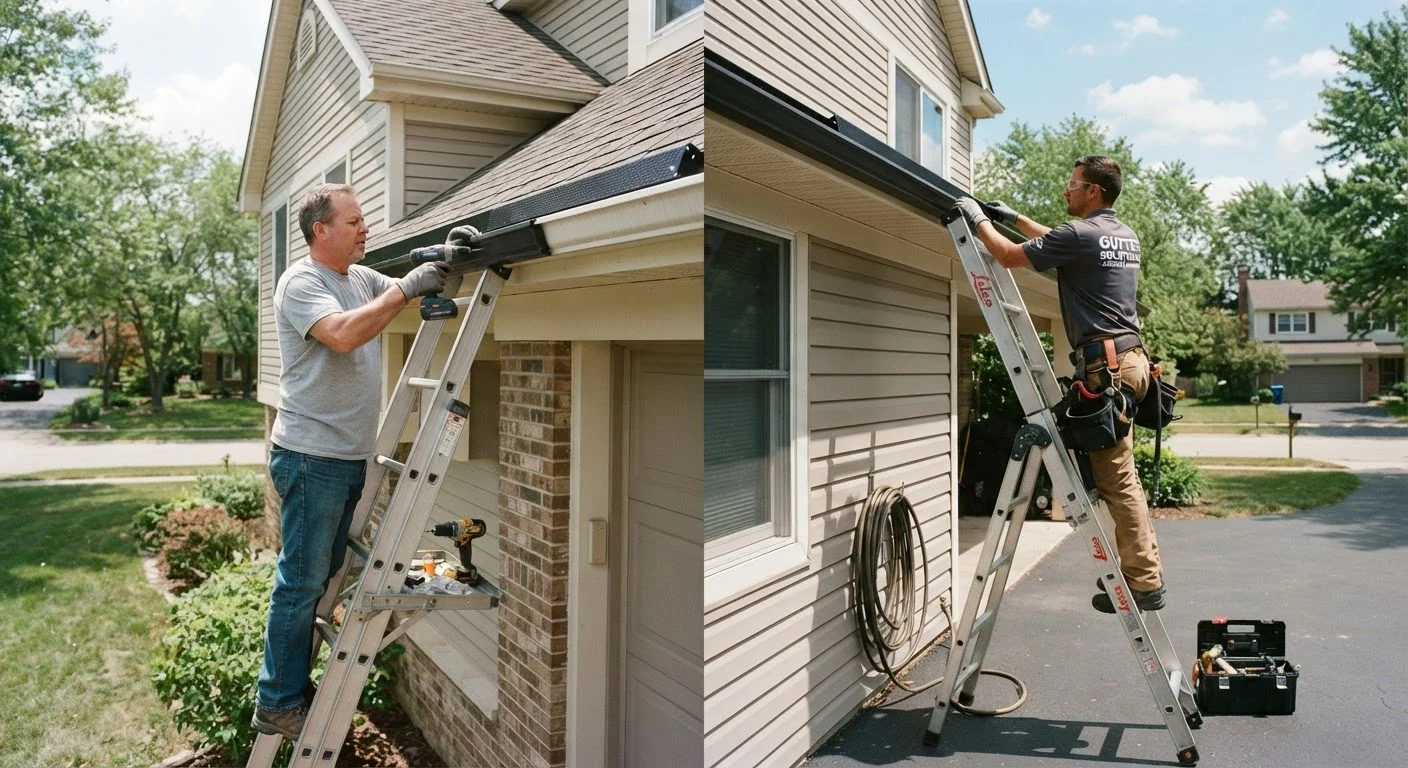
Falls from ladders are among the most common causes of serious injury for adults over 50. Working on a ladder at gutter height — typically 8 to 20 feet off the ground — carries genuine risk, particularly on uneven terrain, near power lines, or on second-story sections of the home.
Professional crews use extension ladders with stabilizers, standoff brackets, and in some cases scaffold systems. They work in pairs, with one person footing the ladder. A solo homeowner working alone doesn't have these safeguards.
This doesn't mean DIY is impossible — but it does mean you need to be honest with yourself about your physical comfort at height, your mobility, and whether a second person will be present. If there's any doubt, the labor cost of professional installation is worth framing as a safety expense rather than a luxury. For related decisions about who should handle ongoing maintenance, our DIY vs. pro cleaning comparison covers similar trade-offs.
Long-Term Value: When Cheaper Costs More
A poorly installed gutter guard can cause more problems than it solves. Guards that don't align correctly with the gutter's inner lip allow debris to accumulate at the seams. Water can overshoot the gutter entirely on heavy-rain days. In winter climates, improperly fitted guards can contribute to ice dam formation.
Removing and reinstalling guards — whether you or a contractor does it — adds cost that erases the original savings. Some gutter types (notably older K-style gutters or gutters with unusual widths) require more precise fitting that is easier to get right with professional experience.
That said, professional installation is not automatically superior in every scenario. Common cost myths around gutter guards include the assumption that hiring a pro guarantees a perfect outcome — contractor quality varies, and getting multiple quotes and checking references matters. To think through the full picture of long-term value versus upfront outlay, our long-term value guide is a useful companion read.
This article is for informational purposes only. Cost estimates are general ranges and will vary by region, product type, and home configuration. Always verify requirements with a licensed local contractor before beginning any installation work.