

| Guard families covered in this reference | 5 (micro-mesh, screen, reverse curve, foam, brush) |
| Best all-around debris blocker | Micro-mesh (handles pine needles, grit, and leaves) |
| Lowest upfront cost option | Foam or brush inserts |
| Highest maintenance demand | Foam and brush inserts (debris embeds in material) |
| Most important local factor | Tree type and proximity to roofline |
| Professional install recommended | Yes — especially for roofline access and safety |
The Five Main Gutter Guard Families
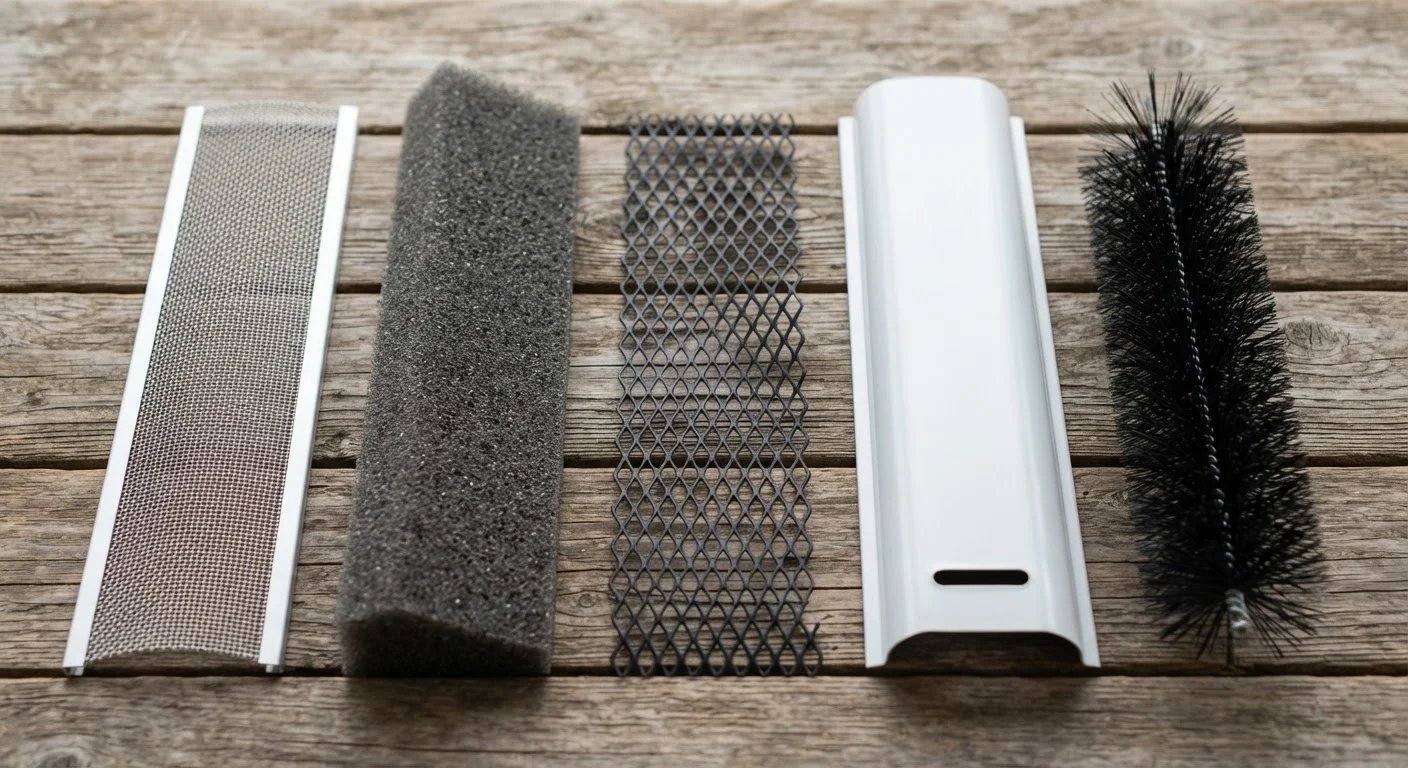
Before calling a contractor, it helps to know the basic landscape. Five guard families dominate the residential market, each working differently and handling different debris loads. This reference card gives you the essentials at a glance. For a deeper dive into how each type performs over time, see the complete homeowner's guide to choosing a gutter guard.
Micro-Mesh
A gutter guard design using a very fine stainless-steel mesh — with openings smaller than 400 microns on quality models — that allows water through while blocking nearly all debris including pine needles and shingle grit.
Reverse Curve
Also called a surface-tension guard, this design uses a curved surface so water clings and flows into a narrow slot while leaves and debris slide off the edge and fall to the ground.
Perforated Cover
A flat or gently curved sheet, typically aluminum or vinyl, with punched holes that sit over the gutter opening. Water passes through the holes while larger debris is blocked.
Foam Insert
A porous foam block sized to fit inside the gutter channel. Water soaks through the open-cell foam while debris rests on the surface above; however, seeds and fine particles can embed in the foam over time.
Brush Insert
A cylindrical brush, similar in shape to a large pipe cleaner, that sits inside the gutter. Water flows around the bristles while leaves and twigs catch on top — though debris can become tangled in the bristles.
Linear Footage
The total length of gutter run measured in feet, used by contractors to calculate material and labor costs for gutter guard installation.
| Guard Type | How It Works | Common Materials | Best Suited For | Key Limitation |
|---|---|---|---|---|
| Micro-Mesh | Water passes through a fine metal mesh; debris sits on top and blows or washes off | Stainless steel mesh, aluminum frame | Heavy tree cover, pine needles, shingle grit | Higher upfront cost; may need occasional rinsing |
| Screen / Perforated Cover | Flat or slightly curved sheet with punched holes sits over the gutter opening | Aluminum, galvanized steel, vinyl | Moderate leaf fall, budget-conscious installs | Larger holes pass small debris; seeds can sprout |
| Reverse Curve (Surface Tension) | Water clings to a curved surface and flows into a narrow slot; leaves fall to the ground | Aluminum, steel | Heavy rainfall areas, large leaf debris | Can overshoot gutters in very heavy downpours |
| Foam Insert | Porous foam block fills the gutter; water soaks through while debris rests on top | Polyether or polyurethane foam | Low-debris environments, rental properties | Debris and seeds embed in foam over time; mold risk |
| Brush Insert | Cylindrical bristle brush sits inside gutter; debris catches on bristles above water flow | Polypropylene bristles, steel core | Light leaf and twig debris | Debris tangles in bristles; requires frequent cleaning |
Matching Guard Type to Your Home's Conditions
No single guard type is ideal for every home. The right match depends on the trees near your roofline, your local rainfall intensity, your gutter size, and how much maintenance you're prepared to do. Use the quick facts below as a starting checklist.
| Guard families covered in this reference | 5 (micro-mesh, screen, reverse curve, foam, brush) |
| Best all-around debris blocker | Micro-mesh (handles pine needles, grit, and leaves) |
| Lowest upfront cost option | Foam or brush inserts |
| Highest maintenance demand | Foam and brush inserts (debris embeds in material) |
| Most important local factor | Tree type and proximity to roofline |
| Professional install recommended | Yes — especially for roofline access and safety |
Questions to Ask Before You Decide
- What drops on your roof? Pine needles and shingle grit need micro-mesh. Large maple leaves work fine with screen or reverse-curve guards.
- How much rain falls at once? High-intensity storms can overwhelm reverse-curve designs; a wider-slot mesh or deep gutter profile handles surges better.
- What are your gutters made of? Some guards clip onto aluminum gutters easily; others require fasteners that suit steel or copper profiles.
- How accessible is your roofline? Insert-style guards (foam, brush) are easier for DIY placement on single-story homes, though professional installation is still recommended for safety.
For a full side-by-side performance comparison across debris handling, durability, and climate suitability, see this detailed comparison of all four guard families.
Maintenance Differences Matter
Guard type directly affects how often you'll need to clean. Foam and brush inserts tend to trap fine debris and require more frequent attention than micro-mesh or reverse-curve covers. For type-specific care schedules, the maintenance guide by material type is a useful follow-on read. When budgeting, also review installation and cost considerations so there are no surprises on quote day.