

Key Takeaways
Our Verdict
No single gutter guard family is the right fit for every home. Mesh — particularly micro-mesh — comes closest to an all-around performer, while screen guards suit simpler, lower-debris environments. Foam and reverse curve designs each have niche strengths but carry trade-offs that make them a secondary choice for most homeowners.
| Best for | Recommended |
|---|---|
| Homes surrounded by mixed tree types and varied debris | Micro-mesh guards |
| Budget-conscious homeowners with minimal nearby trees | Screen guards |
| Regions with very heavy seasonal rainfall and large leaf debris | Reverse curve guards |
| Homeowners wanting a quick, tool-free temporary solution | Foam inserts (with a clear maintenance plan) |
How the Four Guard Families Work
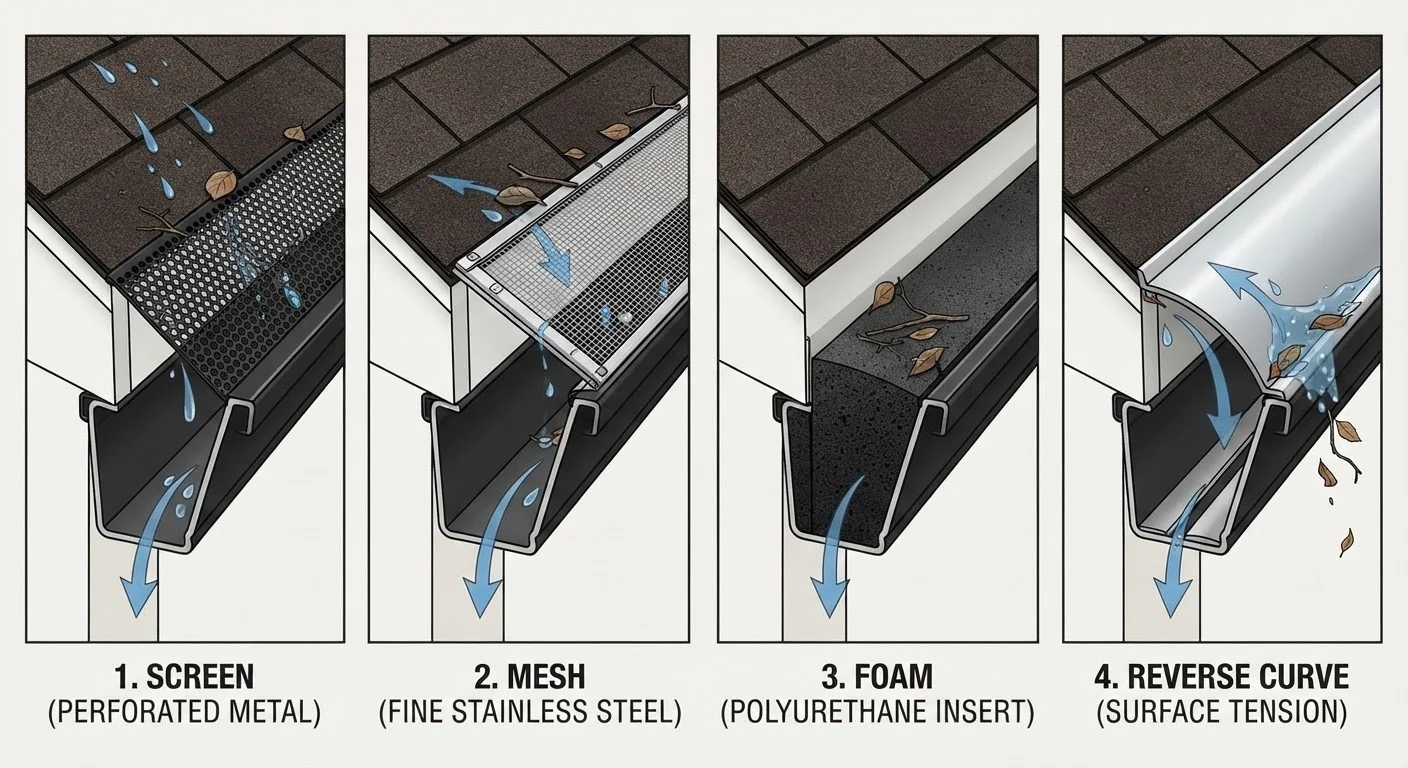
Gutter guards fall into four broad families, each using a distinct mechanism to keep gutters clear. Understanding how they work is the first step toward choosing the right one for your home. For a quick visual overview of all styles, see our homeowner's quick reference guide.
- Screen guards sit over the gutter opening with a perforated or slotted surface. Water passes through the holes; larger debris theoretically blows off or falls away.
- Mesh guards (including micro-mesh) use a finely woven or stamped metal sheet with very small openings — small enough to block shingle grit, pine needles, and seeds while still passing water.
- Foam inserts are porous polyurethane blocks that sit inside the gutter channel. Water soaks through the foam; debris rests on top.
- Reverse curve guards (also called surface-tension or nose-forward guards) guide water around a curved lip and into the gutter below, while debris is meant to fall off the front edge.
Each approach has a different relationship with water volume, debris size, and climate. The sections below break down how they compare across four key dimensions.
Debris Handling: What Each Type Can — and Cannot — Block
Debris filtering is where the four families diverge most sharply.
Screen guards handle large leaves reasonably well, but their openings — typically 1–3 mm wide — allow smaller material to pass through. Shingle granules, pine needles, and seed pods regularly slip through or bridge across the holes, creating a layer of debris that eventually blocks water flow.
Mesh guards perform best here. Standard mesh has openings around 1 mm; micro-mesh drops to 50–150 microns (thousandths of a millimeter), blocking nearly everything except water. If you have pine trees or a roof with aging asphalt shingles shedding granules, micro-mesh is the most effective option. Our dedicated comparison — micro-mesh vs. standard mesh — covers those differences in detail.
Foam inserts technically stop all debris from entering the gutter channel, but debris accumulates on top of and within the foam itself. Seeds germinate inside the open-cell foam, and organic matter composts over time — defeating the purpose of protection.
Reverse curve guards shed large, flat leaves well when conditions are ideal. However, light rain, fine debris, and horizontal wind can cause water to follow the curve incorrectly and overshoot the gutter entirely. Pine needles and small debris frequently slip into the gap at the nose.
| Screen | Mesh / Micro-Mesh | Foam | Reverse Curve | |
|---|---|---|---|---|
| Large leaf debris | Good | Excellent | Good (surface only) | Good (ideal conditions) |
| Fine debris (pine needles, grit) | Poor | Excellent (micro-mesh) | Poor (penetrates foam) | Poor |
| Maintenance frequency | Moderate | Low | High | Moderate |
| Typical lifespan | 10–20 years | 20+ years | 5–10 years | 15–25 years |
| Cold / freeze-thaw climate | Moderate | Good | Poor | Moderate |
| Heavy rainfall performance | Moderate | Good | Moderate | Variable |
| DIY installation ease | Easy | Moderate to difficult | Easy | Difficult |
| Relative cost | Low | Moderate to high | Low | Moderate to high |
Maintenance Requirements Over Time
Every gutter guard requires some maintenance — the question is how much and how often. For a deeper breakdown by material type, visit our guide on gutter guard maintenance across material types.
Screen guards need periodic clearing of surface debris, especially after storms and in autumn. Small debris that works through the screen can accumulate at the bottom of the gutter, requiring occasional flushing.
Mesh and micro-mesh guards generally have the lightest maintenance burden. Their solid frames keep structural integrity, and debris tends to dry out and blow away. A seasonal rinse with a garden hose and an annual inspection are typically sufficient.
Foam inserts carry the highest ongoing maintenance requirement. They must be removed, cleaned, and inspected at least once or twice per year. Without regular attention, algae, mold, and plant growth inside the foam can block water flow entirely.
Reverse curve guards usually require clearing of the nose gap where debris collects. In high-debris environments, this may need attention two to three times per year. The underside of the curve can also collect film from hard water or organic matter.
Maintenance needs also connect to year-round gutter guard care — keeping any guard type working well involves consistent seasonal checks.
Durability, Climate Fit, and Installation Considerations
Material durability varies widely within each family, but some general patterns hold.
Screen guards made from aluminum or stainless steel last 10–20 years with minimal corrosion. Plastic screens degrade faster under UV exposure, typically showing brittleness within 5–7 years in sunny climates.
Mesh guards with stainless steel mesh and aluminum frames are among the most durable options available, often rated for 20+ years. They also perform well in freeze-thaw climates because the fine mesh limits standing water that could freeze and expand.
Foam inserts have the shortest typical lifespan — most manufacturers suggest replacing them every 5–10 years. They also absorb and hold moisture, which can accelerate rot on wood fascia boards and may contribute to ice dam formation in cold climates by trapping water near the roofline.
Reverse curve guards are often made from sturdy aluminum and can last 15–25 years structurally. However, their performance in heavy-rainfall climates is mixed — extremely high water volumes can overwhelm the surface-tension mechanism, causing water to cascade off the guard rather than channel into the gutter.
Installation also differs: screen and foam guards are often designed for DIY placement, while reverse curve guards and quality micro-mesh systems typically involve professional installation that integrates with the roofline. For a broader look at how material type influences what you pay, see how guard type shapes installation cost.
Before choosing, confirm whether your local municipality requires permits for gutter system modifications, and check that any guard installation does not void your roofing warranty — a licensed contractor can help verify both.
This article is for general informational purposes only. Costs, lifespans, and performance vary by product, region, and installation quality. Always consult a qualified roofing or gutter professional before making changes to your home's drainage system.