

Key Takeaways
What Brush-Style Gutter Guards Actually Are
Brush gutter inserts are cylindrical, pipe-cleaner-shaped devices that sit inside your gutter channel. Their stiff polypropylene bristles are designed to let water pass through while catching leaves and larger debris on top. They require no screws, clips, or tools to install — you simply slide them in — which explains their popularity as a DIY solution.
At first glance, they solve a real problem with minimal hassle. But the way debris actually interacts with those bristles is where the marketing pitch and lived experience start to diverge. Understanding that gap is what this article is about.
For a broader look at how brush guards compare to other styles, see why no gutter guard eliminates maintenance entirely.
Common Myths — and the Reality Behind Each One
The following myth-and-fact pairs address the most widespread misunderstandings about brush-style inserts. Each one is grounded in how these products actually behave across seasons and different tree environments.
Myth
Brush inserts are essentially maintenance-free — debris just blows off the top.
Fact
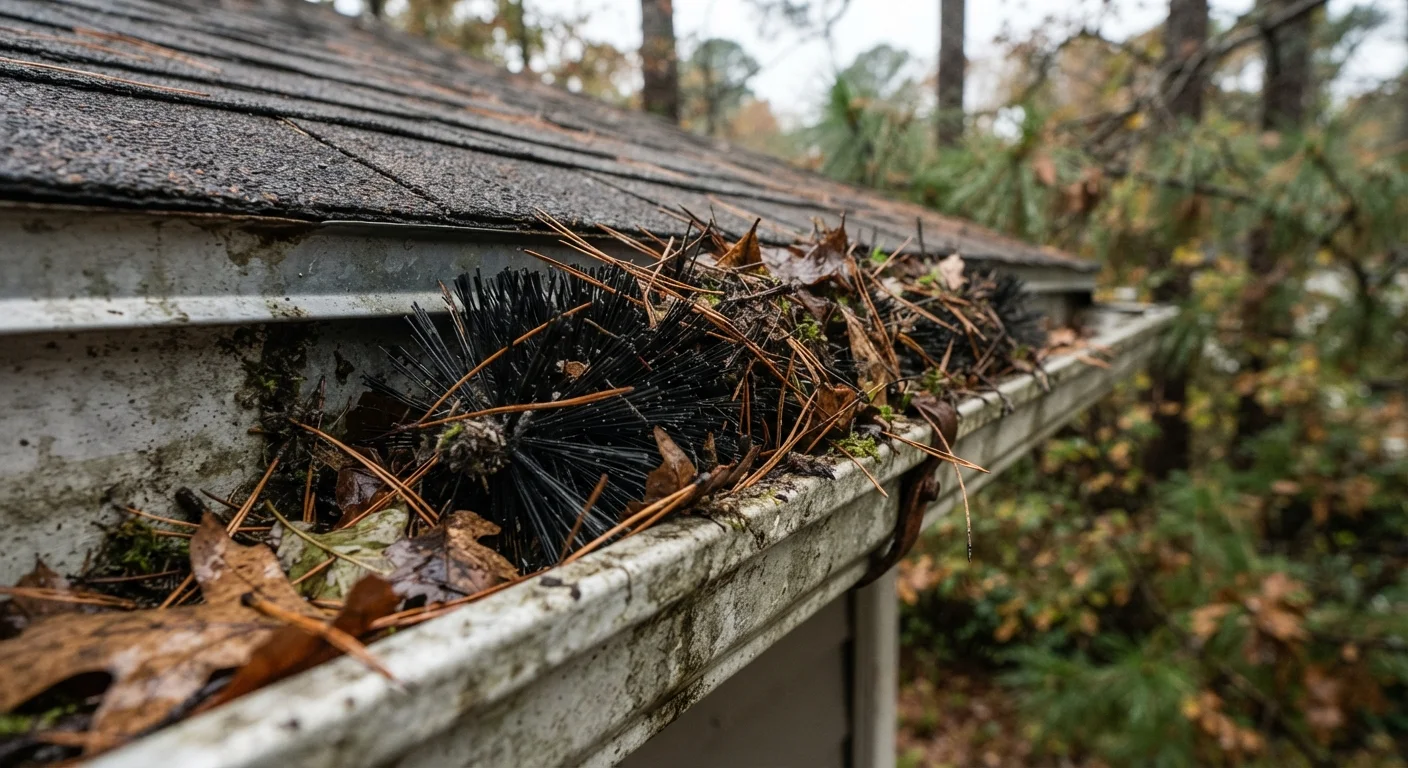
Debris — especially small particles like seeds, shingle grit, and pine needles — becomes lodged deep in the bristles and does not blow away on its own.
The same bristle density that catches large leaves also snags fine material. Over one or two seasons, this compacted debris forms a mat inside the insert that water cannot easily pass through. Rather than eliminating gutter cleaning, brush inserts often make it more labor-intensive, since you must remove the insert before you can clear it properly.
Even well-regarded gutter guard styles still accumulate debris — brush inserts are simply more prone to the problem than most.
Myth
Because they're cheap, brush inserts are the smart economical choice long-term.
Fact
Low purchase price does not account for the labor, replacement frequency, or potential water damage from reduced flow over time.
Brush inserts are among the most affordable gutter guards by unit cost. However, if they require replacement every five to eight years — or if a blockage goes unnoticed and causes water to overflow into your fascia board or foundation — the total cost of ownership rises significantly. Economy at the point of purchase does not guarantee economy over a decade of ownership.
Myth
Any gutter guard eliminates the need to clean gutters — brushes included.
Fact
No gutter guard type, including brush inserts, fully eliminates gutter maintenance. They reduce certain types of debris buildup, but introduce their own cleaning challenges.
This is one of the most persistent myths in the gutter guard category overall. Brush inserts do block large leaf debris effectively when new and uncompacted. But as the bristles fill in, water flow slows. Homeowners who assume the guard is doing its job — and skip inspections — can end up with standing water, sagging gutters, or interior leaks. What manufacturers don't always disclose about upkeep covers this pattern across multiple product types.
Myth
Brush guards work equally well no matter what trees surround your home.
Fact
Homes near pine trees, sweet gum trees, or plants with small seeds or catkins are particularly poor candidates for brush-style inserts.
Bristle-based inserts are poorly matched to fine, fibrous, or seed-heavy debris. Pine needles thread through and between bristles, becoming nearly impossible to rinse out without physically removing and agitating the insert. If your property has significant tree coverage — especially conifers — a micro-mesh or solid-cover system is generally a more practical long-term match for your conditions.
Myth
You can simply rinse brush inserts clean with a garden hose.
Fact
Rinsing works for light, fresh debris, but compacted or embedded material typically requires removal, manual agitation, and sometimes replacement of the insert.
Water pressure from a standard garden hose is rarely sufficient to dislodge debris that has been compressed and dried inside the bristles over months. Contractors who service gutters regularly note that brush inserts in heavily treed yards often arrive at the cleaning appointment with material packed so tightly that the only practical solution is full replacement. Planning for this possibility — and budgeting accordingly — is part of owning brush-style inserts responsibly.
What This Means for Your Maintenance Plan
Brush inserts are not inherently a poor choice, but they are frequently installed by homeowners who were led to believe upkeep would be near-zero. The reality is that brush guards typically demand more hands-on attention than screen, micro-mesh, or reverse-curve alternatives — particularly in yards with pine trees, maples, or flowering plants that shed seeds.
If you do use brush inserts, build a twice-yearly cleaning schedule into your home maintenance calendar. In heavy-debris environments, quarterly checks are more realistic. When rinsing is not enough to dislodge compacted material, the insert may need to be removed, soaked, and scrubbed — or replaced outright.
A year-round gutter guard maintenance overview can help you build a practical schedule that accounts for seasonal debris patterns. And if you are weighing whether brush inserts are worth their lower upfront cost compared to other options, this look at long-term installation value offers useful context.
For a side-by-side comparison with a similarly affordable insert type, see how foam gutter inserts perform over time.