

Key Takeaways
Cooling Load
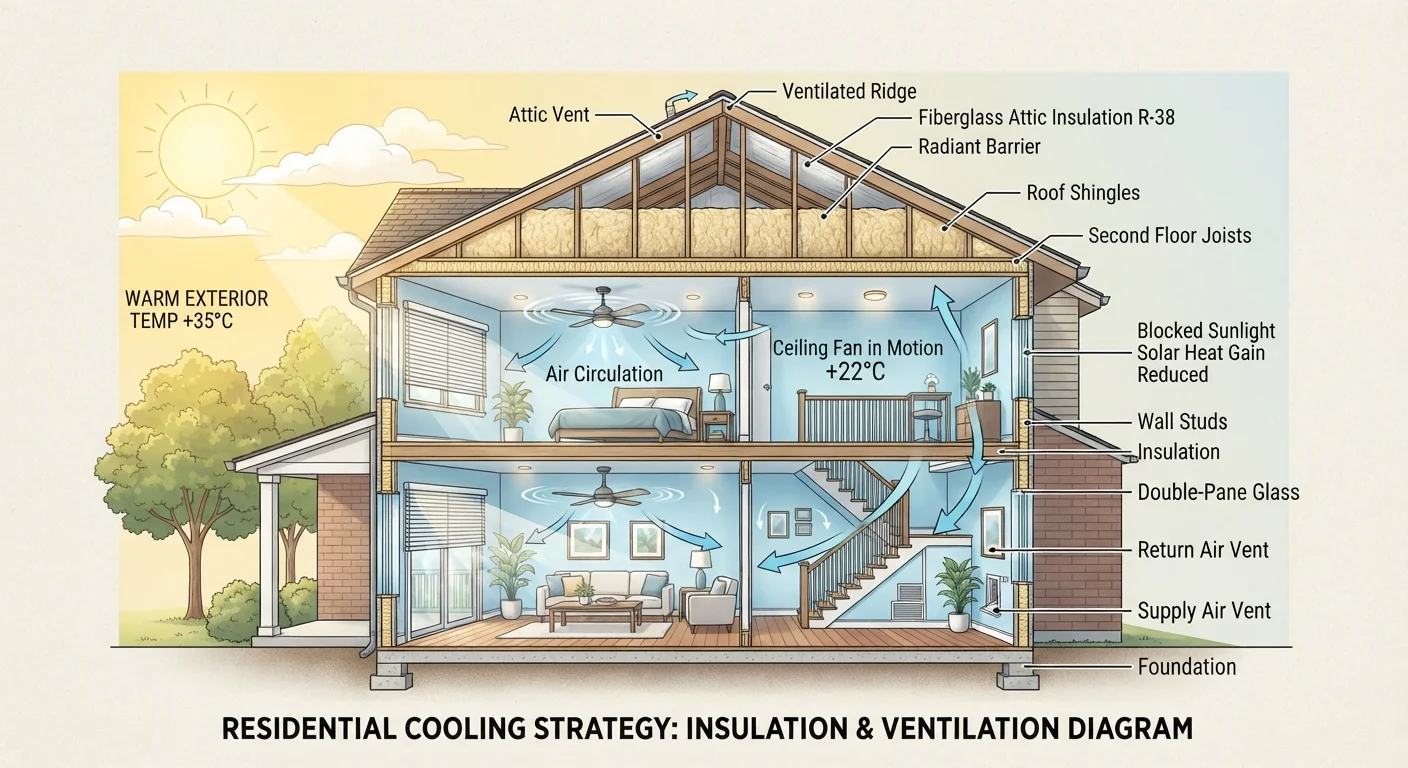
A cooling load is the total amount of heat your air conditioner must remove to keep your home at a comfortable temperature. It's shaped not just by the weather outside, but by how well your home holds cool air in and keeps heat out. Insulation, ceiling fans, and window coverings all influence how large — or small — that burden is.
HVAC engineers calculate cooling load using a Manual J calculation, which accounts for insulation values (R-values), window orientation, square footage, and local climate data to properly size equipment.
Your AC Doesn't Work Alone
When your home feels stuffy even with the air conditioner running, it's tempting to assume the AC is broken or undersized. Often, though, the system is doing exactly what it was designed to do — it's simply fighting a battle your home isn't helping it win.
Your cooling system works as part of a larger envelope: walls, attic, windows, and airflow all determine how much heat enters your living space and how quickly it escapes. Understanding this relationship helps you get more from your existing equipment — and can prevent an unnecessarily expensive equipment upgrade. For a foundational look at how cooling systems work, see Air Conditioning for Beginners.
Attic Insulation: Your First Line of Defense
On a hot summer day, the surface of a dark roof can reach temperatures well above 150°F. Without adequate insulation, that heat radiates down into your living space, raising indoor temperatures and forcing your AC to compensate continuously.
Attic insulation works by slowing that heat transfer. The effectiveness of insulation is measured by its R-value — a rating of resistance to heat flow. Higher R-values mean better thermal resistance. The U.S. Department of Energy recommends R-38 to R-60 for attics in most U.S. climate zones, though your local requirements may vary.
R-38 to R-60
Recommended attic insulation range for most U.S. homes
According to the U.S. Department of Energy's insulation guidelines for residential attics across most climate zones.
4–6°F
Perceived temperature reduction from a ceiling fan
The wind-chill effect of ceiling fan airflow makes occupants feel cooler without actually changing room temperature.
~30%
Of unwanted heat that enters homes through windows
The U.S. Department of Energy estimates that windows account for roughly 30% of residential cooling energy use through solar heat gain.
If your home was built before the 1980s, there's a reasonable chance the attic insulation no longer meets modern standards — it may have settled, degraded, or simply never been updated. A qualified insulation contractor or home energy auditor can measure what you have and advise on whether an upgrade makes sense. Roof materials also play a role in how much solar heat reaches the attic in the first place — learn about how roofing materials affect heat absorption.
Ceiling Fans: Managing Airflow Effectively
Ceiling fans are widely misunderstood. They do not lower the air temperature in a room. What they do is move air across your skin, accelerating moisture evaporation and creating a perceived cooling effect — typically making a room feel 4 to 6 degrees cooler to the people in it.
That distinction matters for two reasons. First, ceiling fans only help when someone is present in the room. Leaving a fan running in an empty room wastes electricity with no benefit. Second, because fans make you feel cooler, you may be able to set your thermostat a few degrees higher without sacrificing comfort — and each degree of adjustment can reduce cooling energy use meaningfully.
One setup detail worth checking: most ceiling fans have a directional switch. In summer, blades should spin counterclockwise when viewed from below, pushing air straight down to create that cooling breeze. In winter, reversing to clockwise recirculates warm air that collects near the ceiling. Check the switch (usually a small toggle on the motor housing) if you're not feeling airflow from your fan.
Window Coverings: Blocking Heat Before It Enters
Windows are natural entry points for solar heat gain — the warmth added to a space by sunlight passing through glass. On a sunny afternoon, an uncovered south- or west-facing window can admit a substantial amount of radiant heat, raising room temperatures and increasing AC runtime.
The good news is that window coverings are one of the most accessible and affordable ways to reduce this effect. Options range from cellular (honeycomb) shades and blackout curtains to solar shades and exterior awnings. Exterior shading — blocking sunlight before it reaches the glass — tends to be more effective than interior treatments, but both provide meaningful results.
For homes considering window upgrades, understanding energy-efficiency ratings such as the Solar Heat Gain Coefficient (SHGC) can help guide decisions. Lower SHGC values mean less solar heat enters through the glass. Learn more about energy-efficient window features that homeowners should know before replacing windows.
Even simple habits help: closing blinds or curtains on sun-facing windows during peak afternoon hours — roughly noon to 5 p.m. — can noticeably reduce how hard your AC works. For more practical strategies, see Keeping Your Cooling Costs Down Without Sacrificing Comfort.
Putting It All Together
Each of these factors — insulation, fans, and window coverings — reduces the heat load that reaches your AC system. Used together, their effect compounds: less heat enters the home, the air that does enter moves more efficiently, and the AC runs fewer cycles to maintain comfort. This reduces wear on equipment and can extend its useful life.
If your AC still runs constantly despite addressing these areas, there may be a more specific issue at play. Learn why your AC might be running without effectively cooling the house — and when to call a technician. You may also want to review how SEER ratings affect long-term energy costs if an equipment upgrade is eventually on the table.
The most important takeaway: your air conditioner's performance is inseparable from your home's thermal characteristics. Investing in insulation, using fans correctly, and managing sunlight are practical, low-disruption steps that help any cooling system — old or new — do its job more effectively.
This article is for informational and educational purposes only. Specific recommendations for insulation levels, window ratings, and equipment should be verified with a qualified local contractor or energy professional, as requirements vary by climate zone and local building codes.