

Key Takeaways
SEER Rating
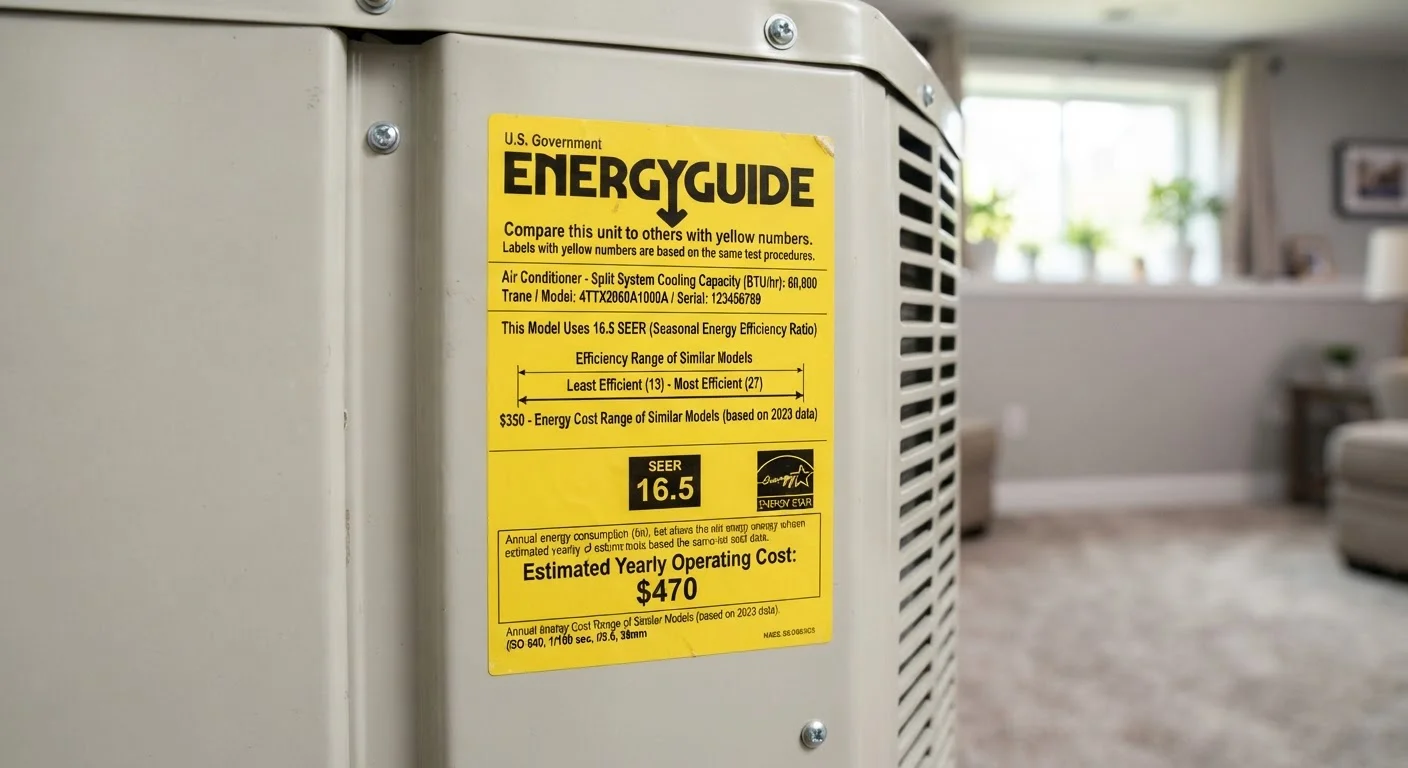
SEER stands for Seasonal Energy Efficiency Ratio. It measures how efficiently an air conditioner cools your home over an entire cooling season — the higher the number, the less electricity it uses to produce the same amount of cooling. Think of it like miles per gallon for your car, but for your AC unit.
SEER is calculated by dividing the total cooling output (in BTUs) over a typical cooling season by the total electrical energy input (in watt-hours) during that same period. A newer standard, SEER2, uses updated test conditions introduced by the Department of Energy that better reflect real-world installation performance.
What the SEER Number Actually Measures
When you look at an air conditioner — whether you're replacing an old one or trying to understand your current system — you'll almost always see a SEER rating on the label. That number isn't just a marketing figure. It's a standardized measure of how efficiently the unit converts electricity into cooling comfort across a full cooling season.
Here's the core idea: SEER compares how much cooling an AC unit delivers (measured in BTUs, or British Thermal Units) against how much electricity it consumes (measured in watt-hours) to produce that cooling. A unit with a SEER of 20 delivers the same cooling as a SEER 10 unit while using roughly half the electricity. That gap shows up directly on your monthly utility bill.
Unlike a simple snapshot of performance on one hot afternoon, the SEER formula accounts for varying temperatures across an entire season — which is why it's a more meaningful efficiency yardstick than a single-point test. It tells you how the system performs on both mild spring days and the hottest stretches of summer combined.
~50%
Potential electricity reduction upgrading from SEER 10 to SEER 20
Based on the proportional relationship in the SEER formula; actual savings depend on home conditions, climate, and usage patterns.
13–16 SEER
Typical federal minimum SEER by U.S. region
The U.S. Department of Energy sets regional minimums, with higher requirements in warmer Southern and Southwestern states.
15–20 years
Average lifespan of a central AC unit
According to the U.S. Department of Energy, central air conditioners typically last 15 to 20 years with proper maintenance.
Why SEER Ratings Have a Floor — and It Varies by Region
The U.S. Department of Energy sets minimum SEER requirements for residential central air conditioners, and those minimums aren't the same everywhere. States in the South and Southwest — where air conditioners run hard for many months — have higher required minimums than Northern states, where cooling seasons are shorter. This means a unit that meets the legal minimum in Minnesota may not be permitted for sale as new equipment in Texas.
If you're researching a replacement unit or a new installation, a licensed HVAC contractor should be able to confirm what efficiency standards apply in your area and what options meet those local requirements. This matters both for compliance and for understanding whether a given unit is considered baseline or above-average for your climate.
It's also worth knowing that the industry has shifted toward a newer testing standard called SEER2. Equipment now sold under SEER2 was tested with conditions that more accurately reflect real-world duct systems and installations. If you're comparing an older unit's SEER rating to a newer unit's SEER2 rating, they aren't directly equivalent — ask your contractor to explain the comparison clearly.
The Gap Between Rated Efficiency and Real-World Performance
SEER ratings are determined under controlled laboratory conditions — not in your specific home with your specific ductwork, insulation levels, and usage patterns. That gap matters. A high-SEER air conditioner installed in a poorly insulated home, connected to leaky ducts, or consistently set to very low temperatures will not deliver its full efficiency potential.
Your home's envelope — how well it holds conditioned air — plays a significant role. Attic insulation, window shading, and ceiling airflow all influence how hard your AC must work. For a broader look at these factors, see our article on how your home's insulation and airflow affect AC performance.
Proper sizing is equally critical. An oversized unit will short-cycle — turning on and off too frequently — which reduces efficiency and increases wear, regardless of its SEER rating. An undersized unit will run continuously without adequately cooling the space. Neither scenario produces the efficiency the rating suggests.
The takeaway: SEER is a reliable comparison tool when evaluating units of similar size and installation quality. It should not be treated as a guaranteed energy savings figure on its own.
How SEER Connects to Your Energy Bill Over Time
Because SEER reflects seasonal efficiency, its financial impact compounds over years of use. An older central air conditioner from the 1990s or early 2000s might carry a SEER rating of 8 or 10. A modern unit in the 16–20 SEER range could use 40–60% less electricity to produce the same cooling — though actual results vary based on all the factors already discussed.
For homeowners on fixed incomes or simply trying to manage predictable monthly costs, this difference in operating expense is worth understanding before making any replacement decision. Energy ratings like SEER are similar in concept to the efficiency labels you'll find on windows and other home systems. If you're curious how SEER compares to energy rating systems in other parts of your home, the window energy ratings guide covering U-factor, SHGC, and VT offers a useful parallel framework.
When speaking with a contractor about a potential upgrade, ask them to walk you through an estimated payback period — the point at which energy savings offset the higher cost of a more efficient unit. That calculation should account for your local electricity rates, typical usage hours, and the size of the efficiency jump between your current and proposed unit.
This article is for general educational purposes only. Actual equipment performance, energy savings, and local code requirements vary. Always consult a licensed HVAC professional for guidance specific to your home and region.