

Key Takeaways
Window Energy Ratings
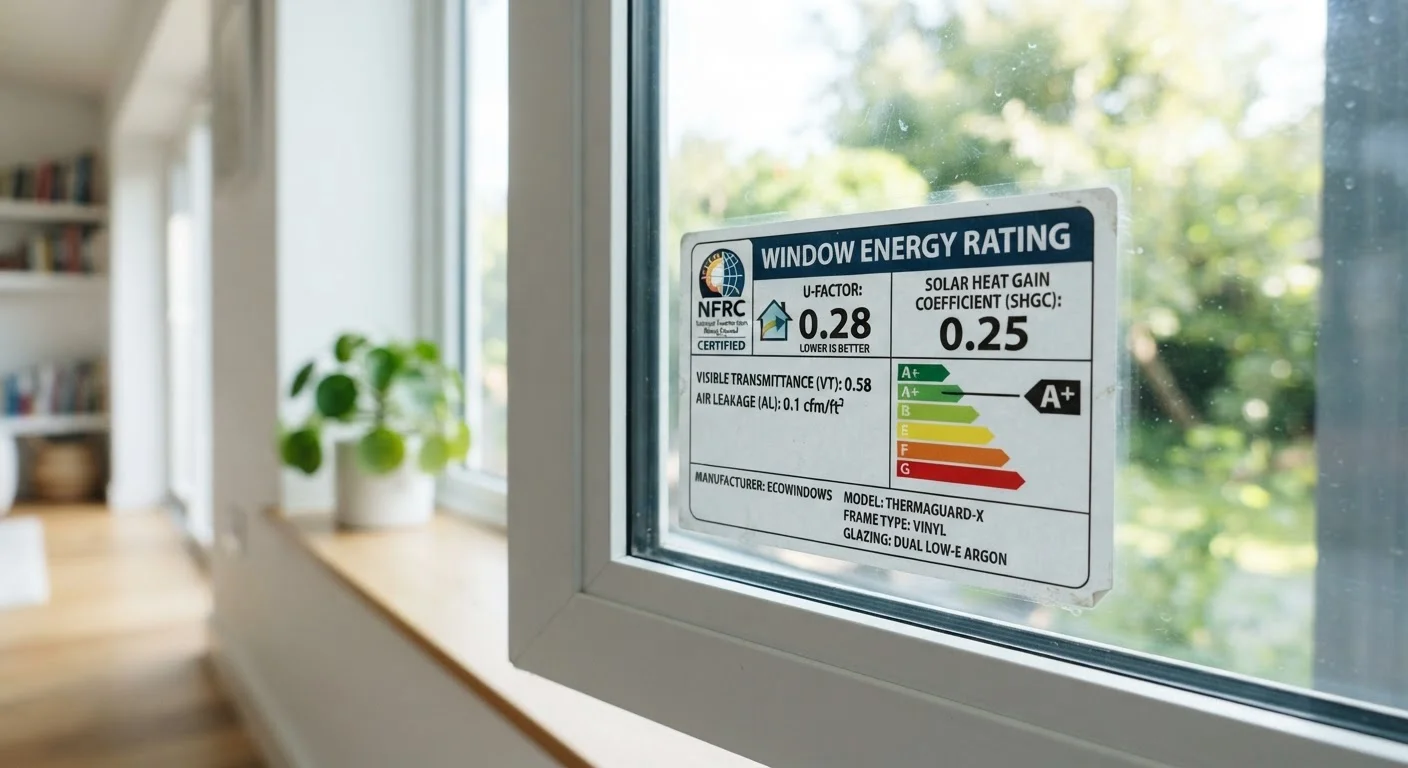
Window energy ratings are standardized numbers that describe how well a window manages heat, light, and air. They appear on labels certified by the National Fenestration Rating Council (NFRC) and allow homeowners to make fair, apples-to-apples comparisons between different windows. The three most important ratings are U-factor, Solar Heat Gain Coefficient (SHGC), and Visible Transmittance (VT).
NFRC ratings measure whole-window performance — including the frame and spacers — not just the glass, making them more accurate than center-of-glass measurements sometimes used in marketing materials.
Why Energy Ratings Matter When Replacing Windows
Window shopping can feel overwhelming when every product promises to be "energy-efficient." The good news: the NFRC label cuts through the noise by providing independently tested, standardized measurements for every certified window. Understanding just three core ratings — U-factor, SHGC, and VT — gives you a reliable framework for comparing options and choosing windows suited to your home's specific climate and layout.
These ratings matter because windows are one of the primary paths for heat gain and heat loss in a home. According to the U.S. Department of Energy, windows account for a significant share of a home's heating and cooling energy use. Replacing old, single-pane windows with properly rated models can meaningfully reduce drafts, improve comfort, and lower utility bills over time — though exact savings depend on many variables including your climate, home size, and existing insulation.
For a broader view of how ratings fit into the full decision-making process, see the complete window energy efficiency overview for homeowners starting from scratch.
NFRC Labels vs. Center-of-Glass Ratings
Some manufacturers advertise center-of-glass U-factor measurements, which only account for the glass itself — not the frame or spacers. NFRC-certified whole-window ratings are always less favorable than center-of-glass numbers, but they reflect actual installed performance far more accurately. When comparing products, make sure you're looking at the same type of measurement.
U-Factor: How Well a Window Holds Heat In
U-factor (sometimes called U-value) measures the rate at which a window conducts heat from the warm side to the cold side. In practical terms: during winter, it tells you how quickly heated indoor air loses warmth through the glass and frame to the cold outdoors.
U-factor is expressed as a number, typically ranging from about 0.20 to 1.20 for residential windows. Lower numbers mean better insulating performance. A single-pane window might have a U-factor near 1.0 or above, while a modern double- or triple-pane window with gas fills can reach 0.20–0.30.
- Cold climates (e.g., northern U.S.): Prioritize U-factor of 0.20–0.27
- Mixed or moderate climates: U-factor of 0.27–0.35 is typically adequate
- Hot climates (e.g., southern U.S.): U-factor up to 0.40 may be acceptable
Upgrades that lower U-factor — such as low-emissivity (low-E) coatings and argon or krypton gas fills — do add to upfront cost. The effect of energy efficiency upgrades on window pricing explains what each upgrade does and how to weigh the added expense.
Solar Heat Gain Coefficient: Managing Sunlight as an Energy Source
Solar Heat Gain Coefficient (SHGC) measures the fraction of solar radiation that passes through the window and enters your home as heat. It's expressed as a number between 0 and 1. A higher SHGC means more solar heat is admitted; a lower SHGC blocks more of it.
Unlike U-factor, there's no universally "better" SHGC — the right value depends on where you live and which direction your windows face.
- Cold or heating-dominated climates: Higher SHGC (0.40 or above) on south-facing windows allows free solar warmth in winter, reducing heating costs.
- Hot or cooling-dominated climates: Lower SHGC (0.25 or below) minimizes unwanted heat gain, keeping air conditioning costs down.
- Mixed climates: A moderate SHGC in the 0.25–0.40 range often strikes a reasonable balance.
Orientation matters, too. West-facing windows in any climate can generate uncomfortable afternoon heat gain, making a lower SHGC worth considering there regardless of region.
Visible Transmittance: Balancing Daylight and Efficiency
Visible Transmittance (VT) measures how much visible light passes through a window. It's also expressed as a number between 0 and 1 — a higher VT means more natural daylight enters the room.
VT doesn't directly control heating or cooling, but it influences your daily comfort and indirect energy use. A window with a VT of 0.60 lets in noticeably more daylight than one rated 0.35, potentially reducing your reliance on artificial lighting during daytime hours.
Some highly efficient coatings that reduce SHGC can also reduce VT, making rooms feel dimmer. When evaluating windows, look for products that maintain a reasonably high VT (above 0.40 is a common general guideline) while still meeting your SHGC needs. This balance is sometimes expressed as the Light-to-Solar Gain (LSG) ratio — VT divided by SHGC — where higher ratios indicate a window that admits more daylight relative to heat.
For practical guidance on reading all the numbers together, the NFRC label room-by-room reference guide walks through each value in context.
Putting It All Together: Matching Ratings to Your Home
No single set of ratings is right for every home. The most effective approach is to treat U-factor, SHGC, and VT as a coordinated set of targets shaped by your climate zone, your home's orientation, and how you use each room.
A useful starting point is the ENERGY STAR climate zone map, which provides recommended U-factor and SHGC ranges for the Northern, North-Central, South-Central, and Southern zones across the U.S. Windows bearing the ENERGY STAR label must meet zone-specific criteria — making that mark a straightforward, reliable filter when comparing products.
Keep in mind that the frame surrounding the glass also contributes meaningfully to a window's overall efficiency. The effect of frame materials on energy performance explains how vinyl, fiberglass, wood, and aluminum each conduct heat differently and influence the final NFRC rating.
Finally, be cautious of efficiency claims that aren't backed by NFRC certification. The guide to evaluating window energy claims can help you tell certified performance data apart from unverified marketing language.
This article is for informational and educational purposes only. Actual energy performance and potential savings vary based on climate, home characteristics, installation quality, and other factors. Consult a qualified window professional or energy auditor for guidance specific to your home.