

Key Takeaways
Our Verdict
Vinyl and fibreglass frames stand out for their combination of thermal resistance, durability, and lower maintenance requirements, making them a practical choice for most homeowners focused on energy performance. Wood remains a strong insulator but demands ongoing upkeep, while aluminium suits climates where heat gain is less of a concern and structural rigidity is a priority.
| Best for | Recommended |
|---|---|
| Homeowners prioritising low maintenance and strong thermal performance | Vinyl frames |
| Those wanting premium performance and dimensional stability in extreme climates | Fibreglass frames |
| Homeowners in historic or traditional-style homes where appearance and insulation matter | Wood frames |
| Mild climates where structural strength and slim profiles are the priority | Aluminium frames with thermal break |
Why Frame Material Is Part of the Energy Equation
When most homeowners think about energy-efficient windows, they focus on the glass — double or triple panes, gas fills, Low-E coatings. But the frame surrounding that glass plays a significant role in the window's total thermal performance. In a typical window, the frame can account for 10–30% of the overall surface area, meaning heat lost or gained through the frame directly affects your home's comfort and energy costs.
Every frame material has a different capacity to resist heat flow, measured by its thermal conductivity. A window's published U-factor (the rate at which heat passes through the entire assembly) reflects both the glazing and the frame together. To understand how your frame choice shapes that number, it helps to look at each material's properties side by side. For a broader look at how U-factor and other ratings work, see Window Energy Ratings Explained.
Comparing the Four Main Frame Materials
The most common residential window frame materials are vinyl (PVC), fibreglass, wood, and aluminium. Each has distinct thermal characteristics, maintenance demands, and cost implications.
| Vinyl | Fibreglass | Wood | Aluminium | |
|---|---|---|---|---|
| Thermal resistance | Good — low conductivity | Excellent — very low conductivity | Good — naturally low conductivity | Poor without thermal break |
| Maintenance required | Low — no painting needed | Low — very durable finish | High — regular sealing/painting | Low — corrosion resistant |
| Dimensional stability | Moderate — expands with heat | High — matches glass expansion | Moderate — affected by moisture | High — structurally rigid |
| Typical relative cost | Lower to moderate | Moderate to higher | Moderate to higher | Lower to moderate |
| Best climate fit | Most climates | Extreme cold or heat | Most climates with upkeep | Mild or warm climates |
| Aesthetic flexibility | Limited colour options | Can be painted any colour | High — stain or paint | Slim profile, modern look |
For a detailed breakdown of how each material affects your replacement budget, see Window Frame Materials and What They Mean for Your Replacement Budget.
Vinyl Frames: Reliable Insulation at a Practical Price
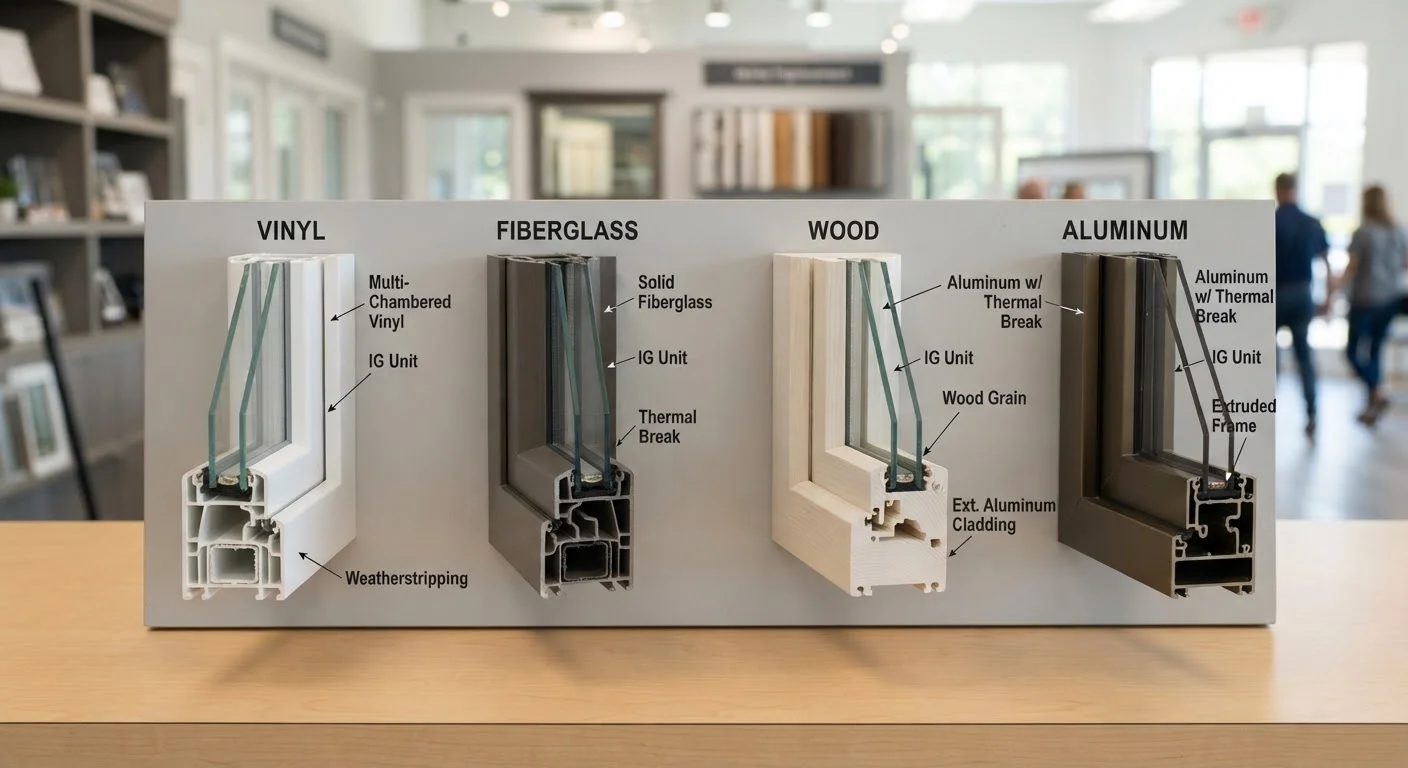
Vinyl frames are made from polyvinyl chloride (PVC) and are among the most widely installed frame types in the US. PVC is a poor conductor of heat, which is why vinyl frames tend to achieve low U-factors without requiring additional treatments. Most vinyl frames are hollow inside, and some manufacturers fill those chambers with insulating foam to improve performance further.
They are resistant to moisture, do not require painting, and hold up well across a wide range of climates. One trade-off: vinyl can expand and contract with temperature swings, which over many years may affect the seal integrity of the frame — though modern manufacturing has substantially reduced this concern.
Fibreglass Frames: High Performance, Greater Stability
Fibreglass frames are composed of glass fibre reinforced with resin, giving them a thermal expansion rate close to that of the glass pane itself. This compatibility reduces stress at the frame-glass junction over time, helping maintain a tighter, more durable seal.
Fibreglass frames can also be filled with insulating foam and generally outperform vinyl in thermal resistance benchmarks. They are dimensionally stable in extreme cold and heat, making them a strong choice for climates with wide temperature ranges. They typically carry a higher upfront cost than vinyl, but their longevity and consistent performance can make them worthwhile over a window's lifespan. The frame you choose interacts closely with other energy upgrades — Energy Efficiency Upgrades and Their Effect on Window Replacement Pricing explains how those layers of investment relate to each other.
Wood and Aluminium Frames: Trade-Offs to Understand
Wood frames have been used for centuries and offer naturally good insulation — wood is a poor conductor of heat, which works in the homeowner's favour. However, wood requires regular sealing, painting, or staining to prevent moisture intrusion, rot, and warping. When well maintained, wood frames perform admirably. When neglected, their thermal and structural integrity can degrade. Many manufacturers offer wood frames clad in aluminium or vinyl on the exterior to reduce maintenance burden while preserving the interior appearance.
Aluminium frames are strong, slim, and resistant to corrosion, but aluminium is an excellent conductor of heat — the opposite of what energy efficiency requires. Without a thermal break (an insulating barrier inserted into the frame's profile to interrupt the conductive path), aluminium frames can significantly increase a window's U-factor. In hot or mild climates where heat loss in winter is a lesser concern, aluminium may be adequate. In colder climates, look specifically for aluminium frames with a certified thermal break.
Window style also affects how well any frame performs in practice — some opening types seal more tightly than others. See Window Style and Energy Efficiency for how design and frame work together.
Choosing the Right Frame for Your Home
No frame material is universally superior. Climate is the most important factor: colder regions demand lower U-factors, favouring fibreglass or insulated vinyl, while milder climates offer more flexibility. Your home's architectural style, budget, and tolerance for maintenance should also weigh in. If you are part of a homeowners association or own a historic property, frame material choices may be subject to approval guidelines — always check before committing.
When comparing quotes from contractors, ask specifically about the frame's thermal properties, not just the glass specification. Request the NFRC (National Fenestration Rating Council) label data for any window being proposed — this label shows the whole-unit U-factor, which accounts for both glass and frame together. For a complete picture of everything that goes into an energy-efficient window decision, Window Energy Efficiency: A Full Overview for Homeowners Starting from Scratch is a useful starting point.