

Key Takeaways
Our Verdict
All three ventilation system types serve a legitimate purpose, but they perform very differently depending on climate, home construction, and household needs. Exhaust-only systems are simple and low-cost but carry real risks in tight or cold-climate homes. Supply-only systems offer better control over incoming air. Balanced systems deliver the most consistent, controllable air quality — though at a higher upfront investment.
| Best for | Recommended |
|---|---|
| Homeowners in mild climates with modest budgets | Exhaust-Only |
| Those in hot, humid climates seeking filtered incoming air | Supply-Only |
| Homeowners in cold climates prioritizing energy efficiency and air quality | Balanced (HRV or ERV) |
Why Mechanical Ventilation Matters
Modern homes are built tighter than ever — which is great for energy efficiency but can trap pollutants, moisture, and stale air inside. Natural airflow through cracks and gaps is no longer reliable enough to keep indoor air healthy. That's where mechanical ventilation comes in.
Before comparing system types, it helps to understand a few core concepts. If terms like ACH (air changes per hour) or CFM (cubic feet per minute) are unfamiliar, our ventilation glossary for homeowners is a useful starting point. There are three main categories of whole-house mechanical ventilation: exhaust-only, supply-only, and balanced. Each moves air differently — and each comes with genuine trade-offs.
Exhaust-Only Ventilation
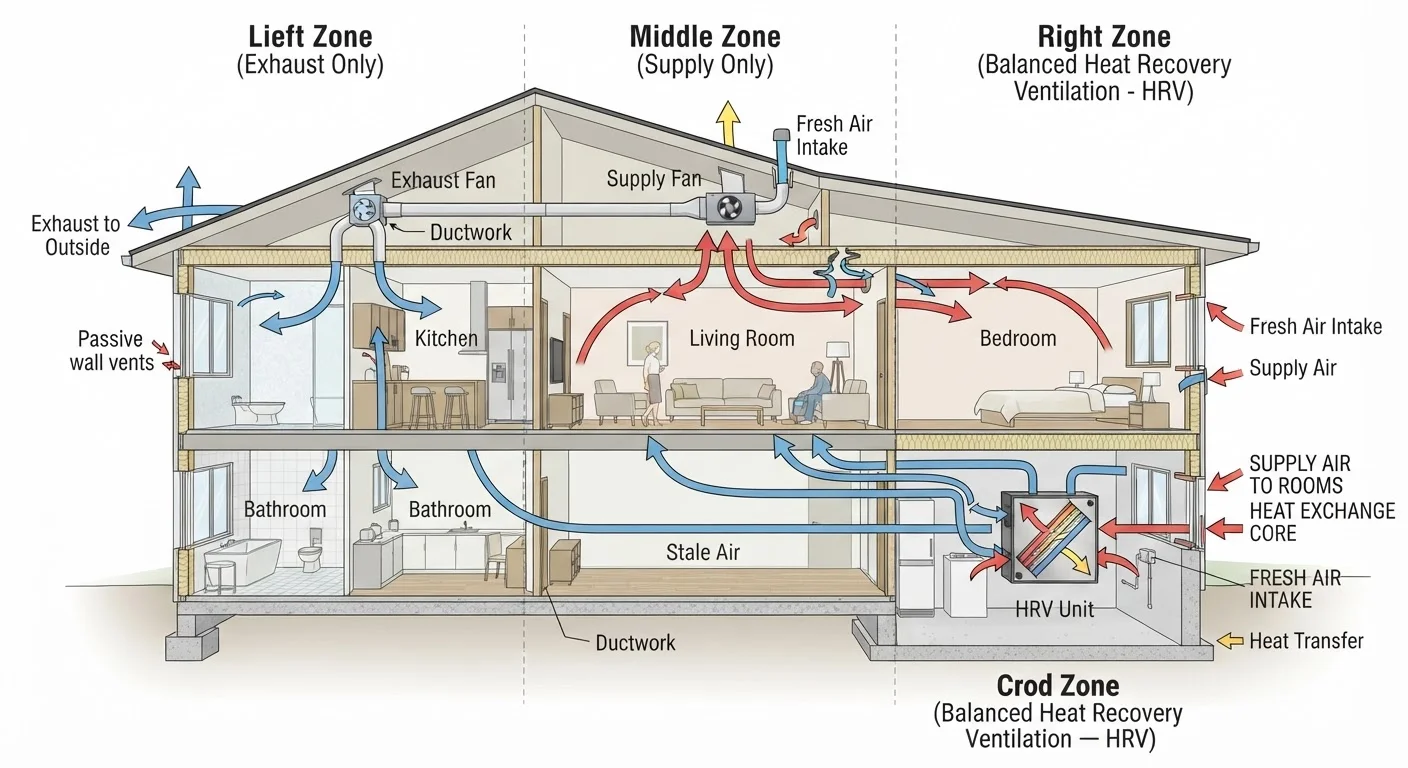
An exhaust-only system works by pulling stale, moist air out of your home — typically from bathrooms and kitchens — using one or more fans. As that air is expelled, outdoor air passively seeps in through small openings in the building envelope (gaps around windows, doors, and utility penetrations).
Advantages
- Simple design with fewer mechanical components
- Generally lower installation cost
- Effective at removing moisture and odors at the source
Drawbacks
- You have no control over where replacement air enters — it can come in through attics, crawlspaces, or wall cavities, potentially bringing dust, radon, or pests
- In cold climates, drawing cold outside air through uninsulated gaps can cause moisture condensation inside walls
- Can create negative pressure that interferes with combustion appliances like gas furnaces or water heaters
Exhaust Fans and Gas Appliances Don't Always Mix
Running a powerful exhaust-only ventilation system in a home with gas furnaces, boilers, or water heaters can create negative pressure that pulls combustion gases back into living spaces — a condition called backdrafting. This is a serious safety hazard. Always consult a licensed HVAC professional before installing or expanding exhaust-only ventilation in a home with any combustion appliances.
If your home uses gas appliances, an HVAC professional should evaluate whether an exhaust-only system could create a backdrafting risk before any installation proceeds.
Supply-Only Ventilation
Supply-only systems take the opposite approach: a fan pushes filtered outdoor air into the home through a dedicated duct, while stale air exits through natural leakage points or intentional exhaust openings. This creates slight positive pressure inside.
Advantages
- You control where fresh air enters, so it can be filtered before distribution
- Positive pressure helps prevent soil gases like radon from infiltrating from below
- Works well in hot, humid climates where keeping outdoor humidity out is less of a concern
Drawbacks
- Pushing humid outdoor air into wall cavities (especially in cold climates) can cause condensation and mold inside building assemblies
- Does not efficiently remove moisture or pollutants generated indoors
- Less effective without a well-sealed duct system
Supply-only systems tend to suit homes in warmer southern states better than homes in cold northern climates, where moisture management inside walls is more critical.
Balanced Ventilation
Balanced systems simultaneously exhaust stale indoor air and supply fresh outdoor air at roughly equal rates. The two most common types are HRV (Heat Recovery Ventilator) and ERV (Energy Recovery Ventilator), both of which transfer heat — and in the case of ERVs, moisture — between the outgoing and incoming airstreams to reduce energy loss.
| Exhaust-Only | Supply-Only | Balanced (HRV/ERV) | |
|---|---|---|---|
| How it works | Fans expel stale air; outdoor air infiltrates passively | Fan pushes fresh air in; stale air exits naturally | Simultaneously exhausts and supplies air |
| Indoor pressure | Negative (below outdoor) | Positive (above outdoor) | Neutral (balanced) |
| Air quality control | Low — no control over infiltration points | Moderate — incoming air can be filtered | High — both streams managed and filtered |
| Energy efficiency | Lower — no heat recovery | Lower — no heat recovery | Higher — recovers heat and/or moisture |
| Best climate fit | Mild climates | Hot, humid climates | Cold or mixed climates |
| Typical complexity & cost | Simple, lower cost | Moderate cost | More complex, higher upfront cost |
For a deeper look at how HRVs and ERVs differ from each other, see our article on ERV vs. HRV systems by climate.
Advantages
- Most consistent and predictable indoor air quality of the three system types
- Energy recovery reduces heating and cooling costs associated with bringing in outdoor air
- Neutral pressure means no risk of backdrafting or uncontrolled infiltration
Drawbacks
- Higher upfront equipment and installation cost
- Requires regular filter maintenance to stay effective
- More complex system design — best installed by a qualified HVAC contractor
Choosing the Right System for Your Home
No single ventilation approach fits every home. Several factors influence which system type makes the most practical sense:
- Climate
- Cold-climate homes benefit most from balanced HRV systems that recover heat. Hot, humid climates may favor ERVs that also manage moisture transfer. Mild climates may do well with simpler exhaust or supply systems.
- Home age and construction
- Older, leakier homes may already have enough natural air infiltration that a simpler exhaust fan system is adequate. Newer, tightly sealed homes typically need a more deliberate balanced approach.
- Existing HVAC equipment
- Your current heating system and ductwork layout affect what can realistically be integrated without a major overhaul.
When you're ready to move from understanding your options to planning an actual installation, our guide on home ventilation planning and professional installation walks through the full process. Always have a licensed HVAC professional assess your home before selecting or installing any whole-house ventilation system — local building codes may also require permits for this type of work.