

Key Takeaways
Option A
Heat Recovery Ventilator (HRV)
The cold-climate workhorse that transfers heat without moisture.
Best for: Homes in cold, humid climates where controlling indoor moisture buildup is the top priority.
Option B
Energy Recovery Ventilator (ERV)
The moisture-balancing ventilator that works across a wider climate range.
Best for: Homes in hot-and-humid or mixed climates where managing both heat and humidity year-round matters.
If you live in a cold northern climate with long winters
Heat Recovery Ventilator (HRV)
HRVs excel at expelling excess indoor moisture in cold weather without freezing up, keeping your home fresh and preventing condensation on walls and windows.
If you live in a hot, humid southern or coastal climate
Energy Recovery Ventilator (ERV)
ERVs limit how much outdoor humidity enters the home in summer, reducing the load on your air conditioner and helping maintain comfortable indoor humidity levels.
If you live in a mixed or four-season climate
Energy Recovery Ventilator (ERV)
ERVs handle both heating and cooling seasons more flexibly, making them a practical all-around choice when your climate swings between extremes.
If your home already struggles with too much indoor humidity in winter
Heat Recovery Ventilator (HRV)
An HRV removes moisture-laden air without transferring it back in, which helps correct chronic over-humidification from cooking, bathing, and occupancy.
What These Systems Actually Do
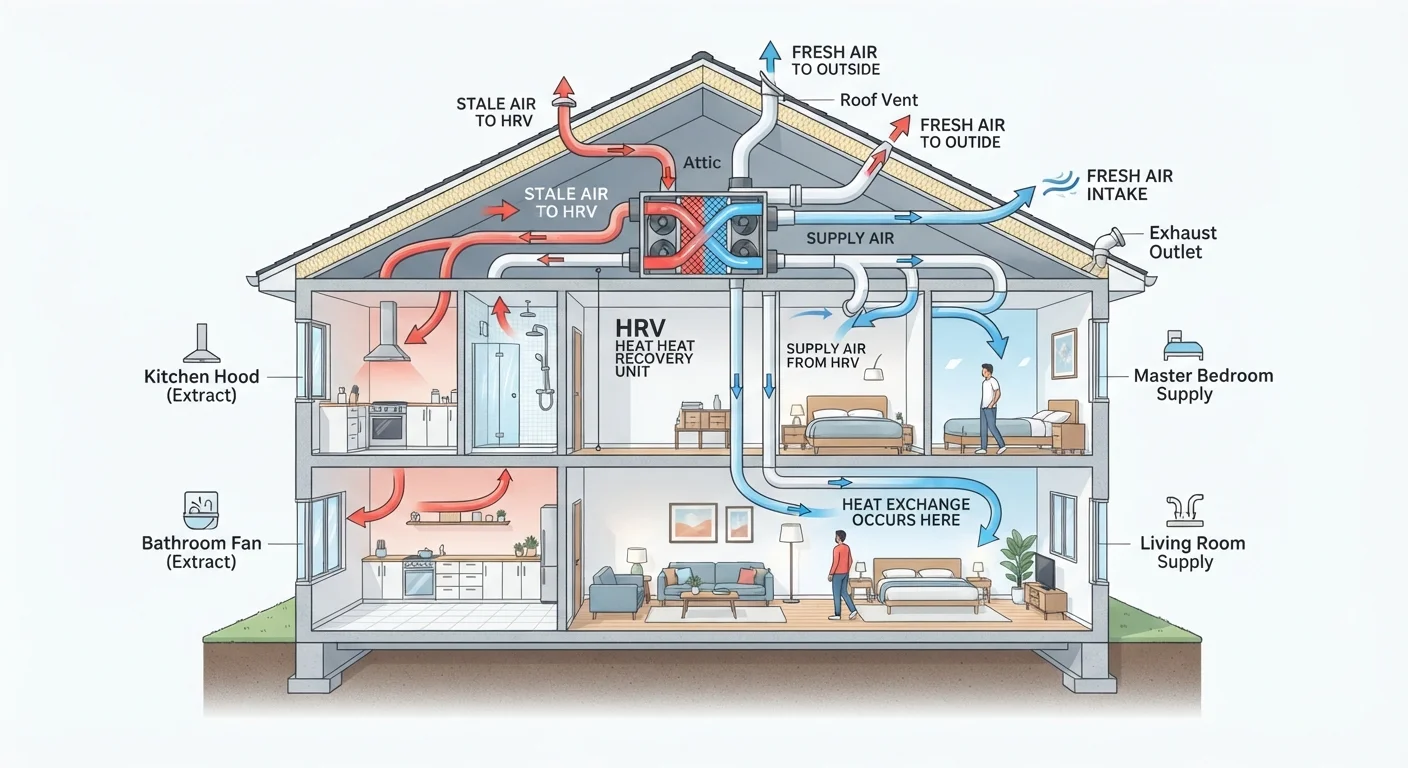
Modern homes are built tighter than ever, which is great for energy bills but can trap stale air, odors, and pollutants inside. Both Heat Recovery Ventilators (HRVs) and Energy Recovery Ventilators (ERVs) solve this problem by continuously exchanging indoor and outdoor air while recovering most of the energy in that outgoing airstream — so you're not paying to heat or cool air you immediately throw away.
Think of them as a two-lane tunnel: one lane carries fresh outdoor air in, the other carries stale indoor air out. In the middle, a heat exchanger core allows the two airstreams to share energy without ever mixing. The result is fresh air with far less energy waste. For a broader look at how these systems fit into your overall setup, see how ventilation and HVAC work together.
The critical difference comes down to what is transferred in that core: heat alone, or heat and moisture.
HRV vs. ERV: The Core Difference Explained
An HRV uses a heat-only exchanger. Warm outgoing air pre-warms the incoming cold air in winter (or the reverse in summer), but moisture stays with whichever airstream it started in. This is ideal when you want to push damp air out of the house without bringing outdoor humidity back in — a common need in cold climates where occupants, cooking, and bathing generate more indoor moisture than the home can safely hold.
An ERV uses an enthalpy exchanger, which transfers both heat and water vapor. In summer, it prevents humid outdoor air from fully entering your conditioned space. In winter, it retains some of the moisture your indoor air already holds, which can prevent the air from feeling uncomfortably dry. If you're unfamiliar with terms like enthalpy or ACH, the ventilation glossary for homeowners is a helpful starting point.
| Criterion | HRV | ERV |
|---|---|---|
| What it transfers | Heat only | Heat and moisture |
| Best climate type | Cold, humid winters | Hot-humid or mixed |
| Winter humidity effect | Removes excess indoor moisture | Retains some indoor moisture |
| Summer humidity effect | Minimal moisture control | Limits incoming outdoor humidity |
| Air conditioning load | Moderate impact | Reduced in humid climates |
| Core technology | Sensible heat exchanger | Enthalpy (total energy) exchanger |
| Typical maintenance | Filter cleaning, core inspection | Filter cleaning, core inspection |
Climate Is the Deciding Factor
No single unit is universally superior — your local climate largely determines which system makes sense.
- Cold climates (Upper Midwest, New England, Pacific Northwest inland): HRVs are typically the preferred choice. In winter, occupant activity generates significant moisture. An HRV exhausts that moisture-laden air rather than recycling the humidity back indoors, reducing the risk of condensation, mold, and structural damage.
- Hot, humid climates (Southeast, Gulf Coast, Hawaii): ERVs generally perform better. Outdoor air in these regions carries substantial moisture in summer. An ERV's enthalpy core limits how much of that humidity crosses into your conditioned space, reducing the strain on your air conditioner.
- Mixed or variable climates (Mid-Atlantic, Midwest transition zones): ERVs tend to offer more flexibility across seasons, though an HVAC professional familiar with your specific area can give more tailored guidance.
You can also explore how your ventilation choice interacts with your heating approach in our overview of forced air, radiant, and baseboard heating options.
Installation, Sizing, and What to Ask a Contractor
Both HRVs and ERVs are whole-home systems that connect to your existing ductwork or run dedicated duct runs. Installation involves cutting penetrations through your building envelope for intake and exhaust ports — work that should be performed by a licensed HVAC contractor. Improper sizing is one of the most common mistakes: an undersized unit won't adequately ventilate the home, while an oversized unit may create uncomfortable drafts or unnecessary energy use.
When meeting with a contractor, consider asking:
- What is the recommended ventilation rate (in CFM — cubic feet per minute) for my home's square footage and occupancy?
- Based on my local climate data, do you recommend an HRV or ERV, and why?
- How will the unit connect to my existing HVAC system or ductwork?
- What maintenance does the unit require, and how often?
For context on how these balanced-ventilation units differ from simpler systems, the comparison of exhaust-only, supply-only, and balanced ventilation explains the full picture. Permits and inspections may be required depending on your municipality — always verify local requirements before work begins.
This article is for general informational purposes only. Consult a licensed HVAC professional for advice specific to your home, climate, and local building codes.