

Key Takeaways
HVAC vs. Ventilation
HVAC stands for Heating, Ventilation, and Air Conditioning — a broad term for the systems that control temperature and airflow in your home. Ventilation specifically refers to the process of replacing or diluting stale indoor air with fresh outdoor air. While ventilation is technically part of the HVAC umbrella, most residential heating and cooling equipment does not actively bring in fresh air from outside. Confusing the two can lead homeowners to assume their comfort system is also handling their indoor air quality — when it may not be.
Most forced-air furnaces and central air conditioners recirculate existing indoor air through a filter rather than introducing new outdoor air. Dedicated mechanical ventilation equipment — such as an ERV or HRV — is required to achieve true fresh-air exchange.
Why the Confusion Happens
The letter "V" sits right in the middle of HVAC, so it is reasonable to assume your heating and cooling system handles ventilation too. And in a technical sense, HVAC systems can include ventilation components. The problem is that most homes are equipped with heating and cooling equipment only — the ventilation piece is either minimal or entirely absent.
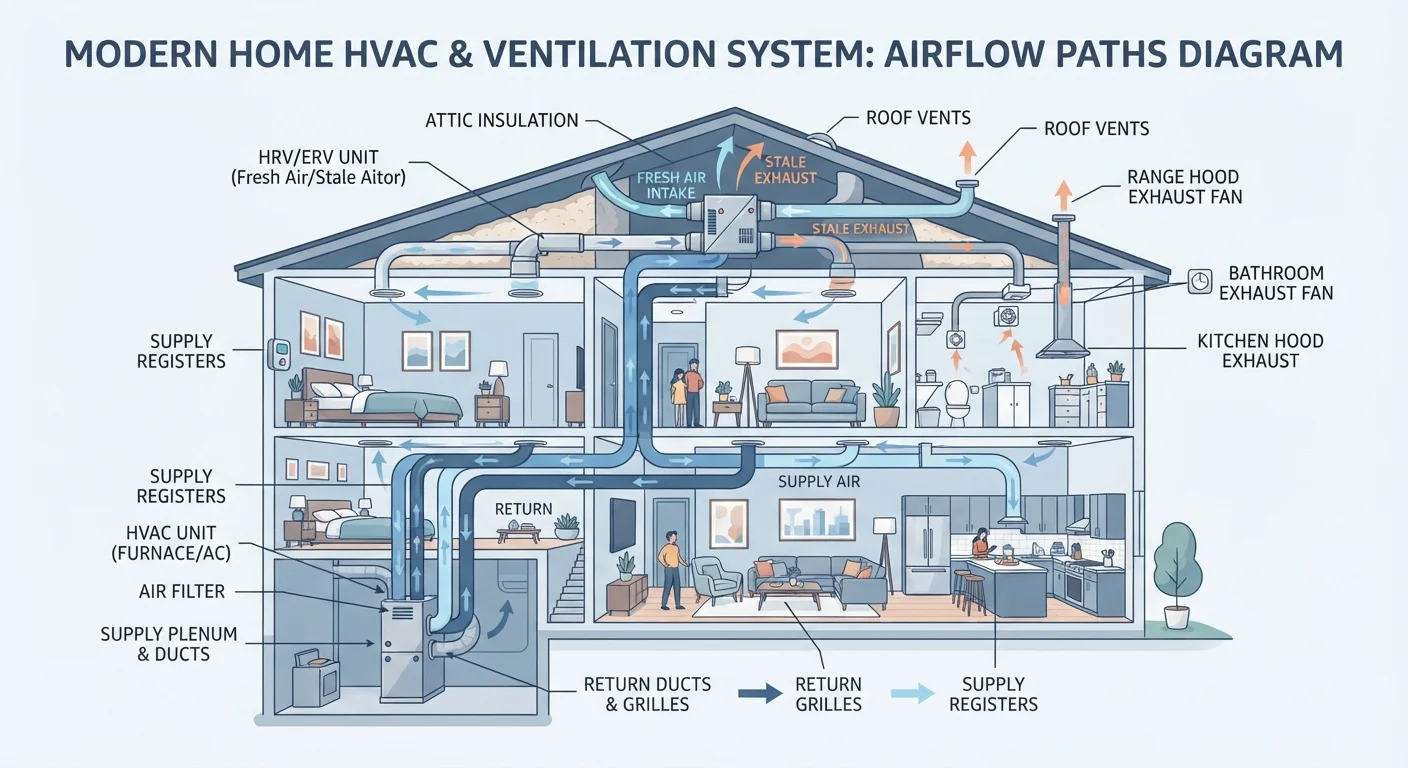
When a contractor installs a furnace and central air conditioner, those systems share ductwork that moves air through your home. That air movement feels like fresh air circulating, but it is largely the same indoor air being filtered, heated or cooled, and sent back through the vents. Understanding this distinction is the first step toward taking control of your indoor environment. For a broader look at how heating equipment specifically works, see our guide to home heating systems.
What HVAC Actually Does
A typical residential HVAC setup has two primary jobs: keeping your home warm in winter and cool in summer. A furnace or heat pump handles heating; a central air conditioner or the cooling side of a heat pump handles cooling. Both systems use a network of supply and return ducts, along with a blower fan, to move conditioned air throughout the house.
Filtration happens as part of this process — air passes through a filter before returning to the furnace or air handler. A good filter can trap dust, pollen, and other particles. What it cannot do is add fresh outdoor air to the mix or remove carbon dioxide that builds up from normal breathing and cooking.
2–5x
How much more polluted indoor air can be vs. outdoor air
The U.S. Environmental Protection Agency has noted that indoor air can be two to five times more polluted than outdoor air, largely due to inadequate ventilation in residential buildings.
~90%
Time Americans spend indoors on average
EPA research estimates that Americans spend approximately 90 percent of their time indoors, making indoor air quality a significant factor in overall health and comfort.
0.35 ACH
Minimum air changes per hour recommended for homes
ASHRAE Standard 62.2 recommends a minimum of 0.35 air changes per hour for residential spaces, a target many existing homes do not meet without dedicated ventilation equipment.
This is why a home can feel stuffy or develop odor problems even with a fully functional, well-maintained HVAC system. The equipment is doing its job — it just was never designed to handle fresh-air exchange on its own.
What Ventilation Actually Does
Ventilation is the deliberate movement of outdoor air into a building and stale indoor air out of it. This exchange dilutes pollutants, moisture, odors, and carbon dioxide that accumulate naturally in occupied spaces. Without adequate ventilation, these contaminants build up over time.
There are two broad categories: natural ventilation (air moving through gaps, windows, and doors) and mechanical ventilation (fans and dedicated equipment that control airflow deliberately). Our overview of natural vs. mechanical ventilation explains how each approach works and where each falls short.
Modern energy-efficient homes are built tightly to reduce heating and cooling losses — which is good for energy bills but means less accidental fresh-air infiltration. Tighter homes generally need intentional mechanical ventilation to maintain healthy indoor air quality. Spot exhaust fans in kitchens and bathrooms help, but as explored in our article on why exhaust fans alone are not enough, they address only part of the problem.
Where HVAC and Ventilation Overlap — and Where They Don't
Some HVAC equipment does incorporate ventilation. Certain air handlers have a dedicated fresh-air intake damper that allows a controlled amount of outdoor air into the duct system. Commercial buildings routinely use this approach. In residential settings, it is less common but not unheard of, particularly in newer construction built to stricter energy codes.
Energy Recovery Ventilators (ERVs) and Heat Recovery Ventilators (HRVs) represent the most effective integration of ventilation with an existing HVAC system. These units attach to your ductwork, bring in fresh outdoor air, and recover a significant portion of the heating or cooling energy from the outgoing stale air — so you are not simply throwing conditioned air out the window. If you want to understand which type suits your climate, our ERV vs. HRV comparison breaks down the differences.
The key point: HVAC and ventilation can work together effectively, but only when the system is specifically designed or upgraded to do so. A standard furnace-and-AC setup does not automatically provide that integration.
What Homeowners Should Do Next
Start by identifying what your current system actually includes. Look for any fresh-air intake on your air handler, check whether you have an ERV or HRV installed, and consider whether your home feels consistently stuffy, humid, or develops odors that linger. These are practical signals that ventilation may be inadequate.
If you are uncertain about the terminology, our ventilation glossary for homeowners can help you prepare for a conversation with a contractor. When you are ready to explore options, a licensed HVAC professional can assess your home's current air exchange rate and recommend whether a dedicated ventilation system makes sense for your situation.
Heating and cooling your home comfortably is one goal. Breathing clean, fresh air inside it is another. Both matter — and now you know they are not always the same thing.
This article is for general informational purposes only. Always consult a licensed HVAC professional for guidance specific to your home and local building codes.