

Key Takeaways
Why Ventilation Myths Are So Persistent
Many ventilation misconceptions are rooted in reasonable-sounding logic: insulation keeps air in, so more must be better; fresh outdoor air comes in through windows; your heating and cooling system must be doing it all. The problem is that each of these assumptions treats ventilation as a side effect of other building systems rather than a purpose-built function in its own right.
For homeowners aged 50 and older who spend more time at home, the stakes of getting this wrong are higher. Poor indoor air quality is linked to respiratory irritation, fatigue, and worsened allergy or asthma symptoms. It can also cause gradual structural damage through unchecked moisture. Understanding what ventilation actually does — and what it does not — is a practical form of home protection. For a broader look at why this matters as you age, see what ventilation does and why it matters more as you age.
Myth
The more insulation I add, the healthier my home's air quality will be.
Fact
Insulation reduces heat transfer but has no ability to filter, circulate, or refresh indoor air. Excessive insulation without ventilation can actually trap pollutants indoors.
Insulation and ventilation solve two completely different problems. Insulation keeps conditioned air from escaping your home's thermal envelope. Ventilation replaces stale, pollutant-laden indoor air with fresh outdoor air. When a home is sealed tightly through heavy insulation or air-sealing work without a corresponding fresh-air strategy, indoor concentrations of carbon dioxide, volatile organic compounds (VOCs), and moisture can rise steadily. Building scientists sometimes describe this as making a home "too tight to breathe." A well-insulated home is a worthy goal — but it requires a deliberate ventilation plan alongside it.
Myth
Opening windows is all the ventilation a home needs.
Fact
Natural window ventilation is weather-dependent, uncontrolled, and unable to move air through interior rooms reliably. It is a useful supplement, not a system.
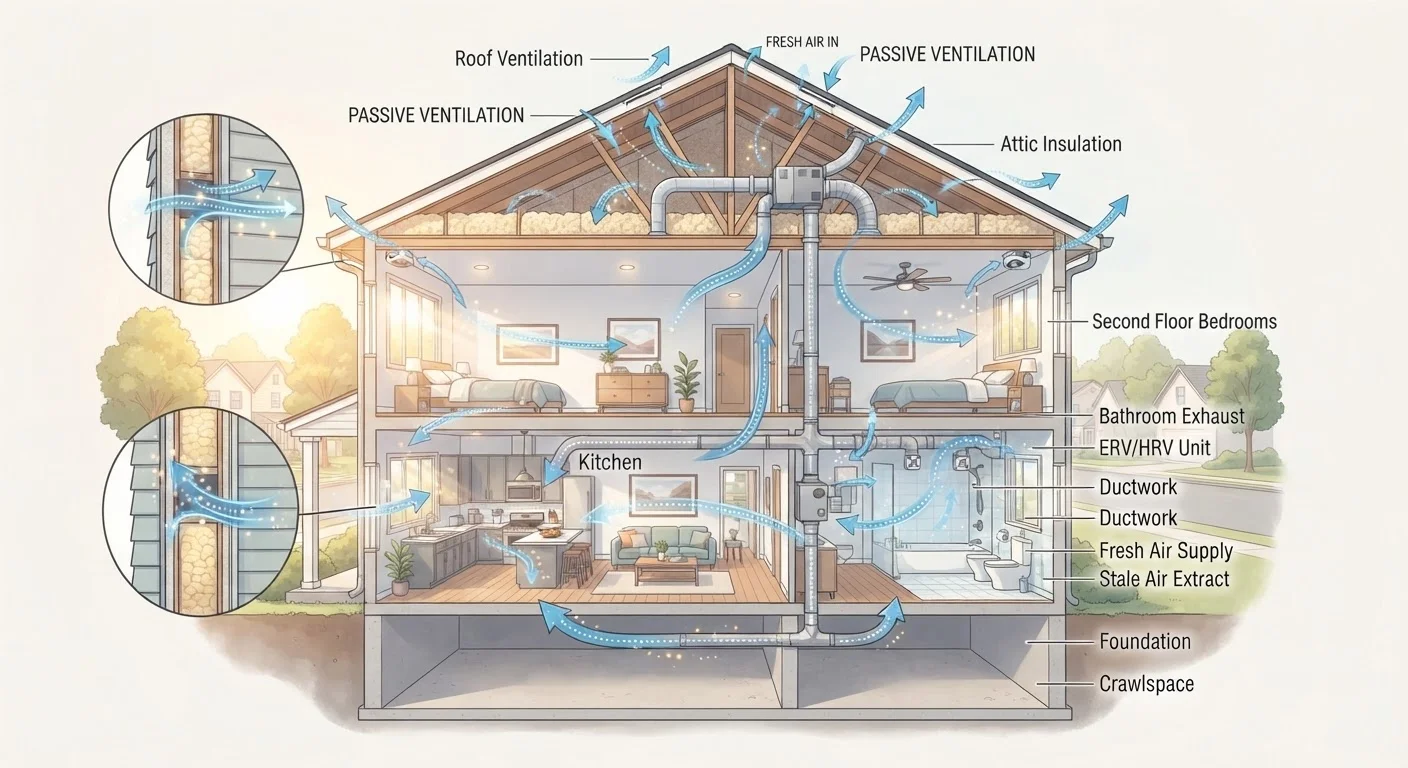
On a mild, breezy day, opening windows can introduce meaningful fresh air. But ventilation through open windows depends entirely on outdoor temperature, humidity, wind direction, and your home's layout. During summer heat, winter cold, allergy season, or air-quality alerts, opening windows may introduce more problems than it solves. Interior rooms without exterior windows receive almost no benefit at all. Mechanical ventilation systems — including whole-house ventilators and heat recovery ventilators (HRVs) — are designed to deliver consistent, measured airflow regardless of outdoor conditions. For more on how the two approaches compare, see natural vs. mechanical ventilation.
Myth
Running bathroom and kitchen fans takes care of my home's ventilation needs.
Fact
Exhaust fans remove moisture and odors from specific spots but do not supply fresh air to the rest of the home.
Bathroom and kitchen exhaust fans are classified as spot ventilation — they pull localized pollutants or moisture out of one area. They are not designed to circulate or supply fresh air throughout your living spaces. Running them continuously can even create negative pressure that pulls unconditioned air through gaps in the building shell, introducing dust, allergens, or outdoor humidity in an uncontrolled way. Whole-house ventilation strategies address the entire home's air volume on a scheduled, balanced basis. Why exhaust fans alone fall short explains this distinction in greater detail.
Myth
If I can't smell anything musty or stale, my indoor air quality is fine.
Fact
Many of the most harmful indoor air pollutants — including radon, carbon monoxide, and VOCs — are odorless and completely undetectable by smell.
Human senses are poor instruments for measuring air quality. Radon, a naturally occurring radioactive gas linked to lung cancer, is colorless and odorless. Carbon monoxide is famously undetectable without a detector. VOCs off-gassed by paints, adhesives, and furnishings accumulate invisibly. Even high carbon dioxide levels — which cause fatigue and reduced concentration — have no discernible odor. Relying on smell alone to judge air quality is a habit that can leave serious problems undetected for years. If your home has been tightly sealed for energy efficiency, consider having an indoor air quality assessment done by a qualified professional. You can also learn more about pollutants that build up in sealed homes.
Myth
My HVAC system handles ventilation, so I don't need to think about it separately.
Fact
Most standard HVAC systems recirculate existing indoor air. Unless specifically equipped with a fresh-air intake, they do not bring in outdoor air.
This is one of the most common and costly misunderstandings homeowners hold. A furnace heats air. A central air conditioner cools and dehumidifies air. Neither system, by default, draws fresh air from outside — they simply condition and recirculate the air already inside your home. Over time, without a dedicated fresh-air source, indoor pollutant concentrations can rise even while the HVAC runs constantly. Some systems can be fitted with energy recovery ventilators (ERVs) or fresh-air intakes, but these are separate components that must be intentionally added and maintained. See how HVAC and ventilation work together for a clear breakdown.
Recognizing the Real Warning Signs
Because many ventilation problems are invisible until they worsen, it helps to know what indirect signs to look for. Condensation on interior window glass, musty or stale odors that return quickly after airing out, peeling paint near bathroom ceilings, or a persistent sense of stuffiness in certain rooms can all point to inadequate air exchange. Frequent headaches or unusual fatigue indoors — particularly in newer or recently weatherized homes — are worth taking seriously.
Don't Ignore Persistent Moisture or Musty Odors
Recurring condensation on windows, walls, or ceilings is a signal that moisture is not being removed effectively from your home's air. Left unaddressed, excess moisture can lead to mold growth, wood rot, and deteriorating insulation. Do not attempt to seal or cover these symptoms — address the root cause by consulting a licensed HVAC or building performance professional.
If you notice any of these warning signs, a qualified HVAC contractor or indoor air quality specialist can perform a home assessment. They may use a blower door test to measure how airtight your home is, or use monitoring equipment to check CO₂ and humidity levels. Acting early is far less costly than addressing moisture damage or mold remediation later. You can also review signs your home isn't breathing properly for a fuller checklist.
Ventilation decisions don't exist in isolation. Just as window choice affects how air moves through a home — see common myths about window styles — roofing and attic conditions also directly influence how moisture and heat behave in your living spaces. Treating ventilation as part of your overall home system, rather than an afterthought, leads to better decisions and fewer costly surprises.
This article is for informational and educational purposes only. Ventilation needs vary by home age, climate, construction type, and occupant health. Consult a licensed HVAC professional or certified indoor air quality specialist before making changes to your home's ventilation systems.