

Key Takeaways
Why Safety Engineering Matters in a Walk-In Tub
Bathrooms are consistently among the highest-risk rooms in the home for adults over 50. Wet surfaces, awkward entry points, and the effort of lowering into and rising from a standard tub create conditions where slips and falls are common. Walk-in tubs are specifically engineered to reduce these risks — not through a single fix, but through a combination of features that work together.
If you're new to the concept, our introduction to walk-in tubs explains the basics of how they differ from standard baths. This article goes deeper — breaking down the individual safety features you're likely to encounter and explaining what each one is actually designed to prevent.
Understanding these features also makes you a more informed buyer. When speaking with a contractor, knowing what to ask about — and why — puts you in a better position to evaluate what's being offered.
Low-Threshold Entry Door
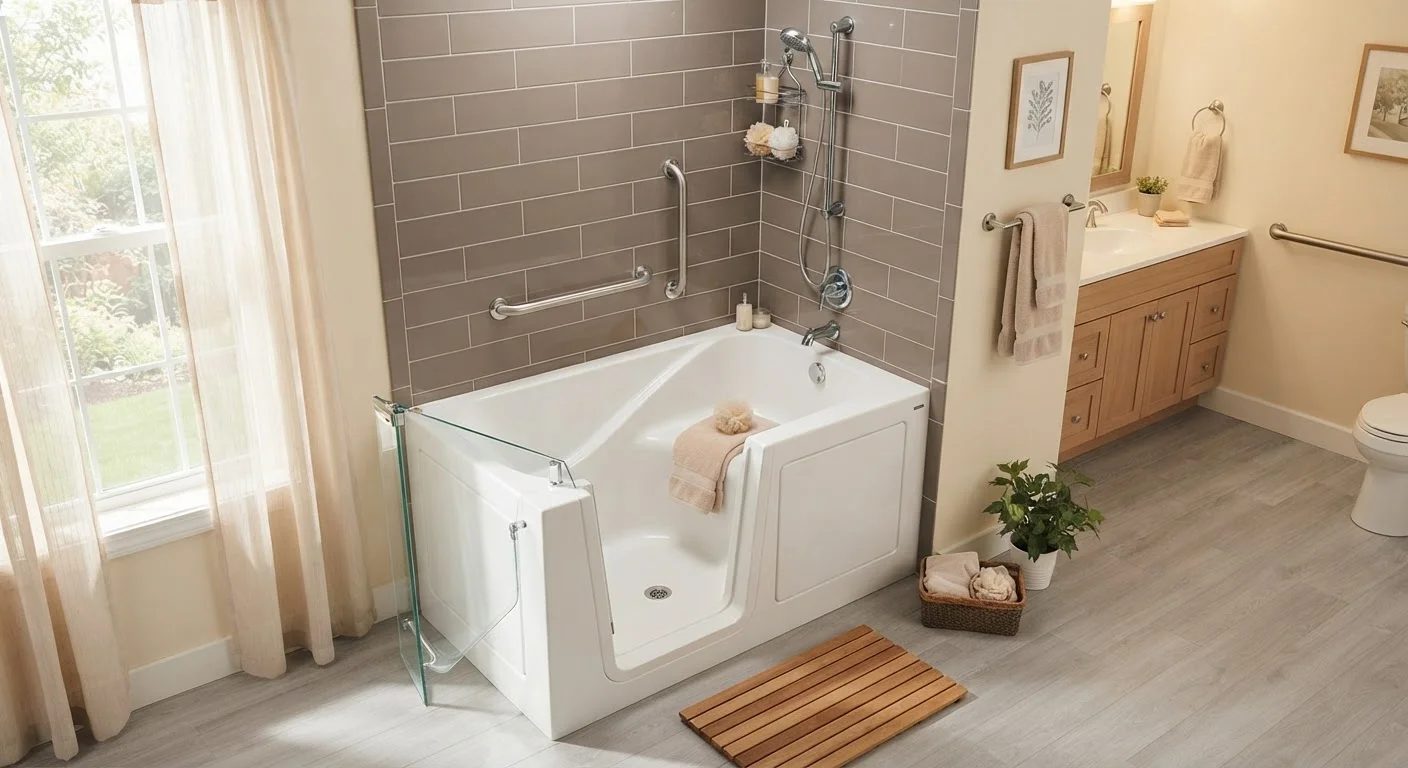
The entry door of a walk-in tub typically sits just a few inches off the floor — a dramatic reduction from the 14–18 inch step-over height of a standard bathtub. This low threshold is one of the most fundamental safety features because it directly addresses the most dangerous moment of the bathing process: getting in and out.
A high step-over requires balance, flexibility, and leg strength that many older adults find difficult or painful. Reducing that threshold to roughly 2–4 inches means less strain and a dramatically lower chance of losing balance during entry or exit.
The low threshold directly targets the most dangerous moment — stepping in or out of the tub.
Interior Grab Bars
Once inside a walk-in tub, a bather still needs stable support points for sitting, bathing, and standing. Interior grab bars — typically mounted on the side walls or door frame — provide those anchor points. They're designed to bear significant weight and give bathers something firm to hold when shifting positions.
Unlike decorative towel bars, grab bars installed in walk-in tubs are anchored to structural supports and rated for load-bearing use. For a fuller explanation of how grab bars differ from other bathroom rails, see our guide on grab bars, handrails, and safety rails.
Grab bars are load-bearing anchors, not decorative fittings — the distinction matters for safety.
Built-In Seating
Walk-in tubs include a contoured seat, usually molded into the tub itself, that allows the bather to sit at a comfortable height rather than lying flat in water. This serves a direct safety function: sitting upright is easier to manage than lowering to the tub floor and rising back up, which requires significant core and leg strength.
The seat position also keeps the bather stable during bathing and reduces the risk of slipping down while the tub fills or drains — a hazard specific to walk-in tub use, since the door must be closed before filling.
Built-in seating reduces the physical effort of bathing and helps prevent slipping during tub fill and drain cycles.
Anti-Scald Valve
Hot water scalds are a genuine risk for older adults, whose skin can be more sensitive to heat and whose reaction time may be slower. Anti-scald valves — also called thermostatic mixing valves — regulate water temperature at the fixture, preventing water from reaching dangerously high temperatures even if the household water heater is set too high.
These valves are a plumbing component, not just a tub feature, and their installation typically requires a licensed plumber. They're worth confirming as part of any walk-in tub installation, not assumed. Ask your contractor whether the plumbing work includes anti-scald protection and how it will be tested after installation.
Anti-scald valves prevent dangerous water temperatures at the source — not just through careful adjustment.
Slip-Resistant Floor Texture
The floor surface inside a walk-in tub is typically textured or treated to reduce slipping when wet. This addresses the basic physics of a wet, soapy surface underfoot. Smooth surfaces — even fiberglass or acrylic — become significantly slippery when wet, and a bather who has to shift position or stand is at real risk without adequate grip underfoot.
Slip-resistant textures vary in effectiveness, so ask your contractor about the specific surface finish and how it performs over time, since wear can reduce grip. Our article on bathroom flooring and slip risk explores this topic in more depth for the broader bathroom environment.
Textured tub floors reduce slip risk when wet — but their effectiveness can diminish with age and wear.
Handheld Showerhead
A handheld showerhead on a flexible hose is a practical safety feature that's easy to overlook. For a bather who is seated, a fixed overhead spray is hard to control and may require awkward reaching or twisting to rinse effectively. A handheld unit can be directed precisely where needed without the bather needing to shift, stand, or stretch.
This reduces the number of unnecessary movements during bathing — each of which represents a potential loss of balance. It also makes it easier for a caregiver to assist with bathing if needed, without both parties needing to maneuver around a fixed fixture.
A handheld showerhead reduces unnecessary movement during bathing — each saved stretch is a fall risk avoided.
Fast-Fill and Quick-Drain Faucets
Because a walk-in tub door must be closed before filling and cannot be opened until the tub has drained, the bather sits inside during both the fill and drain cycles. This creates a period of vulnerability — particularly in cooler bathrooms — where the bather is waiting, potentially getting cold, and unable to exit.
Fast-fill faucets and quick-drain systems reduce this waiting time. While they don't eliminate the wait entirely, shortening the fill-and-drain window meaningfully reduces discomfort and the risk of a bather attempting to exit before the tub has fully drained.
Faster fill and drain cycles shorten the time a bather is confined inside the tub — reducing discomfort and impatience-related risks.
Putting It All Together Before You Commit
Each feature listed above solves a distinct problem, but their real value comes from working in combination. A tub with a low-threshold door but no interior grab bars still leaves a bather vulnerable once inside. Anti-scald protection without a slip-resistant floor addresses only part of the risk picture.
Ask for a Feature-by-Feature Walkthrough
Before finalizing any walk-in tub installation, ask your contractor to go through each safety feature on the specific unit being proposed. Confirm which features are included as standard and which cost extra. Request documentation on how features like anti-scald valves and drain speeds will be tested after installation. A contractor who can answer these questions clearly and confidently is one who understands the product they're recommending.
When you speak with a contractor, ask them to walk through each safety feature and clarify whether it's standard on the unit being recommended or an optional add-on. For a broader look at how walk-in tubs fit into a whole-home accessibility plan, the accessible bathrooms hub covers planning considerations across the entire bathroom. And if you're still weighing whether a walk-in tub or a walk-in shower better suits your needs, our side-by-side comparison can help clarify the decision.
This article is for informational purposes only. Always consult a licensed contractor and verify local building codes and permit requirements before beginning any bathroom renovation.