

Key Takeaways
Reverse Curve Gutter Guard
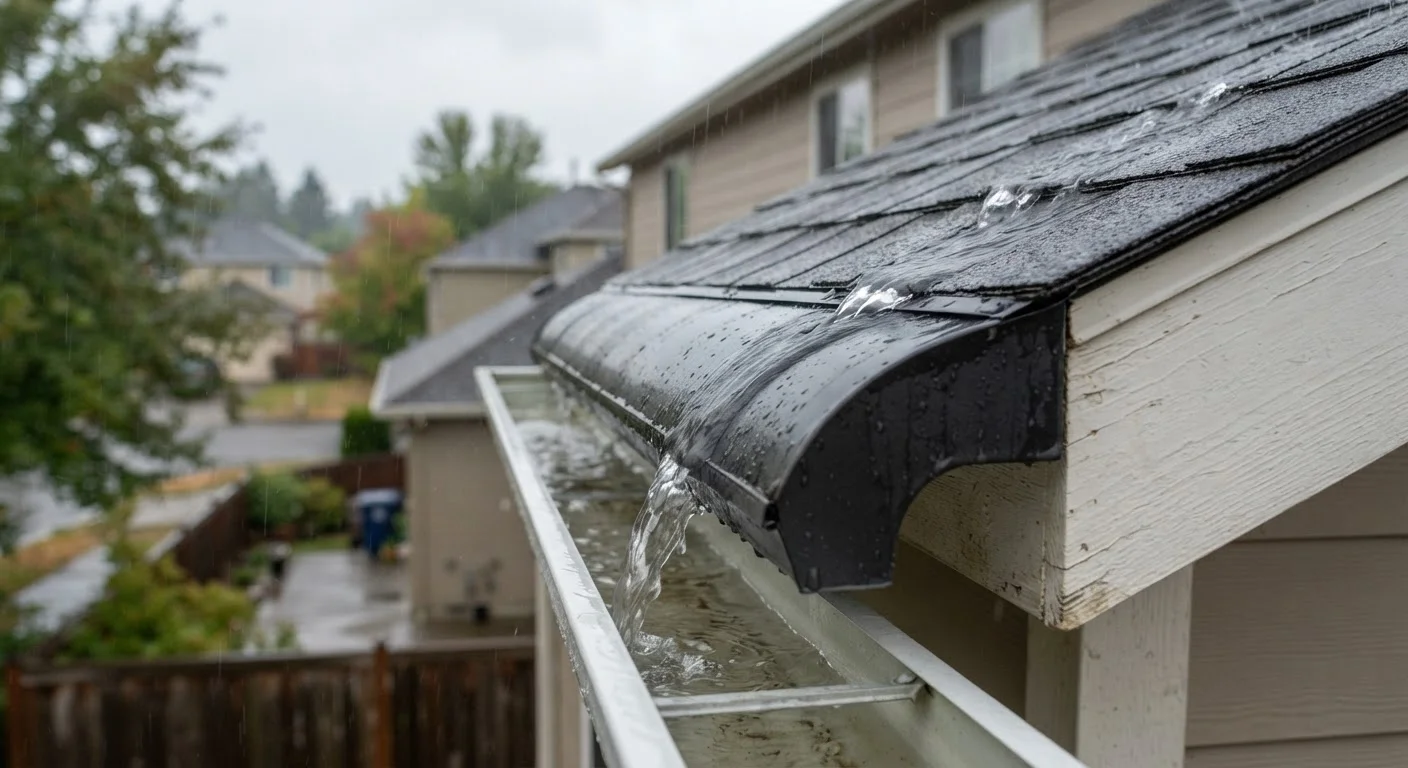
A reverse curve gutter guard is a cover installed over your gutter that uses a curved, downward-sweeping lip to guide rainwater off the roof and into the gutter below. Instead of filtering water through holes or mesh, it relies on a physical property called surface tension — water clings to the curve and follows it down into the channel, while leaves and debris are meant to fall off the edge. These guards are sometimes called surface tension or curved gutter guards.
The operating principle is rooted in the Coandă effect — a fluid's tendency to follow a curved surface rather than travel in a straight line. Performance depends heavily on water flow rate, roof pitch, and debris type.
The Physics Behind the Design
Reverse curve gutter guards look deceptively simple: a solid, curved cover that sits over your gutter with a narrow opening at the front edge. The key to how they work lies in a concept called surface tension — the tendency of water to cling to a surface and follow its contour rather than drip straight down.
When rain runs off your roof and reaches the guard's curved lip, the water wraps around the curve and drops down through the narrow slot into the gutter. Leaves and larger debris, which are rigid and lack surface tension with the guard material, are supposed to continue forward and fall to the ground instead.
This is a fundamentally different approach from mesh or foam guards, which physically filter water through small openings. Reverse curve designs rely entirely on water's natural behavior — which means the conditions have to be right for that behavior to work as intended.
Surface Tension Has Real Physical Limits
Surface tension is a measurable, well-understood property of water — but it's not infinitely strong. At high flow rates, water's momentum overcomes its tendency to cling to surfaces. This is why reverse curve guards that work well in light-to-moderate rain can fail during intense storms. Understanding this limitation upfront helps set realistic expectations.
When the Design Works — and When It Doesn't
Under moderate, steady rainfall, reverse curve guards can be effective at keeping large leaves and debris out of gutters. But several real-world factors limit their reliability:
- Heavy rainfall: When rain comes down fast enough, water builds momentum and overshoots the curve entirely — flowing over the guard rather than into the gutter.
- Fine debris: Small particles like pine needles, shingle granules, and seed pods follow the water film along the curve and end up inside the gutter anyway.
- Roof pitch: Steeper roofs send water across the guard at a higher speed, which can reduce the surface tension effect and increase overshoot risk.
- Guard positioning: The angle and placement of the guard relative to the roof edge must be precise. Even minor misalignment reduces performance significantly.
Homeowners surrounded by pine trees or in climates with frequent heavy storms tend to see less satisfying results. Those with moderate tree cover and regular but not extreme rainfall often report better outcomes.
What Homeowners Should Realistically Expect
Reverse curve guards reduce how often you need to clear large debris from gutters — but they don't eliminate gutter maintenance entirely. Fine material will still accumulate inside the gutter over time, and the guards themselves can collect debris on top of the curve that eventually decomposes and creates a maintenance issue of its own.
It's also worth noting that these guards are among the more visible options from the street, since the curved cover sits above the gutter line. Some homeowners appreciate the finished look; others prefer lower-profile alternatives.
For a broader picture of what upkeep looks like after installation, the guide on why gutter guards don't eliminate maintenance entirely is worth reading before you decide. And once you've chosen a guard type, understanding maintenance across different gutter guard materials will help you plan for long-term care.
Ask About Guard Angle at Installation
When speaking with a contractor about reverse curve guards, ask specifically how they will position the guard relative to your roofline angle. The precise placement determines whether water follows the curve into the gutter or overshoots it. A reputable installer should be able to explain their method clearly and adjust for your specific roof pitch.
Is a Reverse Curve Guard Right for Your Home?
The answer depends on your specific conditions. Ask yourself:
- What types of trees are near your roofline? Large deciduous leaves are easier for these guards to shed than fine needles or seeds.
- What's your local rainfall pattern? Moderate, steady rain suits these guards better than intense, sudden storms.
- What's your roof pitch? A very steep roof may reduce effectiveness.
A qualified contractor can assess your roof angle, surrounding vegetation, and typical weather patterns to help determine whether a reverse curve design makes sense. If you're ready to move toward installation, it helps to understand how the installation process actually works so you know what to expect. For cost context across guard styles, the Installation & Costs hub offers a useful starting point.