

Key Takeaways
Why Heating Safety Deserves More Than a Passing Thought
Most homeowners think about heating in terms of comfort and cost — and those things matter. But gas and oil heating systems involve combustion, and combustion produces byproducts that can become life-threatening if your equipment or venting isn't working correctly. Understanding the basic risks is not about fear; it's about taking straightforward steps that protect everyone in your home.
If you're still getting familiar with how your heating system works overall, our plain-language heating systems guide is a useful starting point before diving into safety specifics.
Gas vs. Electric: Safety Profiles Differ
Homes with electric heating systems do not produce carbon monoxide, which removes one category of risk. However, gas and oil systems remain common and carry distinct ventilation responsibilities. If you're weighing your options, our gas vs. electric heating comparison covers the safety trade-offs in plain terms.
Understanding Carbon Monoxide: The Invisible Risk
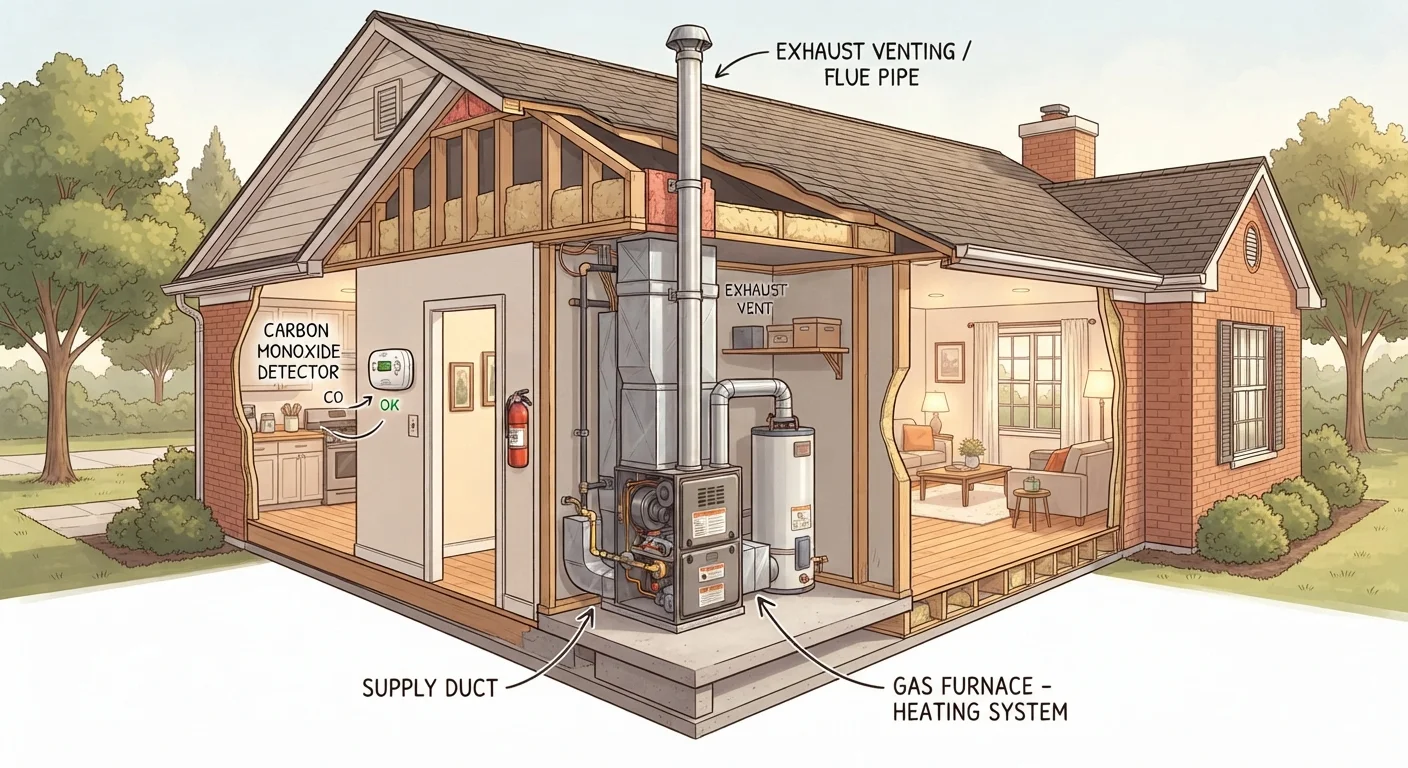
Carbon monoxide (CO) is produced whenever a fuel — natural gas, propane, oil, or wood — burns incompletely. In a properly functioning heating system, CO is safely exhausted outside the home through a flue or vent pipe. Problems arise when that exhaust pathway is blocked, cracked, or disconnected, allowing CO to spill back into living spaces.
Because CO has no smell, taste, or color, you cannot detect it without a purpose-built alarm. Early symptoms of exposure — headache, nausea, fatigue, and dizziness — are easy to confuse with a cold or flu, which is part of what makes it so dangerous. If multiple people in your household experience these symptoms at the same time, especially during heating season, treat it as a CO emergency: leave the building immediately, get fresh air, and call emergency services before re-entering.
For a broader look at how CO fits alongside other invisible home air-quality concerns, see our article on radon, carbon monoxide, and VOCs.
~400
Unintentional CO poisoning deaths annually in the U.S.
According to the U.S. Centers for Disease Control and Prevention, approximately 400 Americans die each year from unintentional, non-fire-related carbon monoxide poisoning.
50%+
Of CO incidents involve heating equipment
The Consumer Product Safety Commission has consistently identified heating systems as a leading source of non-fire CO incidents in residential settings.
Best Practices for Heating System Safety
The following practices represent the core layer of protection for any home heated by gas or oil. They are not complicated, but they do require consistent attention.
Schedule an annual professional inspection of your gas or oil heating system.
A licensed technician can identify cracked heat exchangers, deteriorating flue connections, and incomplete combustion — problems that produce no obvious symptoms until they become dangerous. Annual inspections are the single most effective way to catch issues before they escalate.
Install working carbon monoxide detectors on every level of your home.
A CO detector is your only reliable early-warning system. Since the gas is invisible and odorless, no amount of vigilance or visual inspection substitutes for an alarm designed to detect it. Detectors with digital displays showing CO concentration levels provide additional useful information.
Keep flue pipes, vents, and exhaust outlets clear of obstructions year-round.
Bird nests, ice buildup, debris, and shifting connections can all restrict or block the exhaust pathway that carries combustion gases out of your home. A blocked flue can cause CO to back-draft into living areas within a very short time.
Never use fuel-burning appliances indoors as supplemental heating sources.
Portable propane heaters, charcoal grills, camp stoves, and gas ovens are not designed for indoor heating and produce CO at levels that can be lethal in enclosed spaces. Even a partially open window does not provide adequate ventilation. This risk spikes during power outages when people reach for alternatives.
Replace furnace filters on the schedule recommended for your system.
A clogged filter restricts airflow, forcing the system to work harder and potentially causing overheating. In some cases, restricted airflow can affect combustion quality. Consistent filter replacement also helps maintain indoor air quality throughout the heating season.
Quick Actions You Can Take Today
You don't need to overhaul your entire home to meaningfully reduce heating-related risk. A few targeted actions — some of which take only minutes — can close the most common safety gaps right away.
If you notice warning signs such as unusual odors near your furnace, soot deposits around vents, or a pilot light that frequently goes out, don't wait for your annual inspection. Our guide to warning signs your heating system needs a professional inspection explains which symptoms require prompt attention from a qualified technician.
This article is for general informational and educational purposes only. Always consult a licensed HVAC professional for diagnosis, repairs, or safety evaluations specific to your home. In a CO emergency, exit immediately and contact emergency services.