

| Who issues contractor licenses | State or local licensing boards (varies by state) |
| Typical general liability coverage minimum | $1 million per occurrence (industry standard recommendation) |
| What a surety bond covers | Unfinished work, contract defaults, or unpaid suppliers |
| States with no statewide roofing license | Several, including Texas and Colorado — local rules may apply |
| How to verify a license | Your state's contractor licensing board website |
| Documents to request before signing | Certificate of Insurance, license number, and bond documentation |
Three Words, Three Distinct Protections
When a roofing company says it is licensed, bonded, and insured, it is making three separate claims — each covering a different kind of risk. Many homeowners treat the phrase as a single reassurance rather than three checkboxes to verify independently. Understanding what each term actually means helps you ask the right questions and avoid a costly mistake.
Before exploring the glossary below, it helps to know the short version: a license establishes legal authority to work; a bond protects you financially if the contractor fails to complete the job; and insurance covers damage or injury that happens during the work. All three matter, and none of them substitutes for the others.
Contractor's License
An official credential issued by a state or local government confirming that a contractor has met minimum competency and legal requirements to perform roofing work. Requirements vary widely by state.
Surety Bond
A three-party financial agreement in which a bonding company guarantees a contractor will fulfill their contractual obligations. If the contractor defaults, the bond provides a fund to compensate the affected homeowner.
General Liability Insurance
A policy that covers damage a contractor causes to your property during a job. Without it, you could be responsible for repair costs if something goes wrong.
Workers' Compensation Insurance
Coverage that pays for medical bills and lost wages if a worker is injured on your property. Without it, an injured worker may be able to file a claim against your homeowner's insurance.
Certificate of Insurance
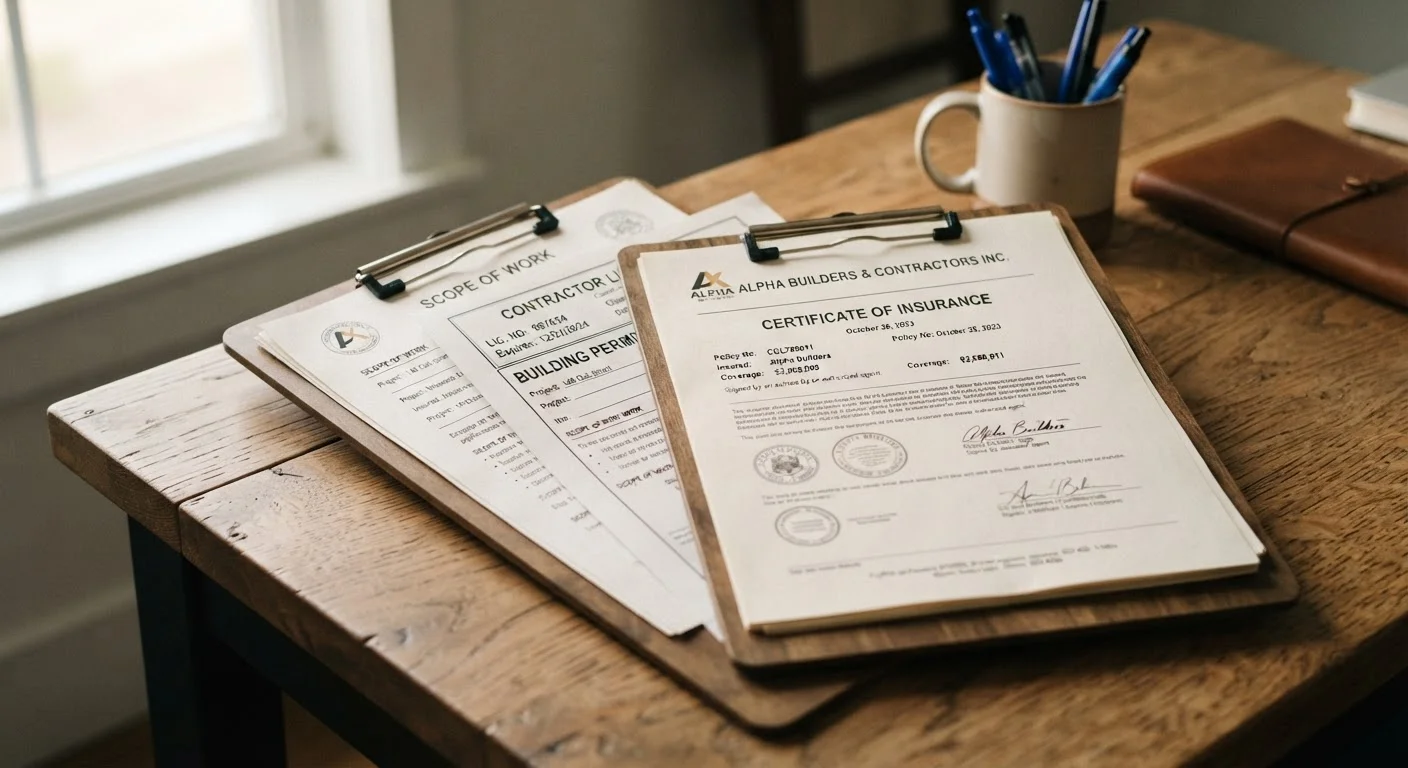
A one-page document issued by an insurer that summarizes a contractor's current coverage, policy limits, and expiration dates. Always request one before work begins.
License Verification
The process of confirming a contractor's license number is valid, active, and in good standing through your state's contractor licensing board or online database.
Licensed: Legal Authority to Do the Work
A contractor's license is permission granted by a government body — usually a state or municipal licensing board — to perform a particular trade. For roofing, it typically means the contractor has passed a test, demonstrated experience, and agreed to follow local building codes.
Licensing Rules Differ Significantly by State
Some states require roofers to hold a statewide license; others leave it to counties or cities; a few have no roofing-specific license requirement at all. Always check with your local or state contractor licensing board to understand what applies in your area. Our companion article on what a roofing contractor's license actually means walks through how to look this up by state.
A license does not guarantee quality workmanship. It does, however, create accountability: licensed contractors can have their license suspended or revoked for violations, which gives them a strong incentive to operate professionally. Always ask for a contractor's license number and verify it yourself on your state licensing board's website before any work begins. See our article on what a roofing contractor's license actually means for a step-by-step verification guide.
Bonded: A Financial Safety Net If the Job Goes Wrong
A surety bond is a form of financial guarantee. When a contractor is bonded, a third-party bonding company has agreed to compensate you — up to the bond's limit — if the contractor fails to complete the job, abandons the project, or causes financial harm such as failing to pay suppliers (which could result in a lien being placed on your home).
| Who issues contractor licenses | State or local licensing boards (varies by state) |
| Typical general liability coverage minimum | $1 million per occurrence (industry standard recommendation) |
| What a surety bond covers | Unfinished work, contract defaults, or unpaid suppliers |
| States with no statewide roofing license | Several, including Texas and Colorado — local rules may apply |
| How to verify a license | Your state's contractor licensing board website |
| Documents to request before signing | Certificate of Insurance, license number, and bond documentation |
Bonds are not the same as insurance. They protect you against the contractor not doing what they promised, rather than against accidents. Always ask for bond documentation, not just the contractor's word. If a contractor goes out of business mid-project, a valid surety bond can be one of your few avenues for recovering money already paid.
Insured: Protection When Accidents Happen on Your Property
Insurance is the most immediately important of the three because roofing work carries real physical risk — workers at height, heavy materials, and equipment near your home. There are two distinct policies to ask about:
- General liability insurance covers damage the contractor causes to your property. If a worker drops a tool through your skylight or a ladder gouges your siding, this policy pays for repairs rather than leaving you to fight for compensation out of pocket.
- Workers' compensation insurance covers injuries to workers on your property. Without it, an injured crew member could potentially make a claim against your homeowner's insurance — or even file a lawsuit. Many homeowners are unaware this risk exists.
Always request a certificate of insurance — not just a verbal confirmation — and check that the coverage is current. Policies can lapse. A contractor who was insured last year may not be insured today. For more on the paper trail that protects you, see our guide to roofing contracts explained.
What to Do Before Hiring Any Roofer
Verifying all three credentials takes less than 30 minutes and can prevent months of legal or financial trouble. Here is a simple checklist to follow:
- Ask for the contractor's license number and verify it on your state board's website.
- Request a certificate of insurance showing both general liability and workers' compensation coverage, with current dates.
- Ask for bond documentation and confirm the bond amount is adequate for a project of your size.
- If subcontractors will be used, ask whether they carry their own coverage — read more in our article on subcontractors on your roof.
- Get all of this in writing before signing a contract.
Being licensed, bonded, and insured represents a minimum baseline — not a guarantee of a great experience. But a contractor who cannot or will not provide verification of all three is a contractor worth walking away from. Pair these checks with a solid written agreement and you will be in a far stronger position from the start. If you are still learning the language of roofing estimates, our article on roofing terms every homeowner should know is a useful next step.