

Key Takeaways
Option A
Full-Frame Replacement
The comprehensive, start-from-scratch approach.
Best for: Homes with damaged frames, rotted sills, outdated rough openings, or where the homeowner wants to change window size or style.
Option B
Insert Window Replacement
The less invasive, lower-disruption option.
Best for: Homes with structurally sound existing frames where only the glass unit and sash need updating.
If your existing window frames are structurally sound and you want to minimize cost and disruption
Insert Window Replacement
Insert windows preserve intact frames, reduce labor hours, and avoid the interior and exterior finishing work that drives up full-frame costs.
If your frames show signs of rot, moisture damage, or deterioration
Full-Frame Replacement
Installing over damaged frames traps hidden problems and can lead to far more expensive repairs later. A full replacement addresses root causes.
If you want to change the size, shape, or style of a window opening
Full-Frame Replacement
Only a full-frame job allows modification of the rough opening, making it the only viable choice when reconfiguring a window's dimensions.
If your home has older construction with non-standard or settled openings
Full-Frame Replacement
Older openings are more likely to be out of square or sized inconsistently, making custom full-frame installations a more reliable long-term solution.
What Each Method Actually Involves
The price difference between full-frame and insert window replacement comes down to scope of work. Understanding what each method entails makes the cost gap easier to interpret.
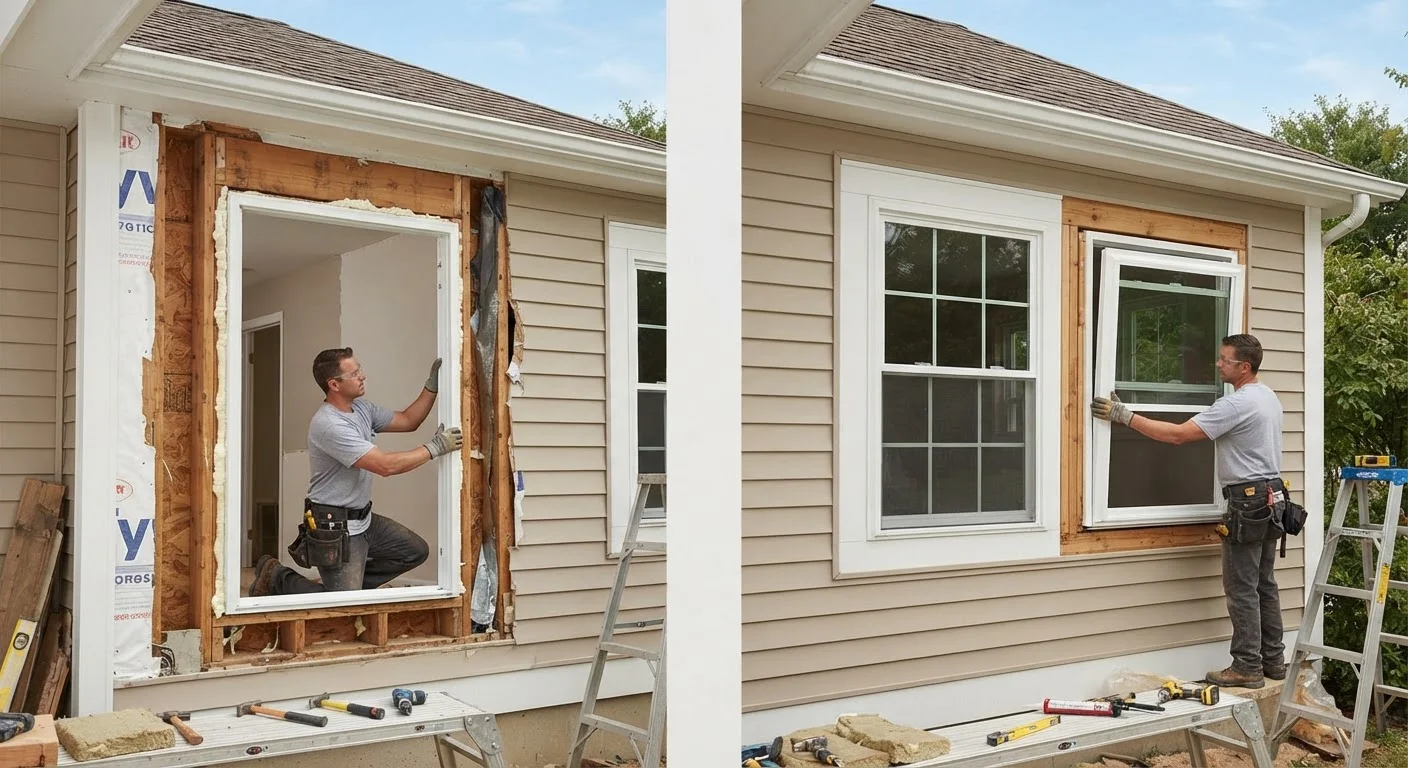
Full-frame replacement removes everything — the window unit, the existing frame, the interior casing, and the exterior trim — down to the rough opening in the wall. The installer then fits an entirely new window assembly, re-flashes the opening for weather resistance, and refinishes both the interior and exterior surrounds. This is essentially rebuilding the window from scratch.
Insert window replacement (also called a pocket replacement) works within the existing frame. The old sash and glass unit are removed, but the frame, sill, and exterior casing stay in place. A pre-sized insert unit is fitted into the existing opening and secured. With no demolition or refinishing required, the labor time is substantially shorter.
The practical consequence: insert installations typically take two to four hours per window, while full-frame jobs can take a full day or more per opening, depending on finishing complexity. Labor is priced by time, so that difference matters.
| Criterion | Full-Frame Replacement | Insert Window Replacement |
|---|---|---|
| Scope of work | Removes frame, casing, and trim entirely | Retains existing frame and casing |
| Typical labor time per window | Full day or more | Two to four hours |
| Exterior finishing required | Yes — siding patching or re-casing | Minimal to none |
| Interior finishing required | Yes — trim and drywall repair | Minimal to none |
| Permit likelihood | More commonly required | Often below permit threshold |
| Can change window size | Yes | No |
| Addresses frame damage | Yes | No |
| Glass area retained | Full original size | Slightly reduced |
| Relative cost per window | Higher | Lower (when frames are sound) |
What Drives the Cost Gap
Several factors explain why full-frame replacements consistently come in higher than inserts on a per-window basis.
Labor and Finishing Work
Full-frame jobs require removing and disposing of old materials, re-flashing and sealing the rough opening, and refinishing both interior trim and exterior cladding. Depending on your home's siding type — vinyl, wood, stucco, or brick — exterior patching after a full-frame removal ranges from straightforward to quite involved. Interior drywall or plaster repair adds further time and cost.
Permits and Inspections
Full-frame replacements more frequently trigger local permit requirements, particularly when the rough opening is altered. Permit fees vary significantly by municipality, but even modest fees add to the project total. Inspections may also require scheduling, which can extend the overall timeline. Insert replacements, which make no structural changes, often fall below the threshold that requires a permit — though you should always confirm requirements with your local building department before work begins.
Hidden Damage Discovered Mid-Job
When frames are removed, contractors frequently find rot, mold, or pest damage in the surrounding framing that was invisible beforehand. Repairing that damage is necessary before installing the new window, and those repairs carry their own labor and material costs. Our article on hidden costs that can raise a window replacement bill covers this in detail.
Glass Area Reduction With Inserts
One cost-related trade-off specific to insert windows: because the insert unit sits inside the existing frame rather than filling the rough opening, the visible glass area is slightly smaller than the original window. For some homeowners this is a minor concern; for others — particularly in rooms where natural light matters — it influences the decision.
For a broader view of what shapes overall project pricing, see our realistic starting point for window replacement costs.
When the Lower-Cost Option Isn't Actually Cheaper
Insert windows appear to offer clear savings, and they often do — but the calculation changes when the existing frames are compromised. Installing a new insert into a frame with hidden moisture damage or structural deterioration essentially locks that damage inside the wall. Within a few years, what looked like a cost-effective decision may require the full-frame job anyway, along with additional rot remediation.
Before assuming an insert replacement is appropriate, ask any contractor you consult to assess the frame condition explicitly. A professional evaluation should include checking the sill for soft spots, inspecting the surrounding framing for moisture damage, and confirming the opening is still square. If there's any ambiguity, a short-term savings on labor isn't worth the long-term risk.
Permits Vary by Location — Always Verify
Whether a window replacement requires a permit depends on your local building code, and rules differ significantly between municipalities. Some jurisdictions require permits for any window work; others only require them when the opening is structurally altered. Never assume a permit isn't needed — always confirm with your local building department before work begins. Working without a required permit can create complications when you sell your home.
Frame material also influences long-term performance regardless of which installation method you choose. Our guide to window frame materials and replacement budget explains how material choices interact with cost.
If you're weighing whether to replace one window or many at once — which affects per-unit cost for both methods — the replacing one window vs. replacing all guide walks through that trade-off.