

Key Takeaways
Why Lighting and Contrast Matter More Than You Might Think
When homeowners think about bathroom safety, grab bars and non-slip flooring tend to get the most attention — and rightly so. But two factors that get far less discussion are lighting and colour contrast, and both have a meaningful impact on fall risk and everyday confidence in the bathroom.
Vision changes gradually as we age. The eye's lens yellows slightly, pupil response slows, and the ability to distinguish similar shades or adjust quickly from dark to bright spaces decreases. These changes can make a poorly lit or visually flat bathroom genuinely difficult to navigate — even for someone with no diagnosed vision condition. Understanding what accessible bathroom design really involves, including these sensory factors, is a helpful starting point. Our article on what an accessible bathroom actually means covers the full picture.
The good news: targeted upgrades to lighting and contrast are often among the more affordable and less disruptive changes you can make. Below are the most impactful strategies to consider.
Increase Overall Brightness — But Avoid Harsh Glare
Many bathrooms are lit by a single overhead fixture that creates uneven brightness — bright at the centre, shadowy at the edges near the toilet or shower entry. Older eyes need more light overall, but excessively bright or poorly positioned lights can create glare, which is itself a hazard.
Look for fixtures that diffuse light broadly rather than directing it in a single beam. Replacing low-wattage bulbs with higher-lumen options (without simply increasing wattage beyond what a fixture is rated for) is a straightforward first step. Aim for warm-white light in the 2700–3000K colour temperature range, which tends to be easier on aging eyes than cooler, bluish tones.
A single dim overhead fixture is one of the easiest bathroom safety problems to fix.
Add Task Lighting at Key Use Points
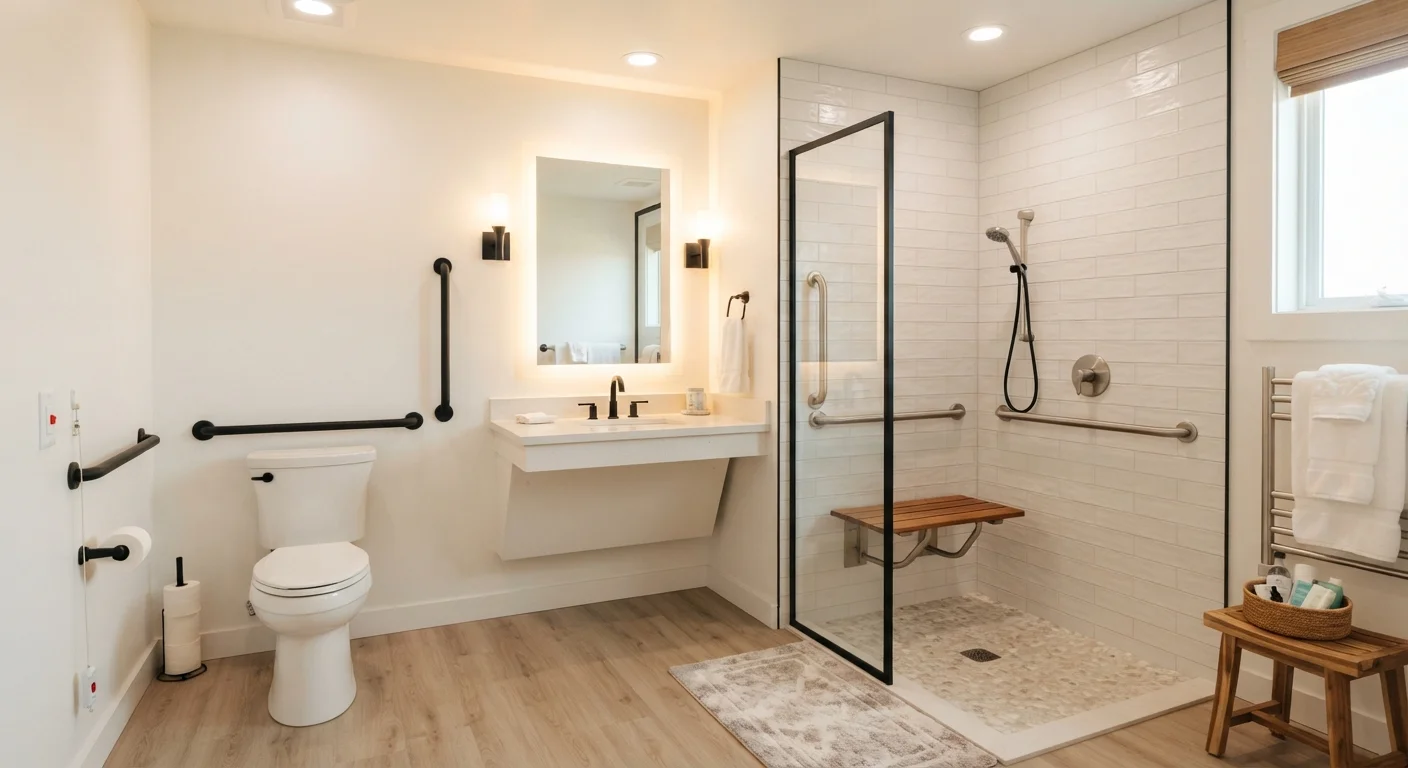
Task lighting targets specific areas where close work happens — the vanity mirror being the most obvious. Side-mounted vanity lights at roughly face height reduce the shadows that an overhead-only setup creates, making it much easier to see clearly for grooming and medication management.
Beyond the vanity, consider lighting near the shower entry and beside the toilet. These are the zones where most bathroom falls occur, and they're often the areas with the worst natural shadow coverage from a standard ceiling fixture.
Task lighting at face height near the vanity dramatically reduces shadows and improves visibility.
Install Motion-Activated Night Lighting
Nighttime bathroom trips are a leading context for falls, particularly because eyes adjust slowly from a dark bedroom to a suddenly bright bathroom. Motion-activated night lights that activate automatically at low brightness allow the eyes to adjust gradually while still providing enough light to navigate safely.
These can be plug-in units placed at floor level, or hardwired low-profile fixtures installed by an electrician. The goal is a clear, unobstructed path of visibility from the bedroom doorway to the toilet — without needing to turn on a bright overhead light that causes temporary visual disruption.
Nighttime falls often happen during the transition from darkness to bright light — gradual lighting helps.
Use Colour Contrast to Define Edges and Surfaces
Colour contrast — the visual difference between adjacent surfaces — helps the brain quickly identify where one surface ends and another begins. In a bathroom where the floor, wall, toilet, and tub surround are all similar shades (a common feature of all-white or all-beige bathrooms), edges become difficult to judge, especially for someone with reduced contrast sensitivity.
Practical applications include: a toilet seat in a colour that contrasts with the toilet base and floor; grab bars in a finish that stands out from the wall tile; a coloured or textured bath mat that defines the area in front of the shower. These don't require a full renovation — many can be implemented as simple product swaps. Our plain-language glossary of accessibility features explains more of these concepts in straightforward terms.
All-white bathrooms can be visually confusing for aging eyes — contrast helps define edges clearly.
Highlight Transition Zones Between Flooring Surfaces
Where flooring transitions between the bathroom and an adjacent hallway or bedroom, a slight change in material or colour can serve as a visual cue that the surface underfoot is changing. Unexpected surface changes are a fall risk, particularly if someone is moving quickly or in low light.
A contrasting threshold strip or a change in tile pattern near the doorway isn't just decorative — it functions as a built-in warning marker. This pairs well with broader flooring safety improvements; our article on choosing the right bathroom flooring covers material selection in more detail.
A contrasting threshold strip at the bathroom doorway functions as a built-in visual warning marker.
Consider Switch and Control Placement and Visibility
Light switches located in hard-to-see positions, or rocker switches that blend into the wall plate, can make it difficult to turn lights on before entering a dark bathroom. Illuminated switches — those with a small built-in light that glows when the switch is off — solve this problem at very low cost.
Similarly, thermostatic shower controls and faucet handles benefit from high-contrast markings or lever-style designs that are easier to identify and operate than small knobs against a matching wall tile. These details are easy to overlook in a standard renovation plan but can significantly affect daily ease of use. See the walk-in shower planning hub for more on control placement in accessible shower designs.
Illuminated light switches are a low-cost fix that makes navigating a dark bathroom much safer.
Putting It All Together with a Contractor
Most of these changes are best assessed in person, because every bathroom has a different layout, window placement, and existing fixture situation. A contractor experienced in accessibility renovations can identify where shadows fall, where colour contrast falls short, and which lighting upgrades will have the most impact for your specific space.
If you're already planning other bathroom changes — such as new flooring or a walk-in shower — it's worth addressing lighting and contrast at the same time. Our guide on safety features to ask your contractor about can help you frame those conversations. And if space is a concern, small bathroom accessibility options explores what's realistic even in tighter rooms.
Ask About Lighting During Your Initial Walkthrough
When meeting with a contractor to discuss bathroom renovations, ask them to evaluate the existing lighting layout alongside any structural changes. Many accessibility-focused contractors will assess shadow patterns, switch placement, and contrast as part of a broader safety review. Addressing lighting at the same time as other renovations is usually more cost-effective than returning to it separately later.
This article is for general informational purposes only. Specific recommendations should be assessed by a qualified contractor familiar with your home and local building requirements.