

| Most visible failure sign | Water overflowing during or after rainfall |
| Common physical failure | Sagging or separation from the fascia board |
| Sign of long-term neglect | Plant or moss growth on guard surface |
| Material deterioration | Rust on metal mesh; cracking or warping on plastic guards |
| Downstream damage indicator | Water stains on fascia board or soil erosion near foundation |
| Recommended inspection method (ground level) | Binoculars or smartphone camera zoom during or after rain |
Why Gutter Guard Failures Matter
Gutter guards are designed to reduce the debris that enters your gutters and to keep water flowing away from your home's foundation, siding, and roof line. When they stop working properly, the consequences can range from cosmetic nuisances to serious structural damage. The challenge is that many failure signs develop slowly and are easy to overlook, especially if you rarely inspect your roof level.
Knowing what to look for — without climbing a ladder unsafely — puts you in a much stronger position to act early. Most of the warning signs described below can be spotted from the ground, from an upstairs window, or with the help of a professional. See our year-round maintenance overview for a broader look at what routine upkeep involves.
| Most visible failure sign | Water overflowing during or after rainfall |
| Common physical failure | Sagging or separation from the fascia board |
| Sign of long-term neglect | Plant or moss growth on guard surface |
| Material deterioration | Rust on metal mesh; cracking or warping on plastic guards |
| Downstream damage indicator | Water stains on fascia board or soil erosion near foundation |
| Recommended inspection method (ground level) | Binoculars or smartphone camera zoom during or after rain |
The Most Common Warning Signs
Water Overflowing During or After Rain
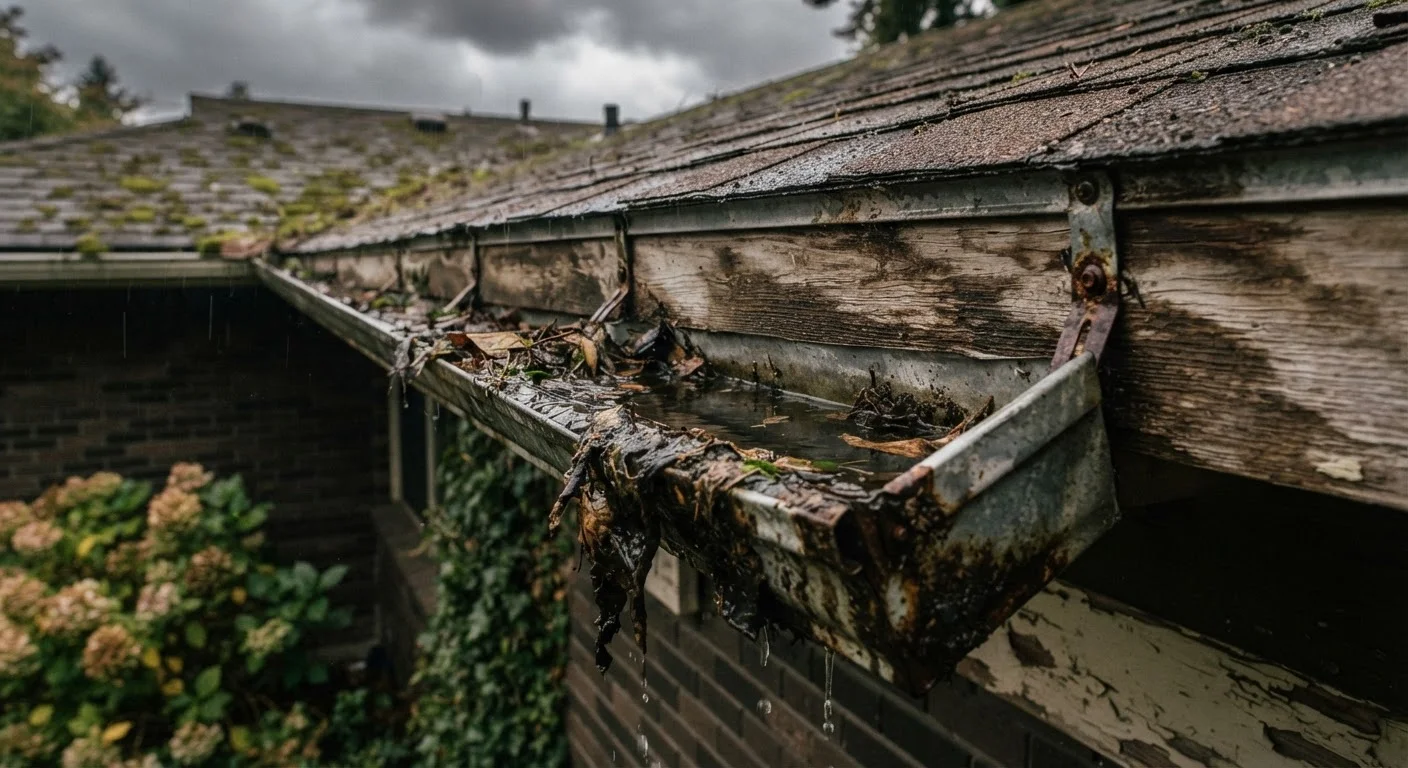
If water spills over the front edge of your gutters during a moderate or heavy rain, something is blocking the channel or the guard surface itself. This is one of the most visible and frequent failure indicators. Surface tension designs — such as reverse-curve guards — are particularly prone to sheeting water over the edge rather than directing it in. Learn more about why overflow happens and what to do.
Debris Accumulating on Top of Guards
Gutter guards don't eliminate debris — they're meant to stop it from settling inside the gutter channel. When leaves, seed pods, pine needles, or shingle grit pile up on the guard surface itself, water cannot pass through efficiently. Fine debris, algae, and shingle grit are especially problematic because they compact over time and are harder to spot from the ground.
Sagging or Pulling Away from the Roofline
Physical deformation — guards visibly bowing, pulling away from the fascia, or sitting unevenly — signals that installation fasteners have failed or that weight (ice, heavy debris, or standing water) has exceeded the guard's structural capacity. A sagging gutter guard often means the gutter itself is also sagging underneath it.
Visible Rust, Cracking, or Discoloration
Metal mesh guards can rust. Plastic or foam guards can become brittle, crack, or warp after years of UV exposure. Discoloration, particularly green or black streaking, may indicate algae growth that is also blocking water flow.
Water Stains or Damage Along the Fascia or Foundation
If you notice peeling paint, soft wood, or watermarks along the fascia board behind the gutter — or soil erosion and moisture near your foundation — those are downstream effects of chronic overflow. The gutter guard may have been failing unnoticed for some time.
Plant Growth Inside or on Top of Guards
Seedlings or moss establishing themselves on or inside the guard surface indicate that organic material has been sitting long enough to decompose and host growth. This level of buildup points to a system that has been underperforming for at least one full growing season.
What To Do When You Spot These Signs
Not every failure sign calls for a full replacement. Some issues — surface debris, minor misalignment — may be addressable with cleaning and minor adjustment. Others, such as structural sagging, rusted sections, or recurring overflow tied to an incompatible guard style, may point to a deeper mismatch between your guard type and your roof's conditions. Understanding the different guard styles can help you evaluate whether your current system suits your home's needs.
For homeowners aged 50 and older, or those with multi-story homes, the safest approach is to document warning signs from ground level — using binoculars or a smartphone camera with zoom — and share those observations with a qualified contractor. Roof-level work carries real fall risk. Our article on when to call a professional for gutter guard maintenance outlines specific situations where DIY is not the right choice. Additionally, review common decisions that lead to costly problems to understand whether a previous installation choice may be contributing to current failures.
This article is for general informational purposes only. Gutter and roofline work involves fall hazards; always consult a licensed contractor before undertaking any inspection or repair at height. Local building codes vary — verify requirements with your municipality.