

Key Takeaways
Hidden Gutter Guard Cloggers
Hidden gutter guard cloggers are the small, often invisible particles — including fine dust and seed particles, algae growth, and shingle granules — that bypass or accumulate on gutter guards over time. Unlike large leaves that sit visibly on top of a guard, these materials work their way into seams, pores, and surfaces gradually. Left unaddressed, they can restrict water flow just as effectively as a gutter full of leaves.
Micro-fine debris as small as 30–50 microns can penetrate or bridge across fine-mesh gutter guard openings, forming a compacted layer that reduces drainage capacity without being immediately visible from ground level.
Why Gutter Guards Don't Stop Everything
Gutter guards are designed to keep large debris — whole leaves, twigs, and seed pods — out of your gutters. Most do this job reasonably well. What they are not designed to block completely is the category of ultra-fine, lightweight, or biologically active debris that arrives slowly and builds up quietly over months or years.
Understanding what these materials are, where they come from, and how they behave on different guard surfaces is the foundation of a realistic maintenance plan. As we explain in why gutter guards still need cleaning, even well-performing guards accumulate material that requires periodic attention.
Not All Debris Behaves the Same Way
Large leaves and twigs are the debris most homeowners picture when they think about gutter guard problems. But fine organic particles, shingle grit, and algae operate on a different scale and timeline — accumulating slowly and often invisibly. Understanding these distinct debris types helps you know what to look for during inspections, not just what to remove.
Fine Organic Debris: Pollen, Seed Fluff, and Decomposed Matter
Every spring, trees release enormous quantities of pollen and seed-bearing fluff — cottonwood, maple samaras, pine pollen, and more. These particles are light enough to drift through the air and settle onto any horizontal surface, including gutter guard tops. On their own, they wash away with rain. The problem arises when they accumulate in layers and begin to bind together with moisture and decaying organic matter.
Over time, layered fine debris can compact into a felt-like mat directly on top of a mesh or perforated guard. This mat does not look alarming from the ground, but it can dramatically slow the rate at which rainwater passes through the guard surface. The difference between perforated and mesh guard filtration is especially relevant here — finer mesh captures more large debris but can also trap compacted fine particles more readily.
Foam and brush-style guards are particularly susceptible because their interiors provide surfaces where fine material lodges directly, rather than resting on top where rain might dislodge it.
Shingle Grit: An Often Overlooked Source of Buildup
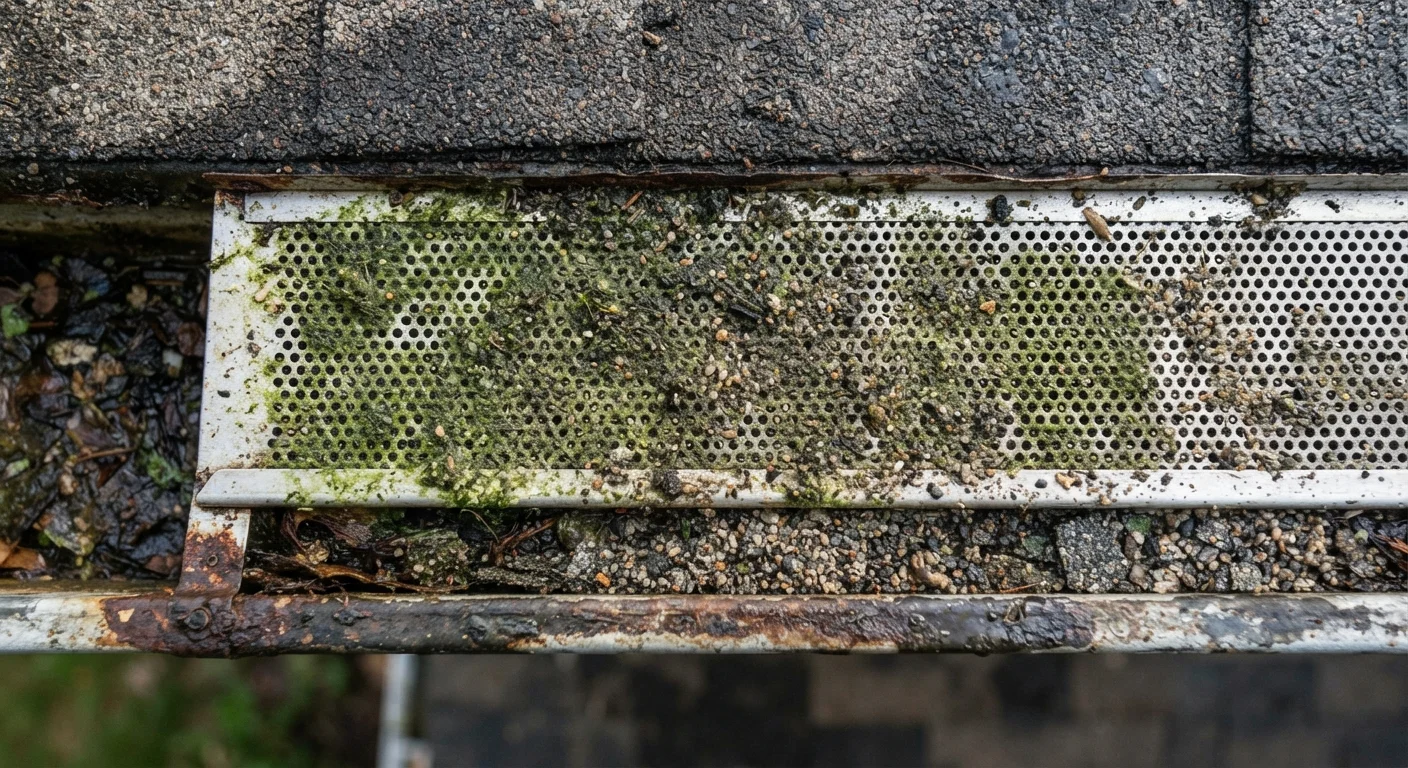
Asphalt shingles are coated with mineral granules — typically crushed stone or ceramic-coated material — that protect the underlying asphalt from ultraviolet degradation and physical weathering. As a roof ages, these granules gradually loosen and shed, especially during heavy rain or hail events. They wash down the roof slope and collect wherever water slows: at the eave, inside gutters, and on top of gutter guards.
Shingle grit is heavier than organic debris, so it tends to settle and stay. Inside a gutter trough, accumulated grit can raise the floor level enough to reduce effective water storage and drainage capacity. On top of a gutter guard, grit fills in the gaps between mesh openings over time. Homes with roofs older than 15 years tend to shed noticeably more granules, making this a growing concern as your roof ages.
If you notice a sandpaper-like surface when you run your hand along a gutter guard, or sandy residue collecting in your downspout splash blocks, shingle grit accumulation is likely already underway. Monitoring your roof's condition is a useful parallel habit — see what gutter guard installation costs if aging shingles are prompting you to consider a full system update.
Algae and Moss: The Biological Cloggers
Algae and moss are not just cosmetic issues. Both organisms require moisture and organic material to establish themselves, and gutter guards — particularly shaded sections that stay damp — provide exactly those conditions. Once established, algae forms a thin biofilm across guard surfaces that acts as a net, catching additional fine particles and holding them in place.
Moss goes further, sending small root-like structures (called rhizoids) into porous surfaces. On foam guards, moss can penetrate deeply and is difficult to remove without damaging the insert. On metal mesh guards, algae can hold moisture against the surface long enough to initiate corrosion in lower-quality materials.
The maintenance needs of different guard materials vary significantly when biological growth is involved — foam requires more frequent inspection in shaded environments, while metal mesh benefits from periodic gentle rinsing to prevent biofilm establishment.
What This Means for Your Maintenance Routine
Recognizing these three categories of hidden cloggers — fine organic debris, shingle grit, and biological growth — changes how you think about gutter guard upkeep. Rather than waiting for visible overflow or obvious blockage, a proactive approach involves looking for early signs: discoloration on guard surfaces, reduced water flow from downspouts during rain, or sandy deposits at ground level.
A year-round gutter guard maintenance overview can help you build inspection into your seasonal home care habits. The timing of checks matters: late spring captures pollen and seed debris; late autumn addresses leaf matter and prepares your system for winter. If your home is surrounded by heavy tree cover, choosing the right guard for high-debris environments is worth reviewing before any maintenance update.
Because working at height carries real safety risks, any hands-on cleaning beyond ground-level inspection should be performed by a qualified professional, or with appropriate safety equipment and a second person present. Signs your guards are failing can help you decide when a professional assessment is warranted.
This article is for informational purposes only. Consult a licensed roofing or gutter professional before undertaking any work on your home's exterior. Always verify local building codes and safety requirements.