

Key Takeaways
Option A
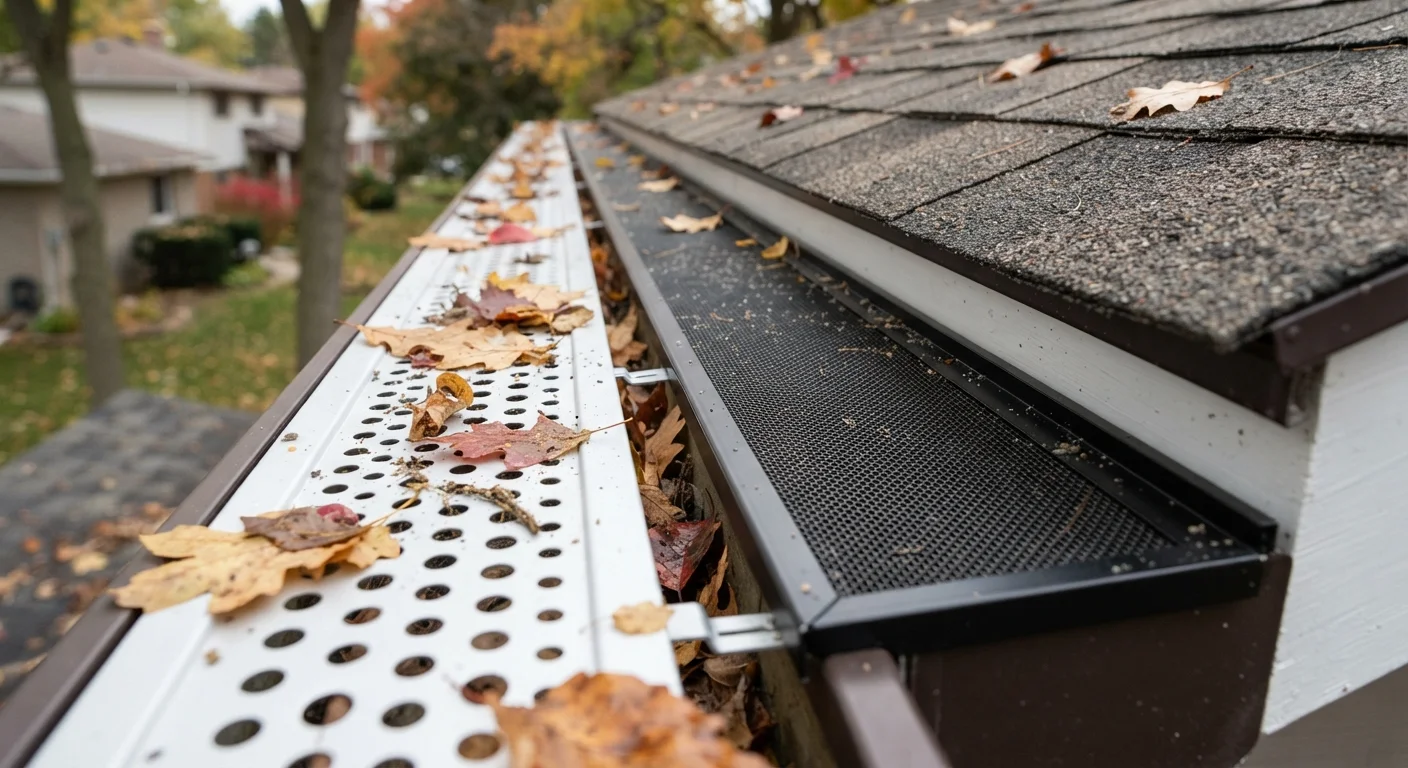
Perforated Cover
The straightforward, budget-friendly barrier.
Best for: Homes surrounded by large leaves where fine debris filtration is less of a priority.
Option B
Mesh Gutter Guard
The finer-filtration, higher-performance screen.
Best for: Homes with mixed tree cover where pine needles, seed pods, and shingle grit are ongoing concerns.
If large leaves are your primary debris problem
Perforated Cover
Perforated covers handle large leaf debris effectively and at a lower cost. They're a reasonable fit if fine particles aren't a recurring issue in your gutters.
If you have pine trees, maples, or heavy mixed tree cover nearby
Mesh Gutter Guard
Mesh guards filter out pine needles, seed pods, and smaller debris that perforated covers let through, reducing interior clogging from finer material.
If you want to minimize future cleaning frequency
Mesh Gutter Guard
The tighter mesh opening keeps more debris types out of the gutter channel, which can extend time between professional cleanings — though some maintenance is still needed.
If upfront installation cost is your main concern
Perforated Cover
Perforated covers are generally less expensive per linear foot than mesh guards, making them a lower-barrier entry into gutter protection.
How Each Guard Type Works
Both perforated covers and mesh gutter guards are placed over the open top of your gutters to prevent debris from entering the channel. That's where the similarity largely ends.
Perforated covers are solid panels — usually made from aluminum or plastic — with a series of punched holes (perforations) across their surface. Water flows in through those holes while debris theoretically slides off the edge. The holes are typically several millimeters in diameter, which means they're effective against large, flat leaves but less capable of stopping smaller particles.
Mesh gutter guards use a woven or stamped grid of much finer openings, often made from stainless steel or aluminum. Water passes through the mesh by surface tension and gravity, while a wider range of debris — including pine needles, small seed pods, and some shingle granules — is caught on top and expected to blow or wash away. For a closer look at how fine debris behaves on both types, see how fine debris and shingle grit interact with gutter guards.
Filtration Performance: What Each Type Actually Stops
The size of the openings in a gutter guard is the single most important factor in filtration performance. Perforated covers have openings large enough that pine needles can either fall through vertically or wash into the channel during heavy rain. Shingle grit — tiny granules that shed from asphalt shingles over time — passes through nearly every perforated cover on the market.
Mesh guards, particularly micro-mesh variants with openings under 400 microns, stop significantly more of this fine debris at the surface level. However, this creates a different challenge: the mesh surface itself can become coated with debris, algae, or shingle grit over time, gradually reducing water flow into the gutter. Standard mesh and micro-mesh guards differ meaningfully in how they handle this buildup.
| Criterion | Perforated Cover | Mesh Gutter Guard |
|---|---|---|
| Opening size | Several millimeters (large) | Sub-millimeter to fine micro-mesh |
| Large leaf blocking | Effective | Effective |
| Pine needle blocking | Limited — many pass through | Good to excellent (fine mesh) |
| Shingle grit blocking | Poor — grit passes through | Better — most grit caught on surface |
| Typical material | Aluminum or plastic | Stainless steel or aluminum mesh |
| Relative upfront cost | Lower | Higher |
| Heavy rain performance | Fast water entry through holes | May slow during intense downpours |
| Where maintenance occurs | Inside the gutter channel | On the mesh surface and channel |
Neither guard type is maintenance-free. Perforated covers may require periodic flushing of interior buildup, while mesh surfaces need occasional brushing or rinsing to clear the screen itself.
Cost Differences and What to Expect
Perforated covers are generally the less expensive option, both in material cost and installation labor. Their simpler construction — a solid panel with punched holes — translates to lower manufacturing costs, which is usually reflected in the price homeowners pay per linear foot.
Mesh gutter guards, especially those made from stainless steel with fine mesh openings, carry a higher upfront cost. The trade-off is potentially longer intervals between gutter cleanings if the mesh performs as expected for your specific debris load. For a detailed breakdown of how guard materials affect pricing, see how different gutter guard types compare on cost.
When calculating long-term value, factor in your local tree environment. A perforated cover in a yard dominated by large oak leaves may outperform a mesh guard on cost-effectiveness. The same perforated cover beside a stand of pine trees may lead to frequent interior clogs that offset any savings.
Choosing Based on Your Yard and Climate
Your yard's tree types matter more than almost any other variable when choosing between these two guard styles. Large deciduous trees — oaks, maples, sycamores — produce debris that perforated covers can often handle adequately. Evergreens, sweetgum trees, and helicopter-seed maples produce smaller, needle-like, or winged debris that tends to pass through perforated openings.
Climate also plays a role. In regions with heavy rainfall, a mesh guard's surface tension-based drainage can slow during intense downpours, potentially causing water to overshoot the gutter entirely. Perforated covers with larger openings may allow faster water entry during high-volume rain events, though they sacrifice filtration in exchange.
If your yard has significant tree cover of any type, this guide to choosing a gutter guard in high-debris environments covers the considerations in more detail.
Maintenance Expectations After Installation
Homeowners sometimes assume that installing any gutter guard means their gutters are fully self-maintaining. In practice, both perforated covers and mesh guards reduce — but do not eliminate — the need for periodic attention.
Perforated covers that allow fine debris through will eventually require the interior gutter channel to be flushed or cleaned. Mesh guards that accumulate debris on their surface will need that surface cleared to maintain proper water flow. The frequency depends heavily on how many trees surround the home and what types they are.
For a practical overview of what maintenance looks like across guard types over time, this maintenance guide covers mesh, foam, reverse curve, and more.
This article provides general educational information about gutter guard types and is not a substitute for a professional assessment of your specific home and local conditions. Costs, performance, and maintenance needs vary by installation, climate, and debris environment. Consult a licensed contractor for guidance tailored to your situation.