

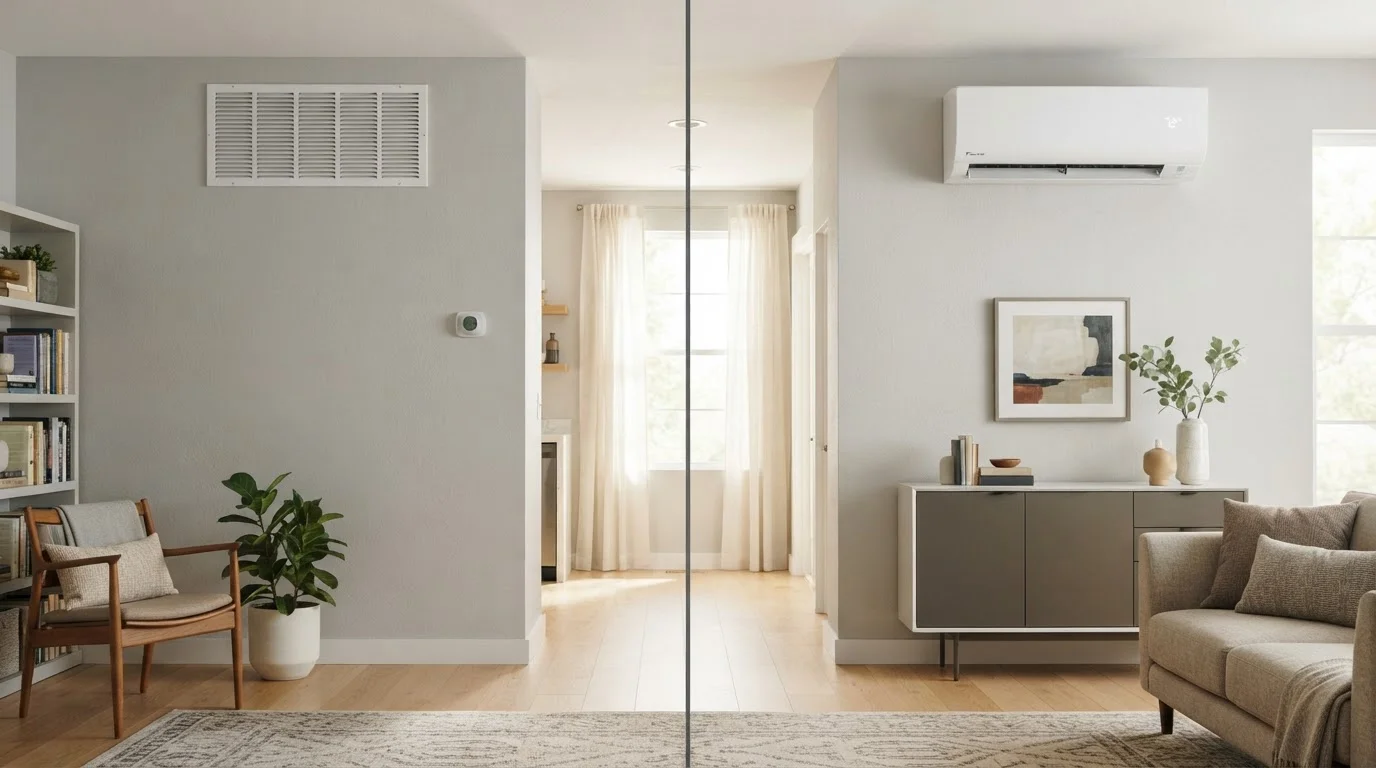
Key Takeaways
Option A
Central Air Conditioning
The whole-home workhorse with familiar technology.
Best for: Homes with existing ductwork that need consistent, uniform cooling across every room.
Option B
Ductless Mini-Split
The flexible, room-targeted alternative without ductwork.
Best for: Homes without ducts, additions, or homeowners who want independent room-by-room temperature control.
If your home already has ductwork in good condition
Central Air Conditioning
Leveraging existing ducts keeps installation costs lower and lets central AC deliver consistent cooling throughout the home efficiently.
If you're cooling a room addition, garage conversion, or older home without ducts
Ductless Mini-Split
Mini-splits require only a small wall penetration, eliminating the cost and disruption of installing new ductwork.
If household members need different temperatures in different rooms
Ductless Mini-Split
Each indoor unit has its own thermostat, so occupants can set their preferred temperature zone independently.
If you want the lowest possible upfront installation cost for whole-home cooling
Central Air Conditioning
When ductwork is already present, a central AC system generally has a lower combined equipment and labor cost than a multi-zone mini-split setup.
If long-term energy efficiency is a top priority
Ductless Mini-Split
Mini-splits avoid duct energy losses — which can account for 20–30% of cooling energy in a typical system — and often carry higher SEER ratings.
How Each System Works
Before comparing costs or efficiency, it helps to understand what each system actually does inside your home. If you're new to home cooling, the beginner's guide to air conditioning explains the fundamentals in plain language.
Central air conditioning uses one outdoor unit (the condenser) paired with an indoor air handler. The air handler draws warm air from your home through return vents, cools it across a refrigerant coil, and pushes the conditioned air back through a network of ducts and supply vents into every room. One thermostat controls the whole system.
Ductless mini-splits skip the duct network entirely. An outdoor compressor connects via a refrigerant line through a small hole in the wall to one or more wall-mounted indoor units. Each indoor unit handles its own zone. Because there's no duct system, cooled air is delivered directly into the room — nothing is lost in transit through attic or wall cavities.
Side-by-Side Comparison
The table below captures the most meaningful practical differences between these two systems. Keep in mind that actual figures vary by home size, local climate, contractor, and specific equipment chosen.
| Criterion | Central Air Conditioning | Ductless Mini-Split |
|---|---|---|
| Requires ductwork | Yes — existing or new | No — refrigerant lines only |
| Typical upfront cost (whole home) | Lower if ducts exist | Higher for multi-zone setups |
| Common SEER range | 14–21 SEER | 18–30+ SEER |
| Zone control | Single thermostat (whole home) | Independent per indoor unit |
| Installation disruption | Moderate (low if ducts exist) | Low (small wall penetration) |
| Duct energy loss risk | Yes — 20–30% if ducts leak | None — no ducts |
| Best home type | Homes with existing forced-air systems | Older homes, additions, no-duct homes |
| Filter maintenance | Replace every 1–3 months | Washable; clean every few weeks |
For a deeper look at how central AC performs across different home types, see this balanced breakdown of central air's strengths and limitations.
Installation: What to Expect in Each Scenario
Central AC installation is relatively straightforward when a forced-air duct system already exists. A contractor connects the outdoor condenser to the indoor air handler and charges the refrigerant lines — often a one- or two-day job. If no ductwork exists, adding it is expensive and disruptive, easily adding thousands of dollars and weeks of work. To understand how ducts interact with your broader heating setup, this guide to forced-air and radiant heating provides useful context.
Mini-split installation requires mounting indoor units on walls or ceilings, running refrigerant and electrical lines through a small penetration (typically three inches in diameter) to the outdoor compressor, and commissioning each zone. A single-zone system can be installed in a day; multi-zone systems take longer. No ductwork means less structural disruption, which is a real advantage in finished spaces or historic homes.
Both systems involve refrigerant handling and electrical work that must be performed by a licensed HVAC professional. Do not attempt DIY installation of either system.
Energy Efficiency and Running Costs
Efficiency for air conditioners is measured by the SEER rating — the higher the number, the more efficiently the unit converts electricity into cooling. Mini-splits commonly achieve SEER ratings of 20 or higher; central AC systems typically range from 14 to 21 SEER depending on the model and installation quality.
However, a high-SEER central AC system can underperform in practice if its ductwork leaks. The U.S. Department of Energy estimates that leaky ducts can waste 20–30% of the energy used to cool a home. Mini-splits bypass this problem entirely by delivering air directly into the room. On the other hand, running multiple mini-split indoor units simultaneously across a large home can approach the energy use of a well-maintained central system.
If you're weighing other high-efficiency cooling technologies, this comparison of heat pumps and traditional air conditioners is worth reading alongside this article.
Maintenance and Long-Term Considerations
Both systems need annual professional servicing — refrigerant checks, coil cleaning, electrical inspections, and filter changes. Central AC also requires periodic duct inspection and sealing. Mini-split indoor units have washable filters that homeowners can clean every few weeks, which is straightforward and takes only minutes.
Repair complexity differs too. A central AC failure affects the whole house. A mini-split failure in one zone leaves other zones functional — a meaningful comfort advantage in multi-zone setups. For homeowners considering other room-level cooling options, this room-by-room cooling comparison covers window units and portables alongside mini-splits.
Average lifespans are broadly similar — roughly 15 to 20 years for both systems with proper maintenance — though this depends heavily on how well the system is maintained and the local climate.
This article is for informational and educational purposes only. Always consult a licensed HVAC contractor to evaluate your specific home before making any installation or replacement decisions. Verify local permit and code requirements with your contractor or local building authority.