

Key Takeaways
Why These Three Styles Deserve a Closer Look
When homeowners start replacing windows, the conversation almost always centers on the same few options: double-hung, casement, or sliding. Those styles are popular for good reasons — they're versatile, widely available, and familiar. But they don't solve every problem a home might present. If you have a narrow bathroom that needs ventilation, a basement that requires egress, or a screened porch in a warm climate that needs maximum airflow, you may find that the usual suspects fall short.
Awning, hopper, and jalousie windows each occupy a specific niche. They're not obscure novelties — they're purpose-built styles with real advantages in the right context. This article walks through what each style is, how it operates, and where it tends to perform best, so you can bring a better-informed perspective to your renovation planning.
If you're still building your overall window vocabulary, the window styles overview is a useful starting point before diving into specialty options.
Awning Windows: Ventilation Even When It's Raining
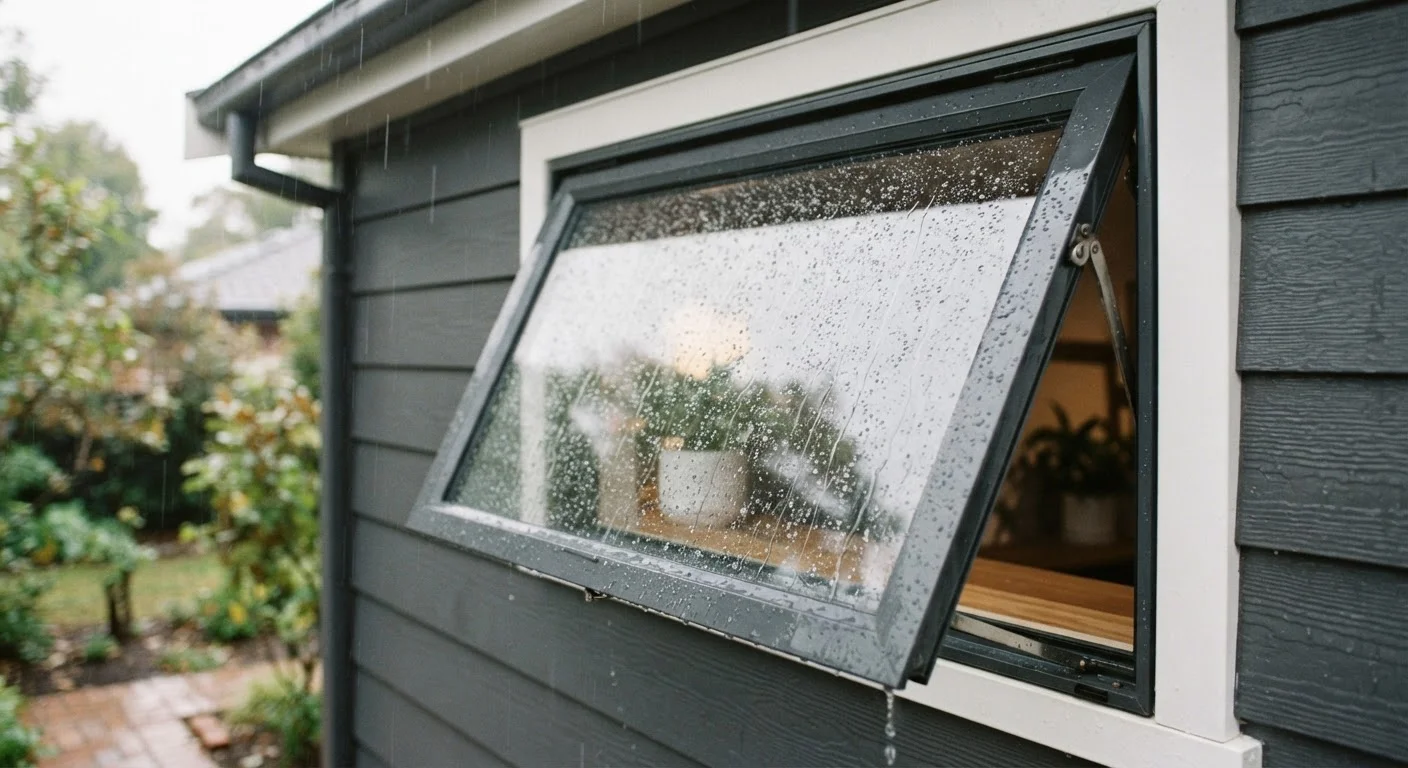
An awning window is hinged at the top and swings outward from the bottom, creating a canopy-like overhang when open. That single design detail has a significant practical consequence: the open sash acts as a shield, allowing air to flow into the room while deflecting rain away from the opening. You can leave an awning window open during a light shower without water entering the home.
This makes awning windows particularly well-suited to humid or rainy climates, and to rooms where ventilation matters but privacy is also a concern — bathrooms, for instance, or spaces where windows need to be positioned higher on the wall. Because they're often installed above eye level, they let in airflow and light without sacrificing privacy.
Awning windows seal tightly when closed, which generally translates to good energy performance. They're commonly paired with picture windows — the fixed pane provides the view, while the awning unit alongside it handles ventilation.
One limitation: because the sash swings outward, you need clear space on the exterior. They're not the right fit for walkways, patios with furniture placed directly beneath, or window wells.
Awning windows can stay open during light rain — a practical advantage in humid or frequently wet climates.
Hopper Windows: The Basement and Bathroom Specialist
A hopper window is essentially the inverse of an awning window. It's hinged at the bottom and tilts inward at the top, opening into the room rather than out. This inward tilt is what makes hopper windows particularly useful in spaces where exterior clearance is limited or nonexistent — most commonly basements and small half-bathrooms.
In a basement setting, hopper windows are often installed near the ceiling of the room, just above ground level on the exterior. The inward-opening design means the sash doesn't need any exterior swing room, which is critical when the window opening is partially below grade or surrounded by a window well. Many basement hopper windows are also sized to meet egress requirements — though egress compliance depends on specific opening dimensions set by local building codes, so confirm those requirements with your contractor or building department.
Hopper windows tend to seal well when closed, offering reasonable energy efficiency for their size. Cleaning is straightforward since the glass tilts inward for access. Their main constraint is size: hopper windows are typically narrow and horizontal, which limits where they work architecturally. They're a functional choice, not a statement piece.
Hopper windows tilt inward, making them the practical solution for basements and spaces with no exterior clearance.
Jalousie Windows: Maximum Airflow, Specific Climate Needs
Jalousie windows — sometimes called louvered windows — are made up of a series of horizontal glass, acrylic, or aluminum slats set in a frame. A crank or lever mechanism adjusts all the slats simultaneously, rotating them from nearly parallel with the wall (fully open) to flat against the frame (closed). When fully open, jalousie windows allow more airflow than almost any other window type.
That ventilation advantage is the reason jalousie windows remain popular in tropical and subtropical climates — Florida, Hawaii, the Gulf Coast — and in screened porches and lanais across the South. In a consistently warm climate where year-round airflow is the priority and air conditioning supplemented by passive ventilation is standard practice, jalousie windows make considerable sense.
The trade-off is insulation. Even when the slats are closed, jalousie windows have multiple gaps and seams where air can infiltrate. They perform poorly in cold climates and are generally not a sound energy choice where heating costs are significant. They're also more vulnerable to breakage — individual slats can crack or come loose — and replacement can be more involved than swapping a standard sash.
If you're comparing ventilation-focused styles, it's worth reviewing sliding vs. casement windows as a baseline, since those two options cover most temperate-climate ventilation needs before jalousie becomes relevant.
Jalousie windows offer unmatched airflow but perform poorly in cold climates due to gaps between slats.
Choosing the Right Fit for Your Home
None of these three styles is a universal replacement for the more common options — and that's precisely the point. Each one is a targeted solution. An awning window won't look right on every façade, and jalousie slats aren't appropriate for a climate with freezing winters. The key is matching the window's functional strengths to a specific location, climate condition, or spatial constraint in your home.
Architecture also matters. Matching window style to your home's architecture explains how different window profiles interact with different exterior styles — a consideration that becomes especially important when you're introducing a less familiar window type. A jalousie window, for instance, is historically associated with mid-century and tropical vernacular homes; placing one on a colonial-style house may look out of place.
Before finalizing any window style, it's also worth discussing your wall assembly, local climate, and code requirements with a licensed contractor. The questions to ask a contractor article can help you prepare for that conversation. Local building codes may require permits for window replacement, particularly when changing the size or type of opening — always verify requirements with your local building department.
Pair Specialty Windows With Standard Styles
Awning, hopper, and jalousie windows often work best alongside — not instead of — more conventional window types. For example, pairing an awning unit with a fixed picture window gives you both a clear view and rain-proof ventilation. Think of these styles as targeted additions to your overall window plan, not wholesale replacements.
This article is for informational purposes only. Always consult a licensed contractor and your local building authority before making window replacement decisions.