

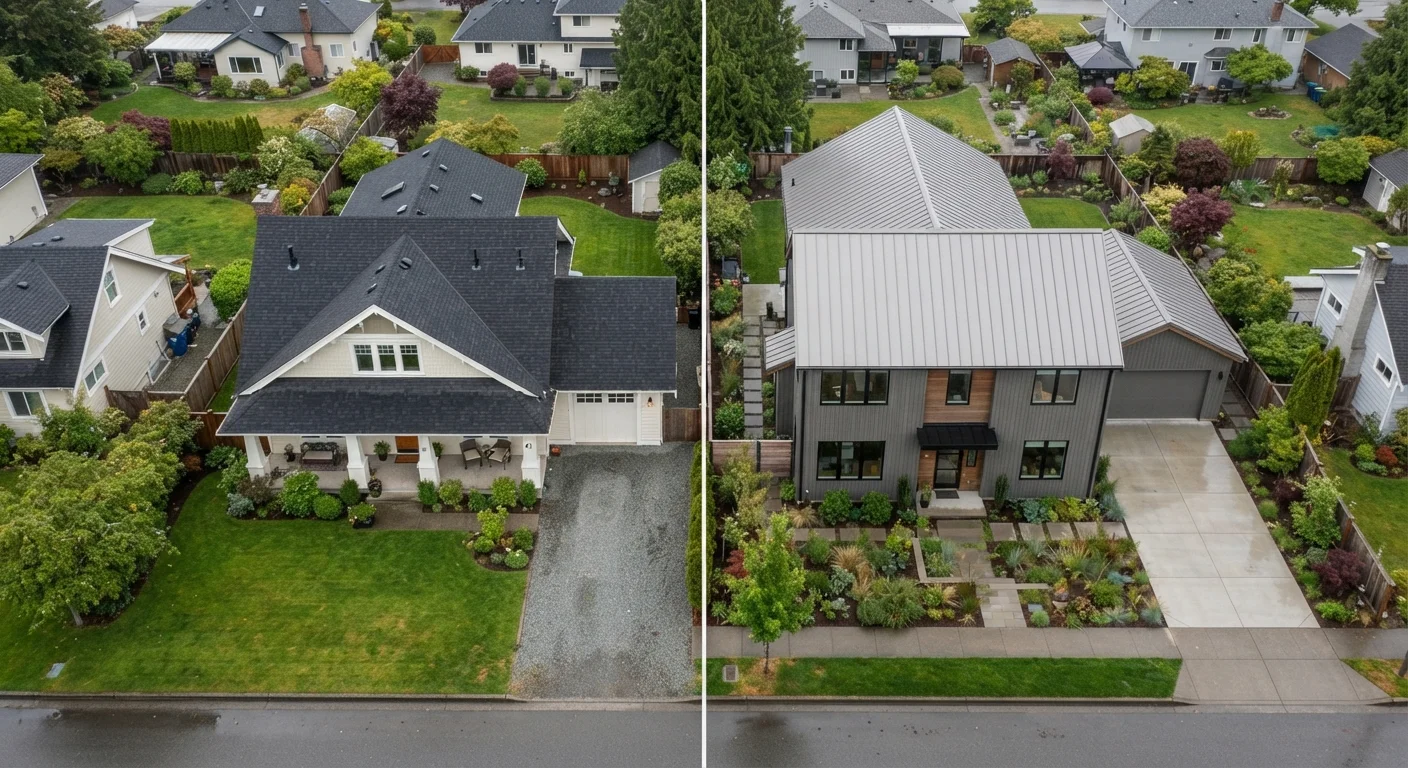
Key Takeaways
Option A
Asphalt Shingles
The familiar, affordable starting point for most homeowners.
Best for: Homeowners seeking lower upfront costs with straightforward installation and widely available repair options.
Option B
Metal Roofing
The long-haul investment built for durability and lower maintenance.
Best for: Homeowners planning to stay in their home long-term and willing to pay more upfront for a roof that can last 40–70 years.
If you need the lowest possible upfront cost
Asphalt Shingles
Asphalt shingles typically install for significantly less per square foot than metal, making them the more accessible choice when budget is the primary constraint.
If you plan to stay in your home for 30 or more years
Metal Roofing
Metal roofing's extended lifespan means you may only need one installation over several decades, potentially lowering your total lifetime roofing spend.
If you live in a region with severe weather — heavy snow, high winds, or hail
Metal Roofing
Metal roofs generally carry higher wind and impact resistance ratings and shed snow more efficiently, making them well-suited to harsh climates.
If you want repairs to be simple and locally available
Asphalt Shingles
Asphalt shingles are the most common roofing material in the US, so qualified roofers and replacement materials are easy to find in virtually every market.
If you're planning to sell your home within the next 10 years
Asphalt Shingles
A new asphalt roof offers strong return on investment at resale without the premium cost of metal, which may not be fully recouped in a shorter ownership window.
Upfront Costs: What You Can Expect to Pay
For most homeowners, the first number that matters is what goes on the estimate. Asphalt shingles — the most widely used roofing material in North America — typically cost between $4 and $8 per square foot installed, depending on shingle grade (3-tab vs. architectural), local labor rates, and roof complexity. For a 2,000-square-foot roof, that often translates to a total project cost in the range of $8,000 to $16,000, though regional variation can push figures outside that range.
Metal roofing covers a wider cost spectrum. Corrugated steel panels represent the more affordable end — often $7 to $12 per square foot installed — while premium standing-seam systems (panels with concealed fasteners that run vertically up the roof slope) can reach $15 to $25 or more per square foot. A comparable 2,000-square-foot metal roof installation might run $14,000 to $50,000 depending on the system chosen. See typical installation costs across roofing materials for a broader comparison.
Labor is a significant portion of both — generally 40–60% of total project cost. Metal installation requires more specialized skills, which is one reason its labor costs tend to run higher.
| Criterion | Asphalt Shingles | Metal Roofing |
|---|---|---|
| Typical installed cost | $4–$8 per sq ft | $7–$25+ per sq ft |
| Expected lifespan | 15–30 years | 40–70 years |
| Manufacturer warranty | 20–30 years (varies by grade) | 40–50 years (varies by system) |
| Repair ease | Easy; widely available | Moderate; specialist may be needed |
| Wind resistance | Moderate (varies by grade) | High (up to 140+ mph rated) |
| Weight on structure | Light (2–4 lbs per sq ft) | Light to moderate (1–3 lbs per sq ft) |
| Contractor availability | Very widely available | Less common; varies by region |
| Typical number of replacements over 50 years | 2 or more | Likely 1 |
Lifespan and Long-Term Value
Upfront price is only part of the equation. How long a roof lasts determines its real cost over time. Standard 3-tab asphalt shingles carry manufacturer warranties of 20–25 years, while thicker architectural (also called dimensional) shingles are often warranted for 30 years. Real-world performance varies with climate, ventilation, and maintenance — in harsh climates, a shingle roof may need replacement at 15–20 years.
Metal roofing, by contrast, typically carries warranties of 40–50 years, and well-maintained metal roofs commonly last beyond that. A quick-reference lifespan guide shows how metal and asphalt compare to other common materials. If you replace an asphalt roof twice over 50 years while a neighbor's metal roof requires no replacement, the cumulative cost difference narrows considerably — and can invert.
There are also indirect long-term considerations. Some metal roof finishes reflect solar heat, which may reduce summer cooling loads in warmer climates, though actual energy savings depend heavily on attic insulation, climate zone, and roof color. Some homeowners also report favorable insurance premium treatment for metal roofs in hail- or wind-prone areas — always verify directly with your insurer.
Maintenance, Repairs, and Practicalities
Asphalt shingles are relatively forgiving when it comes to maintenance. Individual damaged or missing shingles can be replaced without disturbing the surrounding roof, and because asphalt is so common, replacement shingles are widely available. Routine maintenance — clearing debris, inspecting flashing, keeping gutters clean — is manageable and inexpensive. The trade-off is that asphalt is more vulnerable to UV degradation, algae growth, and granule loss over time, which accelerates wear in certain climates.
Metal roofing requires less frequent intervention but is not maintenance-free. Fasteners on exposed-fastener panels should be inspected periodically for backing out or rust. Sealant around penetrations and flashing points needs occasional attention. Repairs to standing-seam systems can be more complex and may require a contractor familiar with the specific panel system — not every local roofer works regularly with metal. For a balanced view of what metal roofing involves over its lifetime, a closer look at metal roofing trade-offs is worth reviewing.
One common homeowner concern — noise during rain — is frequently overstated for properly installed metal roofs with solid decking and adequate insulation. Noise is more of a factor on pole barns or structures without solid sheathing beneath the panels.
Making the Right Choice for Your Home
Neither material is universally superior. The better choice depends on your financial situation, how long you plan to stay in the home, your local climate, and your roof's structural capacity. Metal roofing adds weight that older structures may need assessment for — consult a contractor before assuming your existing framing can support a new system without modification.
If you're early in the decision process, exploring the broader overview of common roofing materials can help you situate asphalt and metal within the full range of options. And when you're ready to move forward, knowing how to find and vet a qualified roofer is the critical next step — especially for a significant investment like metal roofing.
Regardless of which material you lean toward, get at least three written estimates, confirm that each contractor is licensed and insured in your state, and ask specifically about what the warranty covers and who backs it — the manufacturer, the installer, or both. Roofing decisions made carefully at the outset tend to hold up well for years to come.
This article is for general informational purposes only. Costs, lifespans, and performance figures reflect general industry ranges and will vary based on location, materials, contractor, and site conditions. Always consult licensed roofing professionals and verify local permit and code requirements before beginning any roofing project.