

Key Takeaways
Low-E Glass Coating
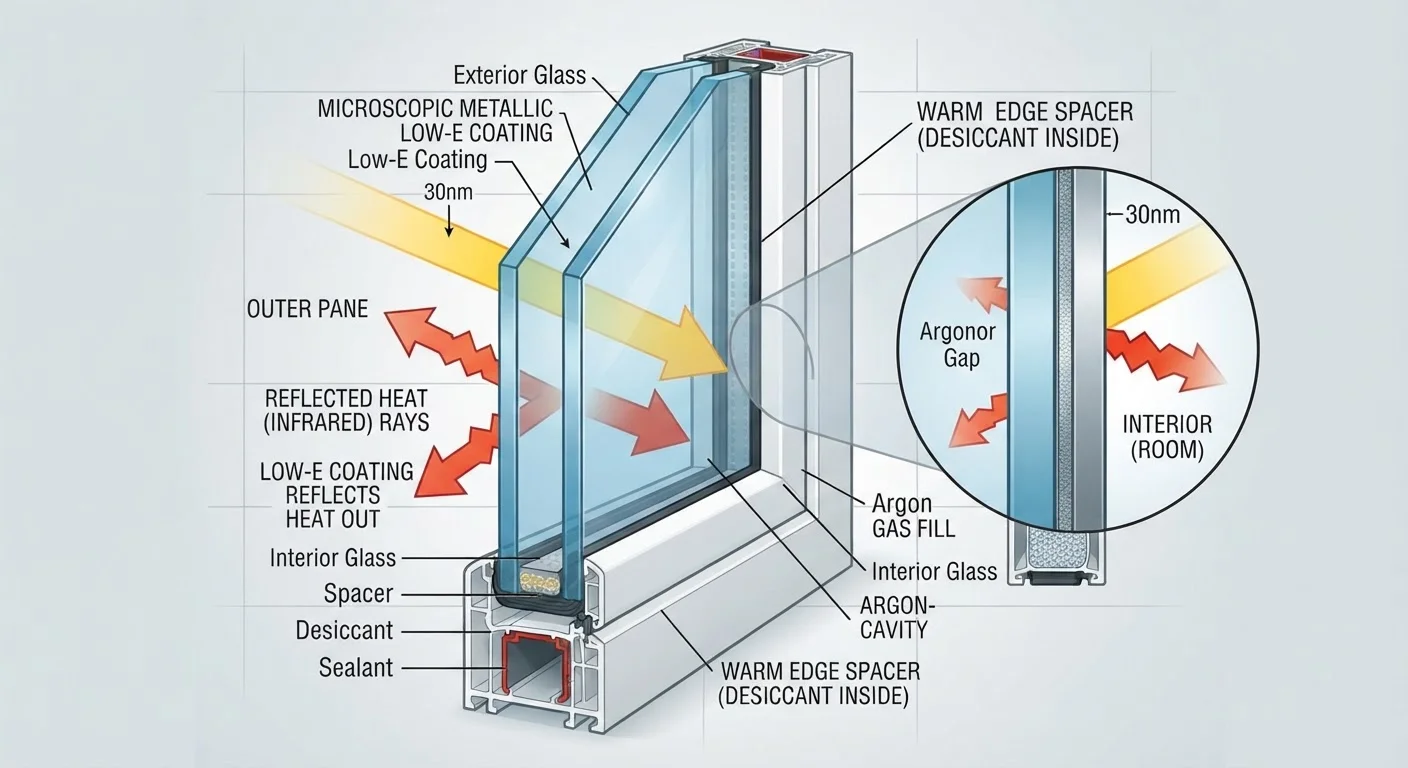
Low-emissivity (Low-E) glass has a microscopically thin metallic or metallic-oxide film applied to one surface of the glass. This coating reduces the amount of heat energy (infrared radiation) that passes through the window, while still allowing most visible light in. The result is a window that helps keep your home warmer in winter and cooler in summer without noticeably darkening your rooms.
Emissivity is measured on a scale of 0 to 1; standard clear glass has an emissivity near 0.84, while most Low-E coatings reduce that figure to between 0.02 and 0.20, significantly limiting radiant heat transfer.
What the Coating Actually Does
Every material radiates heat as infrared energy. Standard glass radiates most of the heat it absorbs, which means your warm interior air transfers heat through the glass to the cold outdoors in winter — and the reverse happens in summer. A Low-E coating interrupts this process by reflecting infrared radiation back toward its source rather than allowing it to pass through.
Think of it like a thermos: the shiny interior reflects heat back into the liquid instead of letting it escape. A Low-E window does the same thing for your home. In winter, the coating reflects indoor heat back inside. In summer — depending on the coating type — it can also reflect solar heat away before it enters.
Importantly, the coating is selective. Infrared radiation (heat) is reflected, but most of the visible light spectrum still passes through. This is why you can stand at a Low-E window and read comfortably while the room stays more temperature-stable than it would with plain glass.
To understand how Low-E performance is measured alongside other energy metrics, see Window Energy Ratings Explained for a breakdown of U-factor, SHGC, and Visible Transmittance.
Hard-Coat vs. Soft-Coat: Two Different Approaches
Not all Low-E coatings are manufactured the same way, and the production method affects both durability and performance.
Hard-Coat (Pyrolytic) Low-E
Hard-coat Low-E is applied while the glass is still hot during manufacturing, fusing the coating directly into the surface. This makes the coating extremely durable — it can be cut, handled, and even used in single-pane applications. The trade-off is that hard-coat coatings are somewhat less effective at reducing heat transfer than soft-coat alternatives.
Soft-Coat (Sputtered) Low-E
Soft-coat Low-E is deposited in a vacuum chamber after the glass cools. The result is a thinner, more precise coating with significantly lower emissivity values — meaning better heat-blocking performance. Because soft-coat coatings are fragile and will degrade if exposed to air or moisture, they must be sealed inside an insulating glass unit (the airspace between panes in a double- or triple-pane window).
Most energy-efficient replacement windows sold today use soft-coat Low-E for this reason. If you are comparing window quotes, ask specifically which type of Low-E is included and on which glass surface it is applied.
0.02–0.20
Emissivity range of Low-E coated glass
Compared to standard clear glass at approximately 0.84, Low-E coatings dramatically reduce radiant heat transfer through the glass surface.
~25–30%
Potential reduction in heating and cooling energy use
The U.S. Department of Energy estimates that Low-E windows can reduce energy loss through glass by roughly 25–50% compared to standard clear glass, depending on coating type and climate.
4
Glass surfaces in a double-pane window
Understanding which surface the Low-E coating is applied to — surface 2 or surface 3 — is one of the most important questions to ask when comparing window specifications.
Coating Position and Climate Matching
In a standard double-pane window, the two panes of glass have four surfaces, numbered 1 through 4 from the outside in. The position of the Low-E coating determines what the window is optimized to do.
- Surface 2 (outer pane, interior face): Blocks solar heat from entering. Better suited to warm or mixed climates where air conditioning is the dominant energy cost.
- Surface 3 (inner pane, exterior face): Reflects indoor heat back inside. Better suited to cold climates where heating is the priority.
Some manufacturers place coatings on multiple surfaces or use dual-silver and triple-silver coatings to improve performance across both heating and cooling seasons. Your local climate — specifically your heating-degree days versus cooling-degree days — should guide the specification you request.
Low-E glass is just one layer of a window's overall efficiency. For a broader look at how frame materials contribute to or limit those gains, see Window Frame Materials and Their Effect on Energy Performance.
What to Ask When Shopping for Windows
Low-E is frequently listed as a standard feature in replacement window marketing, but the details matter. Two windows both described as "Low-E" can perform very differently depending on coating type, position, and SHGC value.
Match the Coating to Your Climate First
Before accepting a contractor's standard Low-E recommendation, look up whether your location is primarily heating- or cooling-dominated. The U.S. Department of Energy's ENERGY STAR program publishes regional climate zone maps that can guide which SHGC range makes the most sense for your home. Sharing this information with your contractor helps ensure you get the right specification, not just the default one.
When reviewing window specifications or talking with a contractor, ask these questions:
- Is this hard-coat or soft-coat Low-E?
- On which surface is the coating applied?
- What is the SHGC rating, and is that appropriate for my climate?
- What is the U-factor, and does it meet or exceed ENERGY STAR guidelines for my region?
Low-E coatings do add to the upfront cost of a window. If you want to understand how this and other upgrades affect your overall project budget, Energy Efficiency Upgrades and Their Effect on Window Replacement Pricing offers a clear breakdown.
Finally, Low-E glass works as part of a system. Pairing the right coating with the right number of panes matters too — Double-Pane vs Triple-Pane Windows: Matching Glass to Your Climate can help you decide whether upgrading to triple-pane is worthwhile in your region.