

Key Takeaways
Option A
South-Facing Windows
The high-exposure orientation that works for or against you depending on climate.
Best for: Homeowners in cold or mixed climates who want to leverage passive solar heat in winter months.
Option B
North-Facing Windows
The low-exposure orientation offering consistent, glare-free natural light year-round.
Best for: Homeowners in warm or hot climates, or those seeking stable indoor temperatures without solar heat fluctuation.
If you live in a cold northern climate and want to reduce winter heating bills
South-Facing Windows with higher SHGC (0.40–0.60)
Higher solar heat gain on south-facing glass lets winter sun do meaningful work, offsetting furnace use during the coldest months.
If you live in a hot southern climate and want to limit cooling costs
South-Facing Windows with lower SHGC (0.25 or below)
Reducing solar heat gain on your most sun-exposed windows is the single fastest way to cut air conditioning demand in hot regions.
If you want consistent, glare-free natural light in a studio, office, or reading room
North-Facing Windows
North-facing windows deliver soft, even daylight throughout the day without the glare or heat spikes of direct sun exposure.
If you're replacing windows across multiple orientations and want a balanced approach
Orientation-specific SHGC selection for each side
Choosing different SHGC ratings for south versus north exposures — rather than one product for the whole house — delivers better year-round comfort and efficiency.
What Solar Heat Gain Coefficient (SHGC) Actually Measures
The Solar Heat Gain Coefficient (SHGC) is a number between 0 and 1 that tells you how much of the sun's energy passes through a window and enters your home as heat. A value of 0.40 means 40% of solar radiation is transmitted indoors; a value of 0.25 means only 25% gets through. Lower numbers block more heat — but that's not always what you want.
Understanding SHGC is the foundation of choosing the right window for each part of your home. For a full breakdown of SHGC alongside related ratings like U-factor and Visible Transmittance, see Window Energy Ratings Explained. The key point here: SHGC isn't one-size-fits-all. The right value depends heavily on which direction your window faces.
South-Facing Windows: The High-Exposure Side
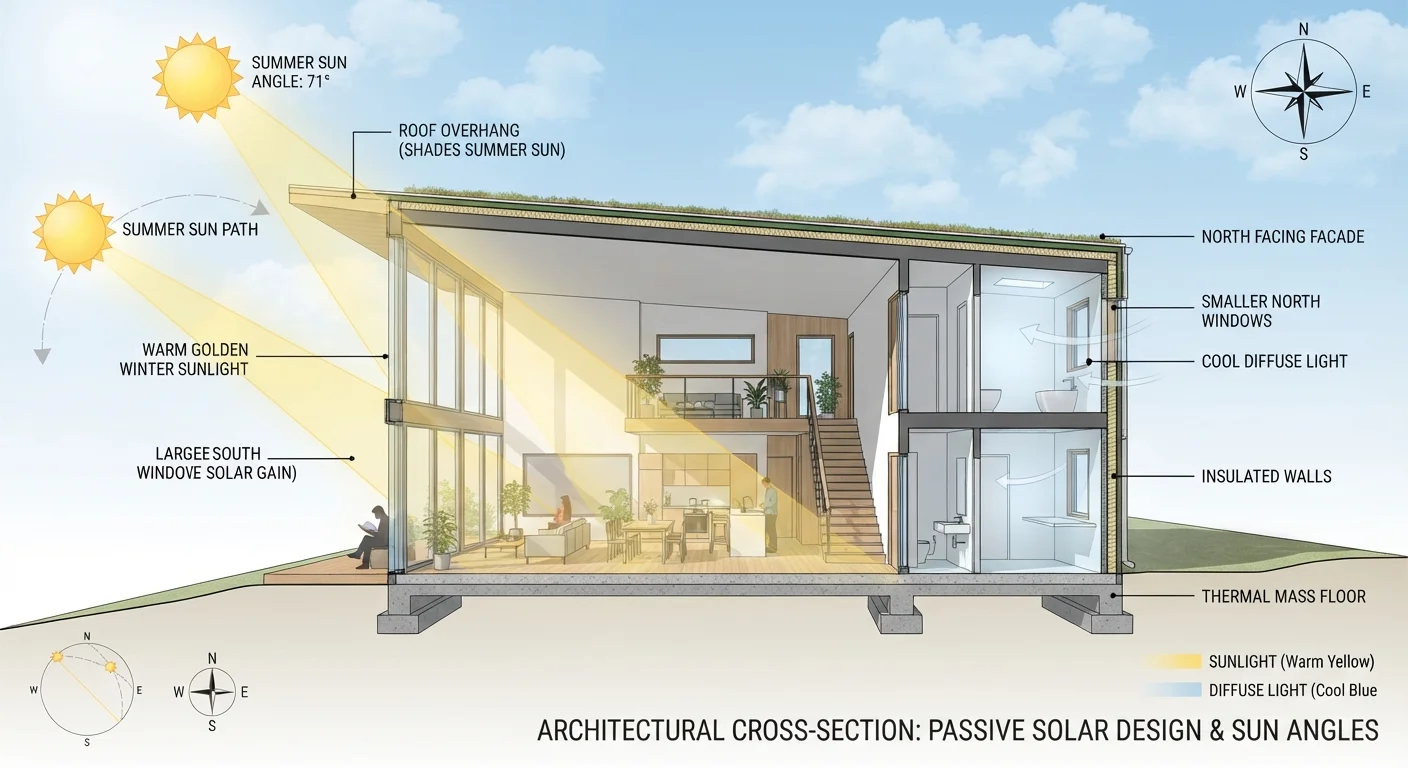
In the Northern Hemisphere, south-facing windows receive the most direct sunlight — especially during winter, when the sun tracks low across the southern sky. This makes them the most consequential windows in your home for energy performance.
In cold and mixed climates, a higher SHGC (generally 0.40 to 0.60) on south-facing windows is often beneficial. The sun's heat passively warms interior spaces during the months you need it most, reducing reliance on your heating system. This principle is sometimes called passive solar design.
In hot climates — much of the South and Southwest U.S. — that same solar gain becomes a liability. High-SHGC glass on south-facing windows drives up cooling costs significantly through spring, summer, and fall. In these regions, south-facing windows typically call for SHGC ratings of 0.25 or lower, combined with low-emissivity (low-e) coatings that reflect infrared heat before it enters.
| Criterion | South-Facing Windows | North-Facing Windows |
|---|---|---|
| Direct sun exposure | High — most of the day | Minimal — indirect/diffuse only |
| Primary energy concern | Solar heat gain (SHGC) | Heat loss (U-factor) |
| Recommended SHGC (cold climate) | Higher (0.40–0.60) | Lower value less critical |
| Recommended SHGC (hot climate) | Lower (0.25 or below) | Low SHGC offers minimal benefit |
| Light quality | Bright, direct, can cause glare | Soft, even, glare-free |
| Passive solar heating potential | Significant in winter | Negligible year-round |
Overhangs, awnings, and deciduous trees can also moderate south-facing solar gain seasonally, but these exterior features work alongside — not instead of — proper SHGC selection.
North-Facing Windows: Consistent Light, Minimal Heat
North-facing windows receive no direct sunlight for most of the year in the Northern Hemisphere. They gather only indirect, diffuse daylight — which is actually desirable in many rooms. The tradeoff is that they contribute very little solar warmth regardless of season.
Because direct solar radiation is rarely an issue on the north side, SHGC becomes a secondary concern compared to U-factor — the rating that measures how well a window resists heat loss to the outdoors. In cold climates especially, a low U-factor matters far more than SHGC on north-facing glass, because the primary energy risk there is warmth escaping outward, not sun heat coming in.
For north-facing windows, homeowners should focus energy investment on double or triple-pane glazing and quality frame materials. Double-pane vs triple-pane windows explains how to match glass layers to your region's heating and cooling demands. Frame choice also matters: window frame materials affect overall efficiency in ways that interact with your glazing selection.
Choosing the Right SHGC for Each Side of Your Home
The most energy-efficient window replacement strategy involves selecting different SHGC values for different orientations — not picking one product for every opening in your home.
25–30%
Home heating and cooling energy lost through windows
The U.S. Department of Energy estimates that windows account for roughly 25–30% of residential heating and cooling energy use.
0.25
Maximum recommended SHGC for hot-climate south windows
ENERGY STAR guidelines for the Southern climate zone generally recommend SHGC values at or below 0.25 for south-facing glazing.
2x
Difference in solar exposure between south and north windows
South-facing windows in northern U.S. climates can receive more than twice the annual solar radiation of north-facing windows in the same home.
A general decision framework for U.S. homeowners:
- Cold climates (Upper Midwest, New England, Mountain regions): South-facing windows benefit from higher SHGC (0.40+); north-facing windows prioritize low U-factor over SHGC.
- Mixed climates (Mid-Atlantic, Pacific Northwest, parts of the Midwest): Moderate SHGC values (0.25–0.40) on south-facing windows balance seasonal heating and cooling needs.
- Hot climates (Southeast, Southwest, Southern Plains): Low SHGC (0.25 or below) on south-facing windows is generally recommended; north-facing windows again benefit most from low U-factor glass.
East- and west-facing windows follow different rules — morning and afternoon sun angles create different seasonal heat patterns than south-facing exposure. This is worth discussing with a qualified window professional when planning a full-home replacement. For broader context on how window decisions fit together, our full overview of window energy efficiency walks through every factor from ratings to installation quality.
This article is for general educational purposes. SHGC and U-factor recommendations vary by climate zone, home design, and local building codes. Consult a licensed window professional or energy auditor to determine the right specifications for your specific home.