

Key Takeaways
Our Verdict
Neither fixed nor operable windows are universally better — the right choice depends on the room's purpose, your ventilation needs, and your maintenance tolerance. Fixed windows excel where views and insulation are the priority; operable windows earn their place wherever airflow, egress, or accessibility matter.
| Best for | Recommended |
|---|---|
| Homeowners prioritising energy efficiency and low maintenance | Fixed windows |
| Rooms requiring ventilation, such as kitchens and bathrooms | Operable windows |
| Spaces where egress codes apply, such as bedrooms | Operable windows |
| Feature walls or large scenic views with no ventilation need | Fixed windows |
What Sets Fixed and Operable Windows Apart
The most fundamental difference between fixed and operable windows is straightforward: fixed windows are sealed permanently in place, while operable windows include a mechanism that allows them to open and close. That single distinction creates a cascade of trade-offs across ventilation, energy performance, cost, and upkeep.
Fixed windows — sometimes called picture windows or stationary windows — have no moving sash, no hardware, and no gaps in the frame through which air can pass. Operable types include a wide range of styles: double-hung, single-hung, casement, sliding, awning, and others. Each opens differently, but they share the defining feature of providing intentional airflow when open. See our comparison of sliding vs. casement windows for a closer look at how operable styles differ from each other.
Understanding which type belongs where starts with asking what you need a given window to do — frame a view, circulate air, meet an egress requirement, or some combination of all three.
Comparing Fixed and Operable Windows Across Key Criteria
The table below summarises how each window type performs across the factors most relevant to a renovation decision.
| Fixed Windows | Operable Windows | |
|---|---|---|
| Ventilation | None — sealed permanently | Yes — opens to allow airflow |
| Energy efficiency | Slightly higher — no sash gaps | Good with quality weatherstripping |
| Egress capability | No — cannot satisfy egress codes | Yes — meets code when properly sized |
| Purchase cost | Generally lower | Generally higher |
| Maintenance required | Minimal — no moving parts | Moderate — hardware, seals, mechanisms |
| View and light | Maximum — no frame interruption | Slightly reduced by sash and hardware |
| Best room types | Living areas, stairwells, feature walls | Kitchens, bathrooms, bedrooms |
A few details deserve elaboration. On energy efficiency, fixed windows have a natural advantage: their sealed perimeter eliminates air infiltration at the sash, which is one of the most common sources of heat loss in operable units. That said, the gap narrows considerably when operable windows use high-quality weatherstripping and multi-point locking hardware. For a deeper look at how glazing choices affect insulation, see our guide on double-pane vs. triple-pane windows.
On egress, many local building codes require bedroom windows to meet minimum openable area and height requirements so occupants can exit in an emergency. Fixed windows cannot satisfy these requirements. Always verify local code before specifying a fixed window in a sleeping area.
Cost and Installation Considerations
Fixed windows are generally less expensive to purchase than operable equivalents of the same size and glass specification, because they contain fewer components. There is no operating hardware, no balance system, and no moving sash to fabricate or install. Labour costs can also be lower, since there are fewer alignment steps involved.
Operable windows carry a higher unit price, and that premium grows with window size and the complexity of the opening mechanism. Casement and awning styles, which use a crank-operated hinge, tend to cost more than single-hung or sliding windows. Installation is also more involved, as the sash must be properly levelled and balanced to operate smoothly over years of use.
For homeowners replacing multiple windows at once, these per-unit differences can add up meaningfully. Our overview of replacement cost factors explains the broader budget picture, and our article on replacing one window vs. replacing all of them can help you decide how many to tackle at a time.
Pair Window Types Strategically
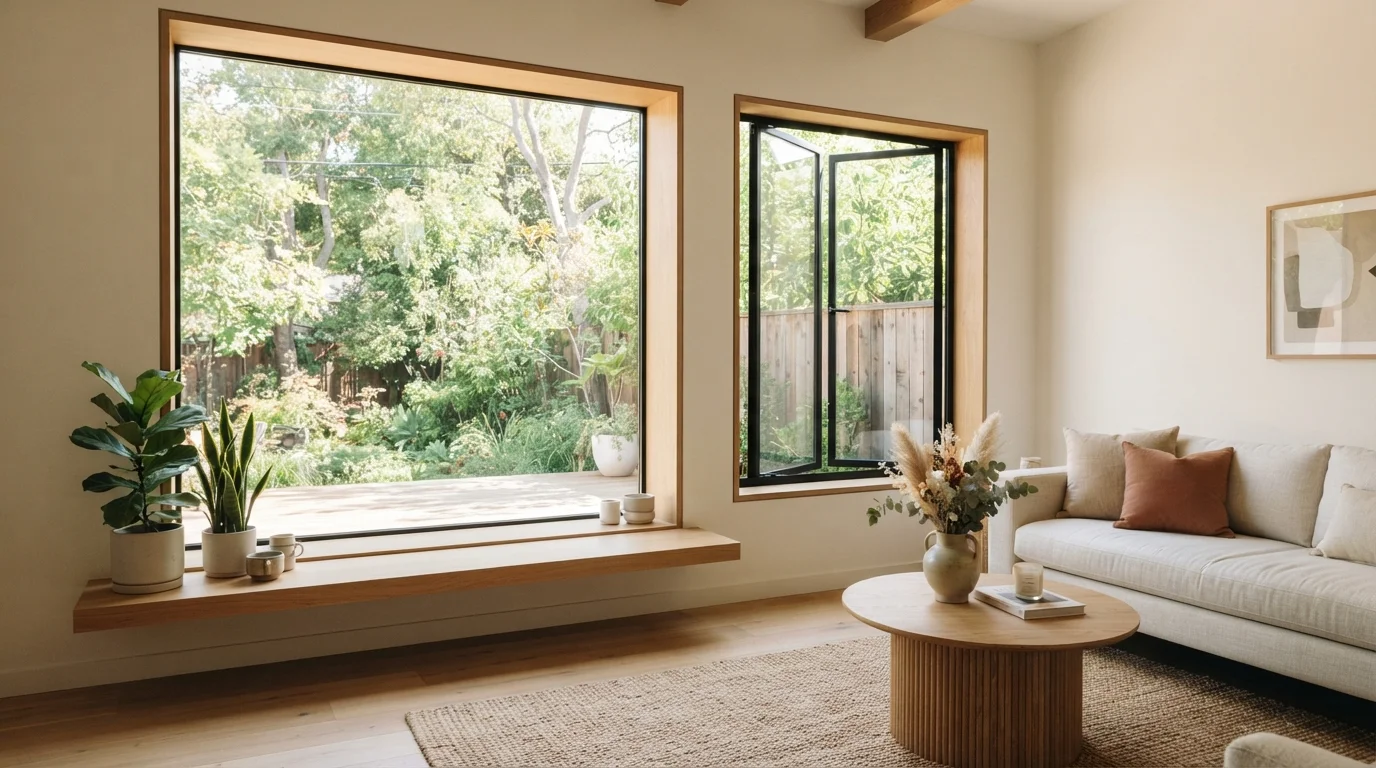
Rather than choosing one type for your entire home, consider pairing a large fixed panel with a smaller operable unit in the same wall opening. This approach captures the view and insulation benefits of a fixed window while still providing ventilation. Many window manufacturers offer paired configurations as a standard product option, which can simplify ordering and installation.
Choosing the Right Mix for Your Home
Very few homes work well with exclusively one type. A practical approach is to match window function to room function:
- Living rooms and stairwells — Large fixed windows maximise light and views without sacrificing insulation. See our article on picture windows for when that trade-off works in your favour.
- Kitchens and bathrooms — Ventilation is essential for managing moisture and odours; operable windows are the practical choice.
- Bedrooms — Egress requirements typically mandate at least one operable window per room. Check local building codes before finalising your plan.
- Basements and utility rooms — Egress windows are often code-required here too, and operable styles serve that need.
Combining a large fixed panel with a flanking operable unit — a common pairing — lets you enjoy expansive views while still controlling airflow. If ease of operation is a concern, casement windows, which open with a simple crank, are often easier to manage than windows that require lifting a sash.
This article is for informational purposes only. Window selection, installation, and code compliance vary by location. Consult a licensed contractor and verify local building codes before making any purchasing or installation decisions.