

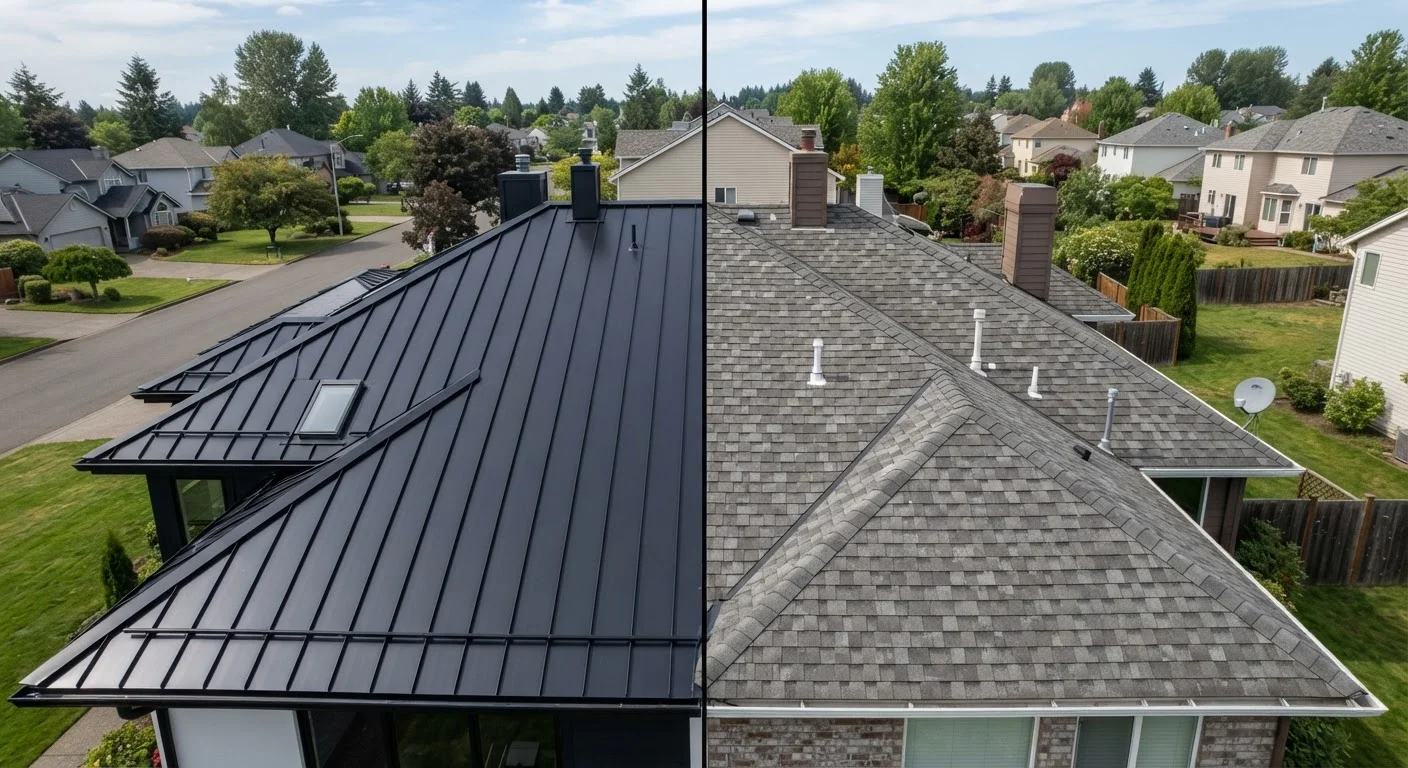
Key Takeaways
Option A
Metal Roofing
The long-lasting, weather-resilient premium option.
Best for: Homeowners planning to stay in their home long-term who want minimal maintenance and strong weather performance.
Option B
Asphalt Shingles
The widely available, budget-accessible standard choice.
Best for: Homeowners seeking a proven, cost-effective material with straightforward installation and easy repair.
If you want the lowest upfront installation cost
Asphalt Shingles
Asphalt shingles have substantially lower material and labor costs than metal roofing, making them more accessible for homeowners with tighter budgets.
If you plan to stay in your home for 40+ years
Metal Roofing
Metal roofing's longer lifespan may reduce or eliminate the need for a second full replacement, potentially making it more cost-effective over time.
If you live in a region with frequent severe storms or high winds
Metal Roofing
Metal panels are generally rated for higher wind speeds and shed water and snow efficiently, offering stronger weather resistance in demanding climates.
If you need a quick, straightforward repair process
Asphalt Shingles
Asphalt shingles are widely stocked, and many local roofers can match and replace damaged sections without specialized tools or skills.
If energy efficiency and roof weight are concerns
Metal Roofing
Metal roofs reflect more solar heat than asphalt and weigh significantly less per square foot, reducing structural load and potentially lowering cooling costs.
What These Two Materials Actually Are
Asphalt shingles are layered sheets made from a fiberglass or organic mat coated with asphalt and embedded with mineral granules. They are by far the most commonly installed roofing material in North America. Learn why asphalt shingles cover most homes to understand the full picture of their dominance.
Metal roofing comes in several forms — most commonly standing-seam panels (raised interlocking seams running vertically) and metal shingles designed to mimic traditional shapes. Steel and aluminum are the most widely used metals for residential roofing. For a broader overview of both materials in context, see Roofing Materials Explained.
Understanding what each material is made of helps clarify why they perform so differently across lifespan, weight, noise, and cost.
Lifespan and Durability
Asphalt shingles are typically rated for 20–30 years, though architectural (also called dimensional) shingles — thicker and layered — can last toward the higher end of that range under favorable conditions. Standard 3-tab shingles tend to be shorter-lived. For a quick reference on how these lifespans compare across materials, see Roofing Material Lifespan at a Glance.
Metal roofing is generally rated for 40–70 years. Steel products often carry warranties in the 40–50 year range, while some aluminum and premium coated products are rated even longer. Metal roofs are also more resistant to cracking, shrinking, and impact damage from moderate hail.
The durability gap is real, but it comes with an important caveat: a metal roof installed poorly or on an incompatible structure will underperform its rating. Installation quality matters significantly for both materials.
| Criterion | Metal Roofing | Asphalt Shingles |
|---|---|---|
| Typical Lifespan | 40–70 years | 20–30 years |
| Relative Upfront Cost | Higher (2–3× asphalt) | Lower |
| Weight per Square | 50–150 lbs | 230–400 lbs |
| Rain Noise | More noticeable | Minimal |
| Solar Reflectivity | Higher | Lower |
| Repairability | Requires specialist | Widely available roofers |
| Wind Resistance | Typically higher rated | Moderate to good |
| Snow Shedding | Efficient | Slower |
Cost: Upfront vs. Long-Term
Asphalt shingles cost considerably less to purchase and install. Material and labor together for a typical home generally run lower per square foot than metal — though exact figures vary by region, roof complexity, and contractor rates. Metal roofing can cost two to three times more upfront on a comparable project.
The long-term math is less straightforward. If asphalt shingles require a full replacement within 25 years while a metal roof does not, the cumulative cost difference can narrow or reverse. That said, future replacement costs, financing, and how long you intend to own the home all factor in. Compare cost and longevity in detail to see how this plays out across time horizons.
For a broader look at what different materials cost to install, Roofing Material Options and What Each One Costs to Install provides useful context.
Noise, Weight, and Structural Considerations
One practical trade-off with metal roofing is noise. Rain and hail are audibly louder on metal panels than on asphalt, particularly in living spaces directly below an uninsulated roof deck. Proper underlayment and attic insulation reduce — but do not entirely eliminate — this effect. Homeowners sensitive to sound should factor this in.
On weight, metal has a clear advantage. Metal roofing typically weighs 50–150 pounds per square (100 sq ft), while asphalt shingles run 230–400 pounds per square depending on type. This lighter load can be meaningful for older homes where the roof structure may not support a heavy replacement material without reinforcement.
40–70 yrs
Typical metal roof lifespan
Industry estimates from roofing trade associations place metal roofing's expected service life well above most other residential materials.
~3×
Metal vs. asphalt upfront cost ratio
Metal roofing installation is commonly estimated at roughly two to three times the upfront cost of comparable asphalt shingle projects, varying by market and product.
75%+
U.S. homes with asphalt shingle roofs
Asphalt shingles are estimated to cover the majority of residential rooftops in North America, reflecting their cost accessibility and widespread contractor familiarity.
Asphalt shingles are heavier but familiar to most structural engineers and contractors, and standard residential framing is generally designed with their weight in mind.
Climate Suitability and Performance
Climate plays a significant role in which material makes more sense. Metal roofs shed snow and ice effectively due to their smooth, sloped surface. They also reflect more solar radiation than asphalt, which can help reduce cooling loads in hot, sunny climates. In coastal areas, marine-grade aluminum or coated steel should be specified to resist salt-air corrosion.
Asphalt shingles perform reliably across most U.S. climates but can be more vulnerable to thermal cycling — repeated expansion and contraction in areas with extreme temperature swings — which can accelerate granule loss and cracking over time. How Climate and Weather Shape the Right Roofing Choice goes deeper on matching materials to regional conditions.
For a fuller look at what you're trading off with metal in particular, The Trade-Offs of a Metal Roof offers a balanced assessment. When you're ready to move from material research to contractor selection, Hiring a Roofer covers how to find and vet qualified professionals.
This article is for general informational purposes only. Costs, lifespans, and performance characteristics vary by region, product, and installation conditions. Always consult a licensed roofing contractor and verify local building code requirements before beginning any roofing project.